



Speed, security, and a frictionless flow still matter in checkout, but relevance, delivered at the exact moment a customer is most receptive, is what separates a strong transaction experience from a forgettable one. AI systems that read purchase intent in real time and respond with a tailored next action are outperforming static personalization, and the window around the transaction itself, from product selection through cart review, payment, and order confirmation, is the highest-value surface in ecommerce. Brands that treat this window as a passive handoff are leaving revenue on the table that AI-driven relevance would otherwise capture, without adding friction to the purchase.
What "real-time relevance" actually means, and why it is different from personalization
Personalization has been the industry's default framing for a decade. It typically means segmenting customers into cohorts and serving pre-assigned content, a reasonable improvement over mass messaging, but structurally limited. Segment-level logic collapses when individual behavior diverges from the group average, which it does constantly.
Real-time relevance works differently. It uses live signals, what the customer just selected, the value of the transaction, the device they're on, and behavioral patterns from prior sessions to determine the single best next action for that specific individual at that specific moment. It’s built around the individual transaction, not a segment.
The accuracy improvement is not marginal. Recommendation systems trained on individual-level interaction data consistently outperform segment-based models, because they capture the variance that cohort averages erase. In practice, a platform processing tens of millions of transactions monthly has far more signal per individual than one relying on segments. That advantage compounds: more transactions generate better predictions, better predictions generate better outcomes, and better outcomes attract more transaction volume.
Why the transaction window is the most underused surface in ecommerce
Standard display advertising converts at a low rate. Search Engine Land's benchmark data puts the average display CTR at 0.27% across countries, platforms, and industries (Q2 2024). Contextual placements served within the checkout flow, where a customer has already committed to a purchase, perform at a different order of magnitude: Rokt’s own data shows a 4.03% click-through rate across Transaction Moment placements, our name for this transaction window, roughly 15x the display average. That gap is the difference between interrupting attention and meeting intent already in motion.
Attention, intent, and trust peak in the moments between selecting a product and receiving an order confirmation. The customer has already committed to the purchase. They're focused on completing the checkout. An offer that fits that state reads as a service, not an interruption.
Three distinct moments within this window carry distinct properties:
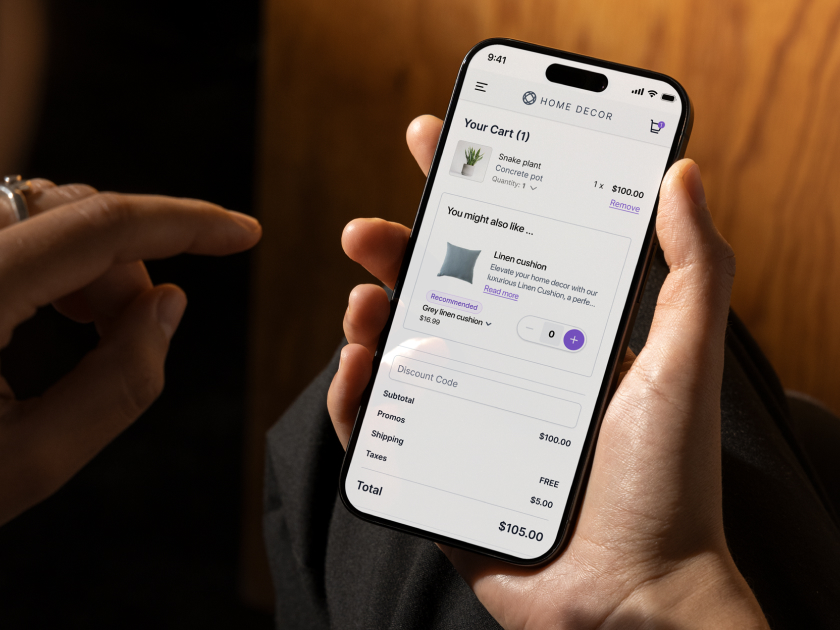
- The cart and checkout stage is high-intent but time-pressured. Offers need to render near-instantly, require minimal friction to accept, and sit directly adjacent to the purchase already in progress. Upsells and complementary products perform best here.
- The payment stage demands high trust. Customers are entering sensitive information and expect a seamless flow. Payment-method incentives and loyalty-program activations fit naturally because they align with the financial decision already being made.
- The post-purchase confirmation stage is emotionally positive and uncrowded. The sale is complete, so there's no abandonment risk. This is where longer-form offers, subscriptions, ancillary services, and third-party recommendations get attention no pre-purchase surface can match.
Static, generic content in any of these moments is money left on the table. Real-time AI-determined relevance captures it.
How AI changes the economics of the transaction window
The shift from rule-based offer logic to AI-driven decisioning changes three things simultaneously.
It eliminates the relevance tax. Legacy systems that show the same offer to everyone completing a transaction generate weaker conversion and, often, friction when the offer is clearly wrong for the individual. AI selection removes mismatched offers at the individual level, which lifts conversion and cuts those friction moments.
It also turns the paradox of choice into a structural advantage. Research published in the Journal of Personality and Social Psychology by Iyengar and Lepper (2000) found that presenting shoppers with 24 options produced a 3% purchase rate, while six options produced a 30% purchase rate, a ten-fold difference. Applied to offer surfaces: value comes from selection accuracy, not option count. A system that selects one highly relevant offer beats one that surfaces twelve adequate ones.
And it compounds. Every customer interaction produces a signal. Closed-loop attribution, connecting the offer shown to the outcome, feeds that signal back into the prediction model and improves the next decision. Platforms built on transaction-level AI tend to widen their accuracy advantage over time instead of plateauing.
Agentic and conversational commerce: the next phase
Real-time relevance at the transaction level is the current best of breed. The next phase is agentic commerce, AI systems that initiate or complete transactions on a customer's behalf, whether through a chat interface, a voice assistant, or automatically against pre-authorized signals like a price drop or a replenishment window.
The forecasts vary by definition, but the direction doesn't. A December 2025 eMarketer forecast puts AI platforms at $20.6 billion of US retail ecommerce sales in 2026, rising to $144 billion by 2029. Morgan Stanley's broader estimate reaches $190 billion to $385 billion in US ecommerce sales by 2030. Whichever number holds, the same transaction window relevance that wins today is the infrastructure agentic systems will run on tomorrow.
The privacy constraint is also a design principle
Every discussion of real-time relevance runs into the same tension: the data required to maximize relevance is the same data customers are increasingly protective of. Regulations including GDPR, CCPA, and their successors impose material constraints on how behavioral data can be collected, stored, and used.
Third-party cookie deprecation has accelerated the shift toward first-party data strategies. First-party transaction data, a customer's own behavior within a merchant's environment, collected with appropriate consent, is both the most privacy-compliant and the most predictively powerful input available. Relevance and privacy aren't a tradeoff here. A customer's own purchase history, their current cart contents, and their real-time session behavior are richer signals than any third-party behavioral profile, and they require no cross-site data sharing to use.
Systems designed around first-party data from the outset are architected for privacy regulation, not constrained by it. Customer control and data transparency build the trust that makes relevance possible in the first place.
What this means for ecommerce strategy
Four priorities follow.
- Treat the transaction window as a product surface, not a handoff. Product selection, cart, payment, and confirmation pages deserve the same design and optimization discipline as any other customer-facing product.
- Invest in closed-loop attribution at the individual level. Segment-level reporting can't optimize individual-level decisioning; AI relevance systems only improve when fed precise outcome signals.
- Build for agentic readiness now. Conversational interfaces and AI agents will increasingly initiate and complete transactions on a customer's behalf. Merchants who've already optimized their transaction window experiences for relevance will translate more easily into agentic formats.
- Design data strategy around first-party signals. First-party transaction data is the highest-quality input for real-time relevance and the most durable asset in a privacy-constrained environment.
The merchants who pull ahead over the next five years won't necessarily have the biggest catalogs or the lowest prices. They'll be the ones who treat every transaction as a chance to be useful, and build the infrastructure to act on it in real time.
Frequently asked questions
What is real-time relevance in ecommerce, and how is it different from personalization?
Personalization assigns pre-built content to customer segments. Real-time relevance uses live transaction signals to pick the best next action for one specific person at the moment of purchase. That matters because individual behavior routinely diverges from segment averages, and models trained on individual-level data capture that variance instead of erasing it.
Why does the checkout and post-purchase window outperform display advertising for offers and recommendations?
Customer attention, intent, and trust peak during and immediately after the transaction. Rokt reports a 4.03% click-through rate across its Transaction Moment placements, against a 0.27% average for display ads generally, roughly 15x higher. The customer is already in an active decision state, which makes a relevant offer feel like a service rather than an interruption.
What is agentic commerce, and when will it be material to ecommerce operations?
Agentic commerce refers to AI systems that proactively initiate transactions, monitor replenishment signals, or complete purchases on a customer's behalf within pre-authorized parameters. A December 2025 eMarketer forecast projects AI platforms will reach about 1.5% of US retail ecommerce ($20.6B) in 2026 and $144B by 2029; Morgan Stanley's broader estimate puts agentic commerce at $190B to $385B of US ecommerce sales by 2030. Merchants should start building transaction-window relevance infrastructure now, since it's the layer agentic systems will depend on.
How can ecommerce brands improve relevance without creating privacy risks?
First-party transaction data, purchase history, cart contents, session behavior, gives richer predictive signals than third-party behavioral data, without any cross-site sharing. Systems built around first-party data with explicit consent end up both more accurate and more privacy-compliant than those relying on third-party profiles.
Does presenting fewer, more relevant offers actually outperform presenting more options?
Yes. Iyengar and Lepper's landmark 2000 study found that reducing choice from 24 options to six increased purchase conversion ten-fold. Applied to ecommerce offer surfaces, this means AI-selected single offers consistently outperform offer carousels, provided the selection is accurate. The goal isn't fewer offers. It's more precise ones.
%20(1).webp)
.png)
.png)
.jpg)