

Shoppers are moving fast
Agentic commerce is the debate of the year, and Bruce started with the person doing the buying. People will keep wanting to buy things, and for many, shopping is entertainment as much as a task. What’s changing is where and how they shop, and how quickly. Discovery and purchase, online and offline, and advertising and commerce are all blurring at once.
That puts pressure on the business side. Think of a car dealer offering insurance, a cinema selling popcorn, or an airline selling add-ons. “About eighty or ninety percent of businesses are highly dependent on the makeup of their ancillary economics,” Bruce said. That revenue has to follow customers wherever they go, whether that’s inside LLMs, offline, or somewhere advertising and commerce become one.
Bruce has seen shifts like this before, including the move to mobile. What’s different now is the pace. In Bruce’s view, the winners will find the spot where a great experience for customers meets a business model that holds up, and they’ll get there first.
Most organizations aren’t ready
“I think most organizations are not at all prepared for what’s about to hit them, full stop,” Bruce said.
Past shifts gave companies decades to adjust. This one is moving far faster. At Rokt, productivity in product development is up 16x since January, while most leaders plan for gains of around 10% a year.
How Rokt rebuilt for speed
Clearing calendars was step one. This year, Rokt cut the layers between Bruce and every person in the business from seven or eight to three or four. Teams once organized by specialty, from engineering and design to finance and legal, now work as generalists with an autonomous execution layer underneath. Engineers and designers became builders.
Everyone can buy the same tools. “The organizational structural change is the key,” Bruce said.
It isn’t easy. “The biggest problem people are having is the identity crisis,” he said, which makes mentorship as important as any tool. For the people who rise to it, the shift unlocks a new kind of opportunity.
The cost of AI is moving fast too. At the start of the year, it ran at about 10% of the cost of the labor it replaced. Today it’s closer to 2%, with one of Rokt’s autonomous agents optimizing token usage on every task. So Bruce won’t put short-term caps on AI spend. “Optimizing for this month, next month, or the month after is the wrong frame of reference when the world’s moving so fast,” he said.
We have one clear objective, which is speed.
Start with the customer and work back
Before Rokt, Bruce spent a decade building a low-fare airline in Asia. He had to work out what to offer someone buying a flight in Tokyo so the experience worked for them and the economics worked for the airline.
That question has shaped Rokt for 14 years. Getting relevance right in the Transaction Moment™, from selection to confirmation, changes the outcome for everyone. Rokt will power more than 13 billion transactions in its 2027 financial year. Most of that work is invisible to shoppers, in decisions like which upgrade to offer or which payment option to show. Bruce said, "If you get the proposition right for the consumer, you get an order of magnitude different outcome."
Fewer tools, deeper partnerships
Speed also means removing friction. “The minute you get rid of every silo or third-party application, your speed increases exponentially,” Bruce said. The partnerships that remain go much deeper. Acquisitions like mParticle and Canal follow the same logic, because every deal has to accelerate the mission.
Nobody can predict what any market will look like in two years. Bruce’s bet is on being ready for whatever arrives first. “The winners are going to be the ones that can respond fastest to the opportunities that present themselves.”
Watch the full conversation
Explore the full transcript
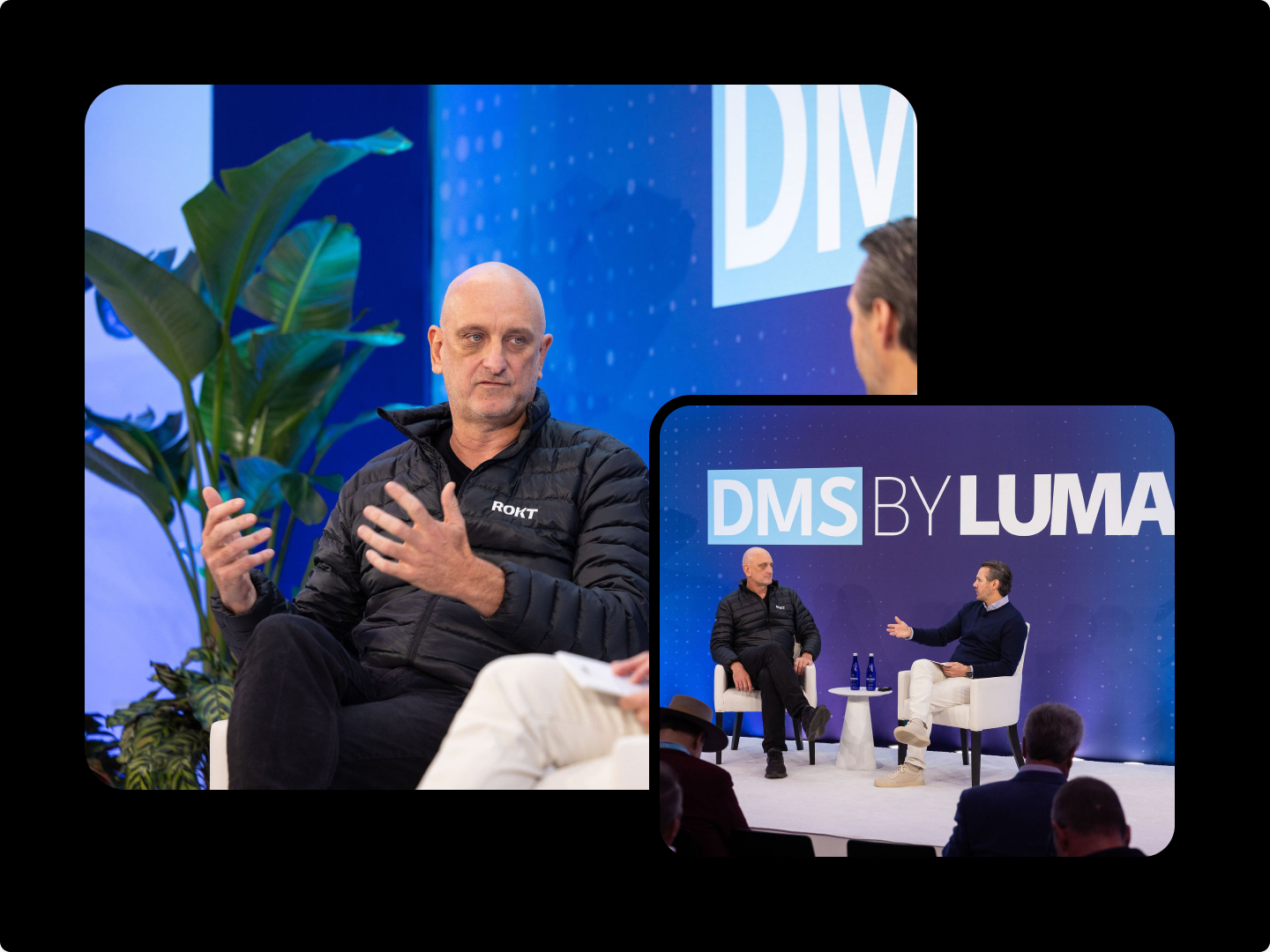
Bruce Buchanan, CEO and co-founder of Rokt, in conversation with Conor McKenna of LUMA Partners at the LUMA Digital Media Summit.
Conor McKenna
For the better part of ten years, a lot of people have thought about Rokt and immediately pictured the purchase moment, where you’re showing offers. Under the hood, there’s so much more here. I went back to materials you shared ahead of a board meeting in 2018, and three things were in there. Impression-level bidding, AI decisioning, and ad tech and martech convergence. You’ve been on these things for a while.
I don’t want to start there, though. I want to start with agentic commerce. You’re sitting at a critical point in the commerce moment. Big debate, hype or reality. Where are you? How are you thinking about agentic commerce today?
Bruce Buchanan
I think there are a few realities. Consumers are going to want to buy stuff. And businesses depend on the economics that come through the transaction flow, however that comes together. If you look at the economics of about eighty or ninety percent of businesses, they’re highly dependent on the makeup of their ancillary economics.
It doesn’t matter if you’re a car dealer selling insurance, a cinema selling popcorn, a ticketing company selling ticket insurance, or an airline selling add-ons. Without that economic prize, you don’t have a viable business. So businesses fundamentally have to rethink the way they’re going to interact with consumers.
But this has happened many times before. It happened in mobile, and in many different ecosystems. It’s just another evolution. Businesses have to rise to the challenge, so I think we’ll see more of a partnership ecosystem as more transactions move online. You’re definitely going to see advertising and ecommerce mix together. But fundamentally, where the consumer proposition meets an economic proposition that works for the business is going to be the secret answer.
Some of the more utilitarian purchases will be automated away. But a lot of them are going to be doubled down on. Consumers love making those purchases, so I think we’ll see that scale and grow.
Conor McKenna
They love making purchases, and they like the act of figuring out what to purchase. Shopping isn’t just functional. It’s entertainment in many forms. If I look at how my wife shops, she’ll spend time exploring and browsing. Browsing is part of what she wants to do.
When you mention needing to rise to the occasion, is that brands rising to the occasion? Or platforms rising to the occasion so brands can interact with consumers that way?
Bruce Buchanan
The winning formula in every one of these businesses is a magic ecosystem where the consumer proposition works and the business model works. If they don’t meet, you either have an unsustainable business or a consumer proposition that doesn’t work. Neither is a sustainable way to move forward.
So rising to the occasion is about how you meet consumers where they want to be met. Maybe that’s embedded applications in LLMs. Maybe it’s where advertising and commerce collapse together. Maybe it’s a different way of transacting with consumers. We’re also seeing a fast revolution in offline transactions.
The boundaries between advertising and commerce, and between offline and online, are blurring, and the whole funnel is blurring too. The discovery process, which used to be either offline or online, is now blurring with agentic commerce and all sorts of other factors.
Conor McKenna
Do you think brands are prepared to make this change? Unlike many people in the ad tech ecosystem, you work very directly with brands. What are those conversations like around how to think about the Transaction Moment in this evolving era?
Bruce Buchanan
I think most organizations are not at all prepared for what’s about to hit them, full stop. Forget about commerce and advertising. That’s just a general statement.
This is a problem with big transitions generally. The incumbents tend to get disrupted because change is really hard. Anyone who’s tried to shift a large group of people from one way of working to another knows it’s really, really hard. Now try to do that while the consumer proposition is changing, the competition is changing, and the way of doing business is changing. I think people are in for a big shock.
The problem at the moment is that the pace of change is so fast. Historically, we’ve had ten, twenty, or thirty years for these big change events to happen. This change is happening way, way faster. Even in our own business, productivity in product development is sixteen times what it was in January. Normally you work in a world where productivity changes by something like ten percent a year. This is nothing like that. And once you start applying those changes to broad swathes of the economy, that will cause massive disruption.
Conor McKenna
I was going to get to this later, but let’s bring it up now. Your teammate backstage told me a story about a melting computer. I want to hear the story, but I also want to understand how you’re managing your organization. What has changed in the last twelve months in how you actually run a product and technology business as the ecosystem continues to advance?
Bruce Buchanan
It’s worth saying we’re a different kind of business. We’re more like Visa or Mastercard. We sit at the back end. We’re a B2B2C business, so trust has always been critical to what we do, and we always want to be ahead of the partners we work with so we can advise them and help them move forward.
Two years ago, we said we have to be prepared for this. It’s going to change the world as we know it. And we started doing some crazy things. We reinvented recruiting. We held an all-hands meeting, deleted every meeting in people’s calendars, and said, “This is a gift of time. Go and take it and learn the tools, because you need to start transitioning.”
This year we’ve really accelerated and doubled down. We said, “You’ve had a year to get prepared for this change.” At the end of last year, we flattened the organization. We had about seven or eight levels between me and every person in the business. We’re now down to three or four at most, and spans have radically increased.
We’ve gone from a world where everyone was organized by specialty to a world of generalists. That’s easy to picture in product, with engineers and designers, but this is across the board, including accountants and lawyers. At your fingertips is the specialty in every single field. Your ability to move fast means breaking down organizational silos, so the organizational structural change is the key. And then you’ve got to lead from the top.
I was at an all-hands meeting last week with one of our AI partners, and they were making fun of my laptop melting down, because that’s when they first noticed we’re one of their top customers on token usage.
We took a mindset of rapid experimentation and learning, and we built an autonomous execution layer across the bottom of the organization. That means people have to move up. They have to work out how to get out of their specialty fields and bridge. That’s wonderful if you’re a builder. You’re no longer an engineer or a designer. You’re a builder, and your job is to solve problems.
That requires mentorship as much as anything, and the biggest problem people are having is the identity crisis. But it’s wonderful for the people who rise up and recognize what this new opportunity can unlock for them.
Conor McKenna
It’s a massive HR opportunity, but I imagine HR had a massive summer.
Bruce Buchanan
A massive summer.
Conor McKenna
That’s fascinating. I love the notion of moving people up so they’re more strategic thinkers, and then using AI. Based on what you’re saying, I have to imagine you’re token maxing to a pretty big extreme. How do you forecast and drive your business if you’re using so many tokens, and it can be so variable?
Bruce Buchanan
One of the autonomous agents we have actually optimizes token usage. It re-architects and runs twin tests on every single task it runs around the business.
The cost of tokens is falling so fast, and the intelligence is increasing so fast, that the AI cost per task is actually decreasing. When we started this at the beginning of the year, the trade-off was about one to ten, so about ten percent token cost for every unit of labor we replaced. That’s dropped dramatically. It’s more like two percent now. So what you’re getting is massive speed and leverage out of everyone.
I think that trend is going to continue. Look at how fast the models have moved over the last couple of weeks. Everyone’s pushing the boundaries. The cost is getting much cheaper and faster, and the quality of outcome is getting much better.
I would never constrain the short term with a budget control on AI, given it can be optimized and the curve is declining so fast. You’ve got to think about where you’re going to be in twelve or twenty-four months. Optimizing for this month, next month, or the month after is the wrong frame of reference when the world’s moving so fast.
We have one clear objective, which is speed. In a world where disruption is so extreme, it’s very hard to predict what any market is going to look like. But the winners are going to be the ones that can respond fastest to the opportunities that present themselves. That’s very hard for a large company to do. But if you can get there, you’ve got the advantage of capital, very smart people, and a system where you can deploy massive capabilities super fast.
Conor McKenna
As you talk about using different models, it’s all about driving outcomes and value. You’re constantly deciding where the best outcomes are. That’s very akin to what’s happened in advertising, and it’s an area you’ve been focused on from very early on. You were doing it with very unique inventory to begin with, but the core of it was never the inventory.
What are the building blocks that let you do that type of decisioning in an advertising format, and how has that changed for you over time?
Bruce Buchanan
First and foremost, we don’t think about it as an advertising problem, which I think is a good frame of reference. I came to this business after spending ten years building the largest low-fares airline in Asia. My problem was how to solve the consumer problem of what to sell a person buying an airline ticket in Tokyo, so the economics and the customer proposition both work.
Our whole world for fourteen years has been how to optimize the Transaction Moment. For us, that’s another way of saying when consumers are highly engaged, with their credit card out, what’s the right way to create an experience that’s highly relevant for them and makes the economics work for the business?
We started down that path a long time ago, and most of what we power isn’t what people see. It’s in the transaction itself. Businesses like airlines need to work out which seat upgrade to offer, which payment option, which buy now, pay later option, and how to manage their co-brand credit card. A lot of things that are just as important, or even more important, to the business.
The way we think about it is we start with the customer and work back. We’ve always thought about the problem as how you get the relevance proposition right for a consumer. If you get the proposition right for the consumer, you get an order of magnitude different outcome.
What most people don’t realize when they talk about the open web versus closed ecosystems is that it’s not even close. The closed ecosystems don’t talk in eCPMs, because they’re in a different frame of reference. Our focus is the economics of an ecommerce transaction. How much can we lift total AOV, cart conversion rate, or the total economics of the transaction?
The real frame of reference is how relevant it is to the consumer. If you start there, the context and relevance of the proposition in front of the consumer is key. It’s very hard in an open web ecosystem to create the right context for the consumer, because the open web is all over the place.
The platforms that work, whether in search, in social, or in the middle of an ecommerce transaction, work because the context and the problem they’re solving are rooted in the customer experience. If you start with context and relevance, it’s orders of magnitude different.
I think that’s why the closed ecosystems have grown their share of the market so much. The fundamental reason isn’t that they’re competing in the ad space. They’re competing in the consumer experience, and that’s why they win.
Conor McKenna
If you can make it better for the consumer and reduce the friction, it’s an exciting experience that gets far more ROI than the interruption most of the ad ecosystem is.
To get that context, you need to know a lot more about the consumer. You’ve thought about the combination of ad tech and martech for a long time, and a couple of years ago you acquired mParticle to bring the CDP in-house. We don’t have time to fully talk about that, but you’ve done a lot of M&A thinking about how to capture value in your stack.
Things are moving so fast around AI, and yet you’ve picked up your M&A over the last few years. How do you think about your M&A calculus? What will you buy, and what will you build? Does that change in an AI context? Is speed more important, so you need to buy more? Or can you build more, so you’re pulling back on M&A?
Bruce Buchanan
I think tools are going to be massively disrupted. That’s pretty obvious, but I don’t think people realize the degree, because the cost of building is so much cheaper. The real prize is getting rid of the friction so you can move faster. The minute you get rid of every silo or third-party application, your speed increases exponentially. If you’re banking on speed, these things become barriers, and that’s the fundamental reason we’re getting them out.
But, and this is a big but, on the flip side you have much deeper partnerships with the ones you do build with. There’s a series of partnerships we have with the major technology platforms, and we’re going super deep on them, rebuilding the way advertising performance works. But a lot of the surface-level tools are disappearing very fast.
From an M&A perspective, we think about the sustainable sources of value in the proposition we put to market. They come from the network, relevance, or consumer value. Where we’ve had real success is revenue synergies. One plus one equals three, four, five. We never buy anything for cost reasons, so it’s never about efficiency gains. It’s always, does this help us accelerate what we’re trying to do to achieve our mission?
That includes businesses that give us new verticals and geographies. Last year we added Canal, which brought new products into the network. We added mParticle. There’s a lot of long-term thinking in terms of the CDP, but we bought it because it solved for frictionless speed. It gets out of the way of other problems.
Conor McKenna
Perfect. Thank you so much, Bruce. It was wonderful to meet in person.
This transcript has been edited for length and clarity.