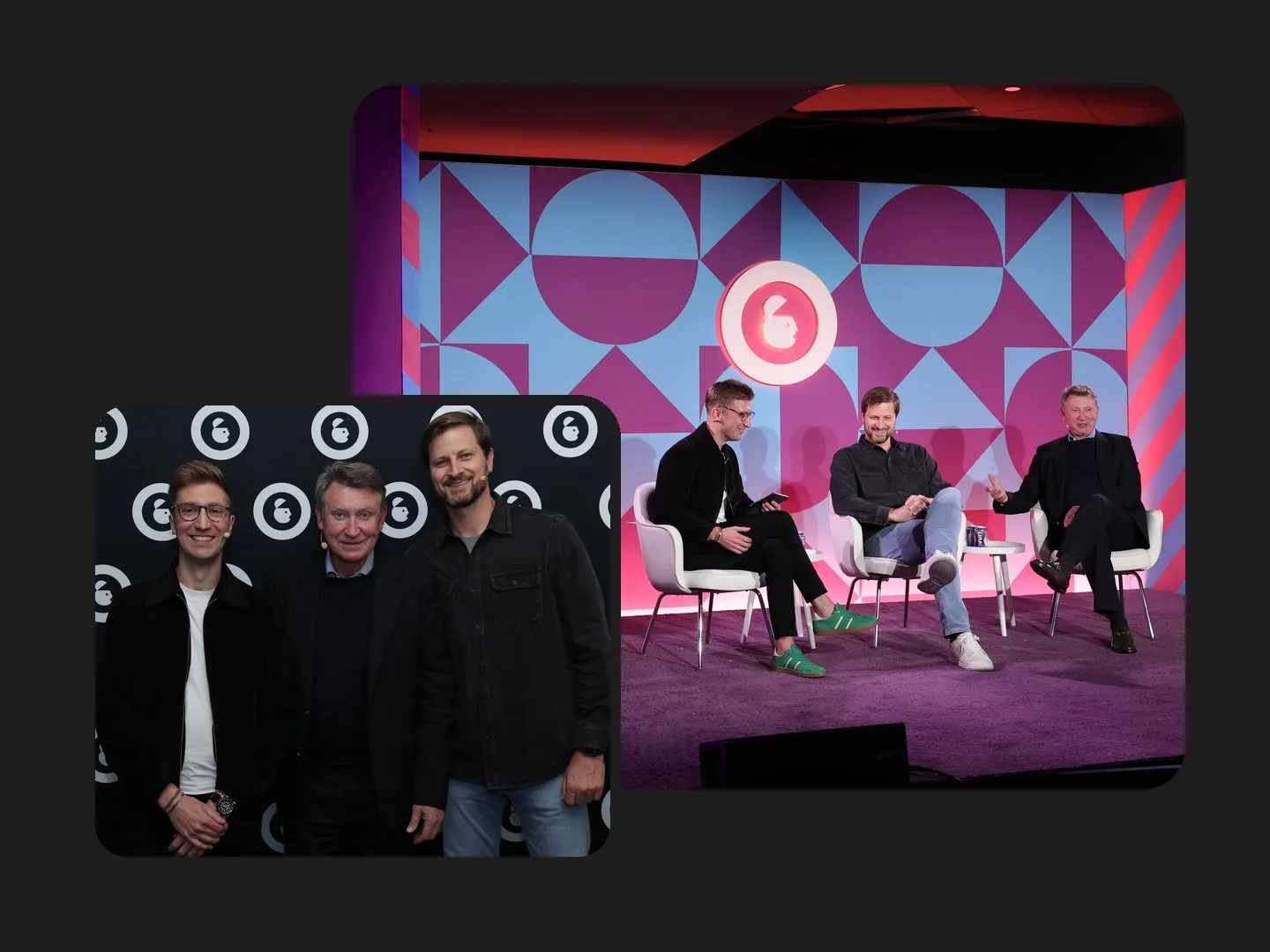
Skating to Where the Puck Is Going: The Great One on Leadership, Advertising Week New York, October 7, 2026. Speakers: Wayne Gretzky, Tucker Kain (Fanatics), and Jon Humphrey (Rokt). This transcript has been lightly edited for clarity and length.
Jon: Thanks for joining. I'll introduce my guests, though I'm not really sure they need any introduction. We're going to talk about leadership. If you haven't read the news recently, we're in the midst of the largest technology transformation in our lifetimes. On one hand, it's a bit of doomsday. On the optimistic side, we've now got tools to solve some of the world's hardest problems. In a period of radical change like this, the most important thing is strong leadership. The challenge is that what we're asking of leaders is both to live through this uncertainty themselves, and to get up in front of their teams and project confidence and clarity. That's not an easy thing to do.
Fortunately for this room, I'm joined by two people who have done that on some of the biggest stages in the world. Tucker Kain has done this not just while Fanatics has reinvented itself, but also helped take the Dodgers from bankruptcy to World Series champions. And the man who needs no introduction, Wayne Gretzky. Wayne did this on ice skates, as a captain and as a coach.
Wayne, I want to start with you. Like the panel title says, you're famous for skating to where the puck is going. There's a bit of a myth that that's a sixth sense. Where did that come from? How did you learn that skill?
Wayne: I doubt it's a sixth sense. Survival. When I was six, I played with ten-year-olds, and when I was thirteen, I played against twenty-year-olds, and at seventeen I played against men. I wasn't very big. I knew my speed and my strength wasn't my forte, so I had to stay ahead of what they were thinking. It was survival, but that was true. It's the greatest game in the world, and I loved every minute. Although I wish I could have played baseball. You guys never drafted me.
Tucker: Before my time, unfortunately.
Wayne: I'll let you off this one. But sports is an incredible thing. We love it. We live it. You get excited when you win, and we all get down when we lose. But the greatest thing about sports is it keeps kids busy, and it keeps kids out of trouble, and that's more important than anything. I think it's more important now than ever.
Jon: Tucker, we were talking about this yesterday. For those of you who don't know a lot about Fanatics, which I doubt is many of you, you're in a lot of businesses. Jerseys and merch, trading cards, live events, and now sportsbook. One of the things we were reflecting on is how hard it can be to keep all of those teams moving in the same direction. How do you get that leadership team moving fast, and moving fast in the same direction?
Tucker: It takes a level of strategic alignment in the organization. But what we've recognized works for Fanatics is creating a very entrepreneurial culture, trying to put the right athletes in the right spots on the team, and then giving them the resources and the space to go do what they do best. If you don't have the culture of speed and entrepreneurialism, and actually lean into failure in certain instances, you're not going to be able to push the envelope the way we'd like to as a company.
Having strong leadership and a clear vision matters too, and over time we've evolved what the North Star for the company is. Is it our relationships with leagues and athletes, or is it bringing fans an experience that is better than it has been before? We came up with this idea of relentlessly enhancing the fan experience, which is something that from Michael Rubin, our CEO and founder, all the way down permeates the company. If people have a feeling for what that means and you give them the autonomy to run against it, that's given us a chance to scale well beyond what a typical organizational structure might allow. We've made plenty of mistakes along the way, but with talented athletes against the right problems, we've been able to make real progress, and hopefully we're just getting started.
Jon: One of the things we reflect on a lot at Rokt is the standardization of knowledge in the world of AI. What that allows us to do is hire a lot of early-career talent into the business, give them access to the same tools, and get them up the curve really fast. Wayne, I want to ask you how you identify talent on the ice. What do you look for in a young player that tells you they're going to be great?
Wayne: Whoever has the puck the most. Hockey knowledge is everything. My dad used to always say, "The guy that has the most hockey sense, that's the guy to watch." I can tell in ten seconds watching a fourteen-year-old or a twenty-two-year-old play that this kid has tremendous hockey sense. It's like you guys in business. You can find out real quickly somebody that, okay, this guy gets it, or this lady gets it. I guess it's a sixth sense that I have because of my love for the sport. It's as simple as that.
Jon: What did you learn from coaching versus playing? What was that transition like?
Wayne: I learned real quick that if I could have coached the Edmonton Oilers in the '80s, I would've been in the Hall of Fame. It's all about the players. I loved it, though. My job in Phoenix was different, and this was before the salary cap era. I remember one game, we had a twenty-one million dollar payroll, and we were playing Detroit, and they had an eighty million dollar payroll. My son, who was a little younger at the time, said, "Dad, what do you think?" I said, "If we can hold them to five, we'll be okay."
As a coach there, I was there for a different reason. I was there to teach them how to be a pro on the ice and off the ice, how to be a family man, how to be good to the media, and great to the fans. It was a different era. Now, because of the salary cap, everybody has an equal chance to win. I wouldn't trade it for the world. It was stressful, but I was lucky. The young kids I had were really good young men, so I was proud that I did it.
Jon: Back when you were playing, when you think about alignment, let's go with you and Messier. It's a long season. If the two of you were running in different directions, you'd set the team off and create a lot of chaos. How did the two of you stay aligned before you got out on the ice?
Wayne: I don't think that was ever an issue. Mark and I started playing together at 18. He's from Edmonton and I'm from southern Ontario, and I used to tease that he was Edmonton's son and I was Edmonton's adopted son. We never had an argument. We never had a debate. I was just telling a story yesterday that if I got three goals in a game and we won three-one, and you were standing outside the locker room like the family members and friends do, when Mark came out of the locker room, you would have thought he had the three goals. He was such a team player, and he had such a big heart.
When we see other great athletes who have conflicts, he and I normally chat about it and go, "I can't remember if we ever had an argument." That wasn't part of our makeup. Maybe it was our age and our naivety. We were so young, we just wanted to win. And I always say to people, the best player I ever played against was Mario Lemieux, the best player I ever played with was Mark Messier, and the two greatest players were Gordie Howe and Bobby Orr.
Jon: Let the rest of us fill in the blanks.
Wayne: You fill in the blanks. And Ovechkin and Crosby were pretty good.
Jon: Not bad. It's unbelievable to think about in a business context. We debate with each other all the time, but there's this element of tenure with one another. The amount of time you spend in the trenches together forms an unbreakable bond, I think.
Wayne: I'm so lucky right now. I work on TNT, and I love it, and the five of us have been together for six years. My son works with us, and he does a great job. He does all the stats for me because I don't know all the young guys. I watch every game, but he's current, and he knows all the players. We've never had a debate or an argument in six years. We might disagree on who makes the playoffs or who's going to win the Cup, but we've never had an argument.
I was saying the other night on TV that this is the closest thing to being in the locker room. I used to love being in the locker room. We played at eight o'clock. I'd be there at three o'clock and sit with the trainers and talk to the stick boys and the security guys. That's what made it fun for me. I loved everything about it, not just the game, but everything that went with it, and that's why it's been fun for me on TNT.
Jon: That's that old saying. You've got to love what you do.
Wayne: Of course. When I was a kid, my dad said to me one day, "You know, you're not the best player."
Jon: He might have been wrong about that one.
Wayne: I said, "Dad, I've got 400 goals." But he said, "The good Lord gave you a passion for the sport like I've never seen, and you're going to meet so many people and get to travel the world." My dad worked for Bell Telephone. He was a blue-collar man, loved life, great family man. He told me about things I wouldn't believe. My wife and I got to host Queen Elizabeth. We got to meet Pope John Paul II. We've met presidents and prime ministers and some wonderful athletes and entertainers, and he was so right. I was ten years old when he was telling me all this. My dad had foresight, and I guess I didn't blow that passion.
Jon: Well, today I met Wayne Gretzky. Tucker, you were part of the group that bought the Dodgers out of bankruptcy. What was that, 2012?
Tucker: 2012, yeah.
Wayne: You didn't call us. We would've put in a hundred bucks.
Jon: As a Yankees fan, I'll remind you of your World Series losses in '17 and '18. But what made you want to buy them out of bankruptcy? What were you thinking?
Tucker: Looking back, people thought it was not a great idea, particularly what we paid for it. But you mentioned at the beginning that AI and the world are changing, and I think this ever-present interest in greatness, watching people in their field excelling and being the best in the world at something, is a human experience that's going to persist. It existed then, and I think it will exist over time. Something like the Dodgers represents global excellence, not every year, but over time, and we saw that as an opportunity.
The team had gotten a little beaten up and gone through some turmoil. But if you can put the product on the field, keep going back to the right people in the right places, and share a vision, it's a pretty magical thing. A team environment is built on trust in the work. Wayne's right. You might have differences of opinion, but if the shared vision and that work is the basis upon which you're building the relationships, I think the sky's the limit. The Dodgers had an amazing run, and the team continues to do great. At Fanatics, we're trying to put as many talented people in the business as we can, give them the resources, and, if we're being honest, get out of their way.
Wayne: Can I take over? Did you buy it because you loved baseball, or because you thought it was a great business venture, or both?
Tucker: A little bit of both. You have to recognize moments in life when there's a once-in-a-lifetime opportunity.
Wayne: That's how I ended up in LA.
Tucker: There you go. You take advantage of it, and then you have to do the work and make sure you understand what you're getting yourself into. It was one of those moments where we weren't going to not make that move. We paid what we needed to pay and figured it out from there. And then there was the love of the game and the opportunity to bring that franchise back.
Wayne: Did you buy it from McCourt at that time?
Tucker: We did.
Wayne: Why didn't you buy the parking lot?
Tucker: That's a sore subject. We can talk about that one over a beer sometime.
Jon: Did you have doubts along the way? Through some of those hard years, what was that like?
Tucker: Sure. There are a lot of Monday morning quarterbacks questioning whether you paid too much. I always come back to this. If you do the work, you're dedicated, and you put in the time and effort, you have to take a little bit of risk in life. If you take it, stay focused, and put the right people around you, it can work. Would I have imagined it working as well as it has? Sports have been an incredible tailwind, and we were maybe more lucky than good on the front end of some of those bets. But you always have questions. Could we have done it better? Should we have made a different bet? At the end of the day, you have to live with those and keep moving forward.
Jon: There's an element of the cost of winning. Those things don't come together overnight.
Wayne: Did you get a ring?
Tucker: I did.
Wayne: Good for you.
Jon: Wayne, I want to ask you about a loss. I think it was '83.
Wayne: '83 and '93.
Jon: I heard you tell a story once about how, because of the way the arena was designed, you had to walk past the other team's locker room. Would you share it?
Wayne: Let me start with '93. '93 was heart-wrenching because we weren't as good a team. We lost three games in overtime. We lost game two over a curved stick penalty late in the game. They tied it up, and we lost in overtime. Our team wasn't as good as their team. We played on heart and gut and desire. The coach at that time, Barry Melrose, passed away recently, and he set the tone for our group. That one was heart-wrenching for me because I wasn't sure we could ever get back there again.
'83 was tough because we really believed we were the better team. When the series ended, we had to walk past their locker room. I remember saying to my teammate, Paul Coffey, "Oh my gosh, I'm going to dread this walk, because they're going to be partying and dancing." As we walked by, it was so humbling, because every guy was sitting there totally drained and drenched in ice packs and everything that goes with being taken care of because you've been physically beaten up. We learned from that, that that's what it takes to win, because we could have played another five games. In our minds we thought we'd given everything, but we hadn't.
We had this rivalry with the Islanders, but in the end it was more of a respect factor. We idolized what they taught us, from Mike Bossy and Bryan Trottier and Denis Potvin and Billy Smith. Because of them, we became the team we became. That's what life is all about. You learn from your peers, and you have respect for people, whether it's a schoolteacher, your mom and dad, or your best friend's mom and dad. You learn from people who have been through it. At the time, we hated them and they hated us, but in the end there was a respect that went a long way.
Jon: You learn more from the losses, I think, than you do from the wins.
Wayne: Yeah, but I'd rather win.
Jon: That's why we're here. No one here wants to lose money. Tucker, how do you think about learning from mistakes? How do you teach the team to go through that? You're not going to win every battle.
Tucker: You're definitely not. We try to honestly celebrate the losses, assuming the work was right and it wasn't frivolous in any way. If you're not failing, you're not trying. To Wayne's point, there will be people who are better or faster or stronger, and if you don't challenge yourself or challenge the organization to take that shot, you're never going to achieve the goals you have.
Wayne: I would tell you this. For the two people I know best in my life, my dad and my wife, the word no is spelled K-N-O-W. N-O is not in the vocabulary. You just go out there, pick yourself up, and go for it. That's life.
Jon: I grew up with a single mom, and just watching her raise me and my siblings, it's unbelievable.
Wayne: It's incredible what people can do when they put their minds to it.
Tucker: I think sports is the ultimate platform where people fail repeatedly. You've obviously done it at the highest level in the world, and those losses taught you to pull the team together.
Wayne: I got traded. I got sold.
Tucker: But you do see, in business broadly, that people who have been in sport understand team dynamics, understand what failure looks like, and know how to come back and put in the work to achieve it. If you culturally, as an organization, can celebrate that and give people the latitude and the freedom to do it, you can achieve pretty amazing things.
Wayne: Let me say this. Fanatics is an incredible company that's growing, and you guys do an incredible job. In 1989, a guy called me and said, "Will you have lunch with my friend?" He sat down with me and said, "I've got this idea that we can sell signed hockey cards." I said, "It's '89 in LA. You're out of your mind. Who's going to buy signed hockey cards?" This guy started in a garage in San Diego. Richard McWilliam, Upper Deck. He had a vision, and nobody was going to tell him no. And here we are today with Fanatics growing that world even bigger than anybody ever imagined. I was so proud that I got to know him. I said, "You don't even know hockey." He said, "I know this can work." And here we are years later.
Jon: Those are great stories. You've got to believe in what you believe in, and have the guts to take the shot.
Wayne: And they're relentless, too. My wife and I are at this hotel, and they're endlessly around the hotel. "Just give me one signature." I think there's somebody here who's got a thousand of my signatures.
Jon: Tucker, where do sports and fandom go from here? Looking out into the future, what's next for Fanatics?
Tucker: One of the really cool parts of what we're trying to do with Fanatics is make people feel closer and more personally connected. We're all fans of multiple teams and multiple players. If we really achieve what we want to do, we deliver a lot of those experiences connected, and we can reward your fandom. It's hard to be a fan sometimes, with the ups and downs. Can we help make that experience feel better, more exciting, more engaging, and more rewarding for fans?
From my point of view, sports remains this incredible connection point for communities. It doesn't matter what background or what political side you're on. Sports brings us together. As this world becomes more AI-enabled, and the world kind of averages out over time, sports is still where you're going to go engage with excellence, the best in the world at something. I think it's always going to matter to people and make people strive for more in their own pursuits. I feel super lucky that we get to be in this industry and be a small part of moving it forward and connecting people more closely. I'm very long on sports, maybe self-interestedly. We don't know exactly how people are going to engage with each other or with the world, but I do think we'll all continue to come together around sport because of how unique and dynamic it is, and the excellence embedded in what sports represents.
Jon: This summer's World Cup must have been huge for Fanatics. Soccer cards?
Tucker: Soccer cards. It's an amazing global event, and it was great to see not only US fans lean into it, but global fans come to the US and appreciate that mixture of cultures, with everybody following and supporting that excellence and greatness. We obviously had a great opportunity in the merchandise business and in trading cards. But what was really cool was to see the US get behind the global game. The passion was pretty cool.
Wayne: And we did well in Canada too.
Tucker: Canada and Mexico did great. It couldn't have been better for all three countries.
Jon: I was at the USA-Paraguay game, the first US game, and I left thinking the US was going to win the World Cup. The energy in there was unbelievable. Now you've got the Olympics too. How do you think about the Olympics?
Tucker: I think it's going to be incredible.
Wayne: Will you guys have cards for the Olympics?
Tucker: We will. We've done that for the last couple of Olympics, and we'll do it for this one. It's another amazing global event, and LA is ready for it. It's a really cool moment for people to celebrate excellence and athletic achievement, and to see the country get behind it.
Wayne: Is it a whole different market for cards with the Olympics than with the World Cup and the NBA, or is it the same people?
Tucker: Those events expand the addressable market. Trading cards have historically been primarily US, and primarily football, basketball, baseball, and hockey. Global football and the Olympics expand that, because people get introduced to cards as a way to express and engage with their fandom, and that helps the whole business.
Jon: Wayne, I want to go back to that quick comment you made, that you got sold and you got traded. You're on top of your game, and then you show up at a new team. What's that like?
Wayne: At seventeen, I signed in Indianapolis. I was really unknown at that time. Indianapolis was not a great hockey city, and I wasn't going to change the franchise. So the owner called me and said, "I'm going to sell you," and I said, "Okay." I got sold to Edmonton, and then I won the Stanley Cup. My mom and dad, my wife, and I were sitting in my kitchen at five a.m. after winning the Cup, and my dad said, "You're going to get traded or sold." And I got sold again. I set another record. Sold twice in eight years. It's part of business, and it's part of sports. I loved Edmonton, and I wish I hadn't been sold, but on the other side of it, I'm so happy I was, because it changed my life. I had five kids who grew up in California, and they're wonderful young people. That's life. It's the business side of sports, and you go with it.
Jon: You were talking backstage about playing in New York. What's it like playing in New York?
Wayne: There's nothing like it. I loved every minute. I wish I could have played here as a twenty-one-year-old instead of at thirty-nine, because I was a lot better at twenty-one than I was at thirty-nine. But the fans were wonderful to me. I love coming here. You can't beat it. And Madison Square Garden is an incredible arena.
Jon: We've only got a few seconds left. We're going through this huge change, and leadership is at the core of it. We've got to lead our teams through this crazy change that is AI. If you were to give some advice to leaders today, what would it be?
Wayne: I don't know anything about AI. I'm not going there. I don't even know how to turn on my Instagram.
Jon: Let's go with that. Say you're giving advice to a new coach or a new player. How do you get somebody ready for big change, like their first Stanley Cup or their first playoff game? What do you tell them?
Wayne: I would tell them the same thing my dad told me as a kid. You dreamt about this your whole life. You've thought about this. You've acted it out on the driveway, in a pond in the backyard. You wouldn't want to be anywhere else but right here, right now.
Jon: Talk about a way to end it. Tucker and Wayne, thank you very much.