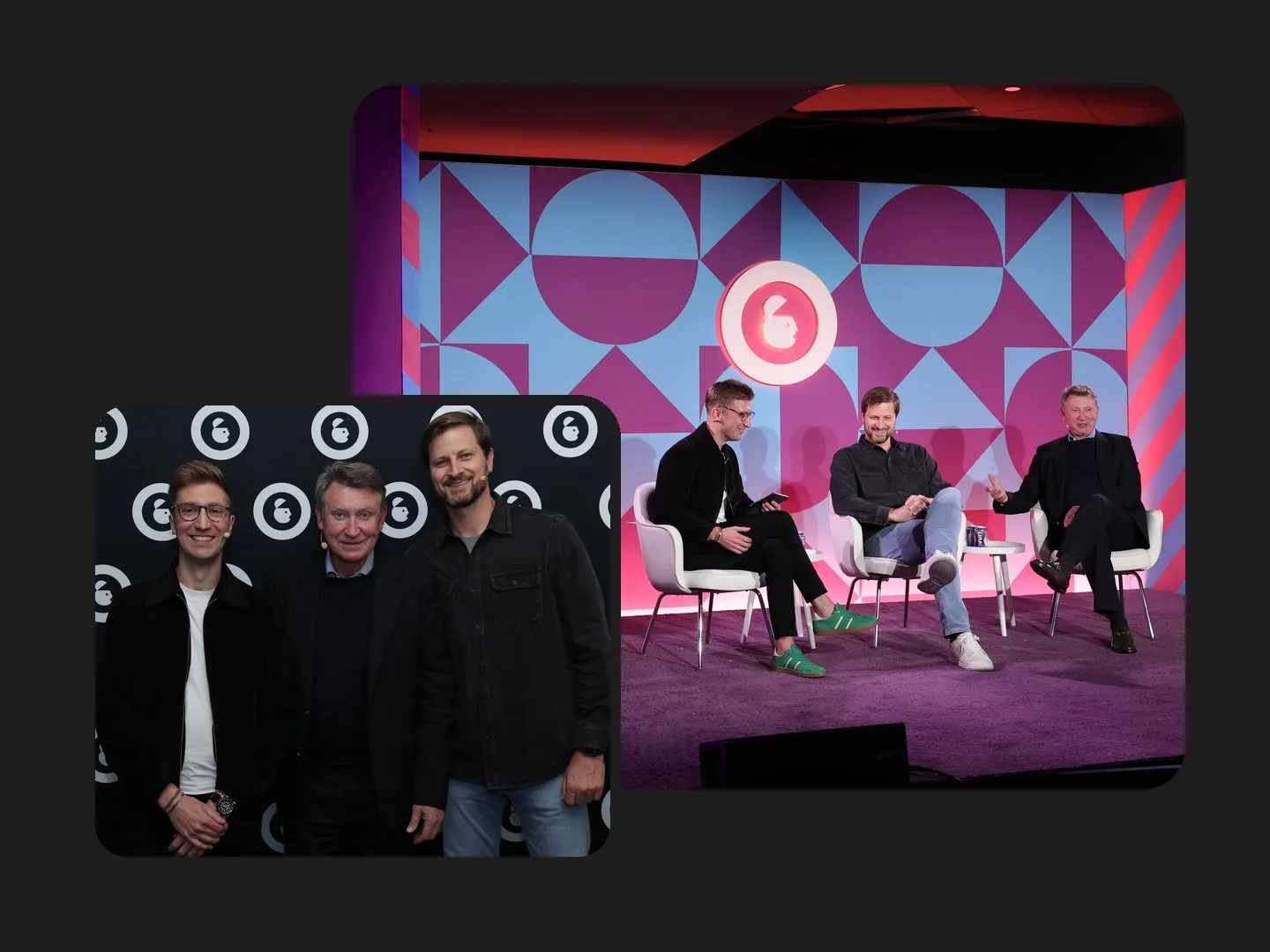


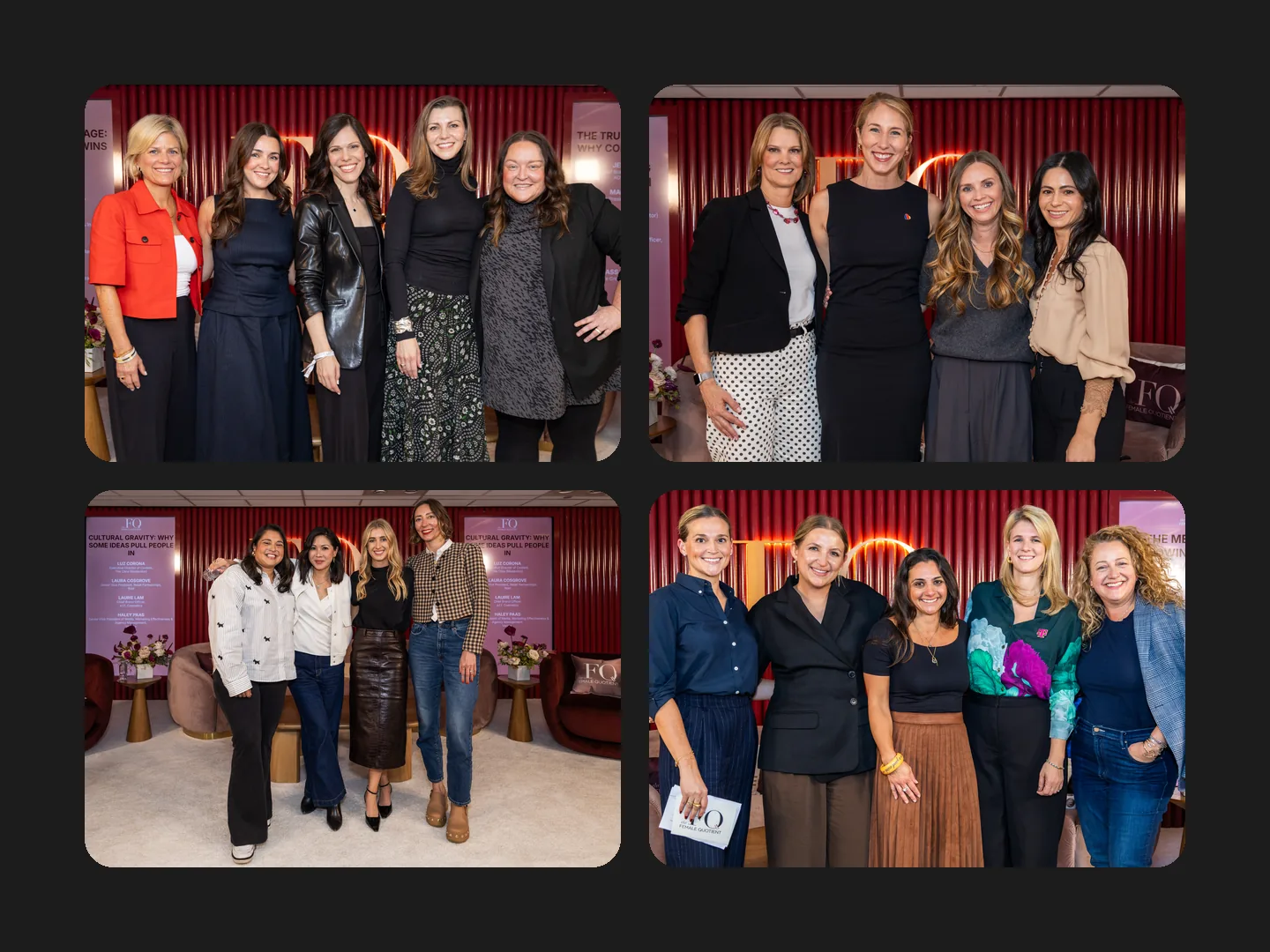
Four Rokt leaders spoke at The Female Quotient's FQ Lounge™ at Advertising Week New York on Tuesday, October 6, 2026. Across four panels, they joined marketers and media leaders from Mastercard, Clinique, Lyft, Southwest Airlines, Carnival Cruise Line, e.l.f. Beauty, Verizon, TripleLift, T-Mobile, and American Airlines. They talked about trust, discovery, culture, and where people spend their attention.
The Female Quotient sets up the FQ Lounge™ at the industry's biggest events to give women leaders a stage and to start conversations that are more honest than most conference sessions. This year at Advertising Week, the lounge ran from October 5 to 7 under the theme Media That Moves. The program asked what most marketers are already asking. How do you stay relevant when culture moves faster than your campaigns? What does AI change about creativity? Why have trust and community become growth strategies?
Each of our four panels started from a different question, and all four reached the same answer. People still give brands their attention, as long as the brand shows up with something relevant at the moment it matters.
The Trust Advantage: Why Confidence Wins
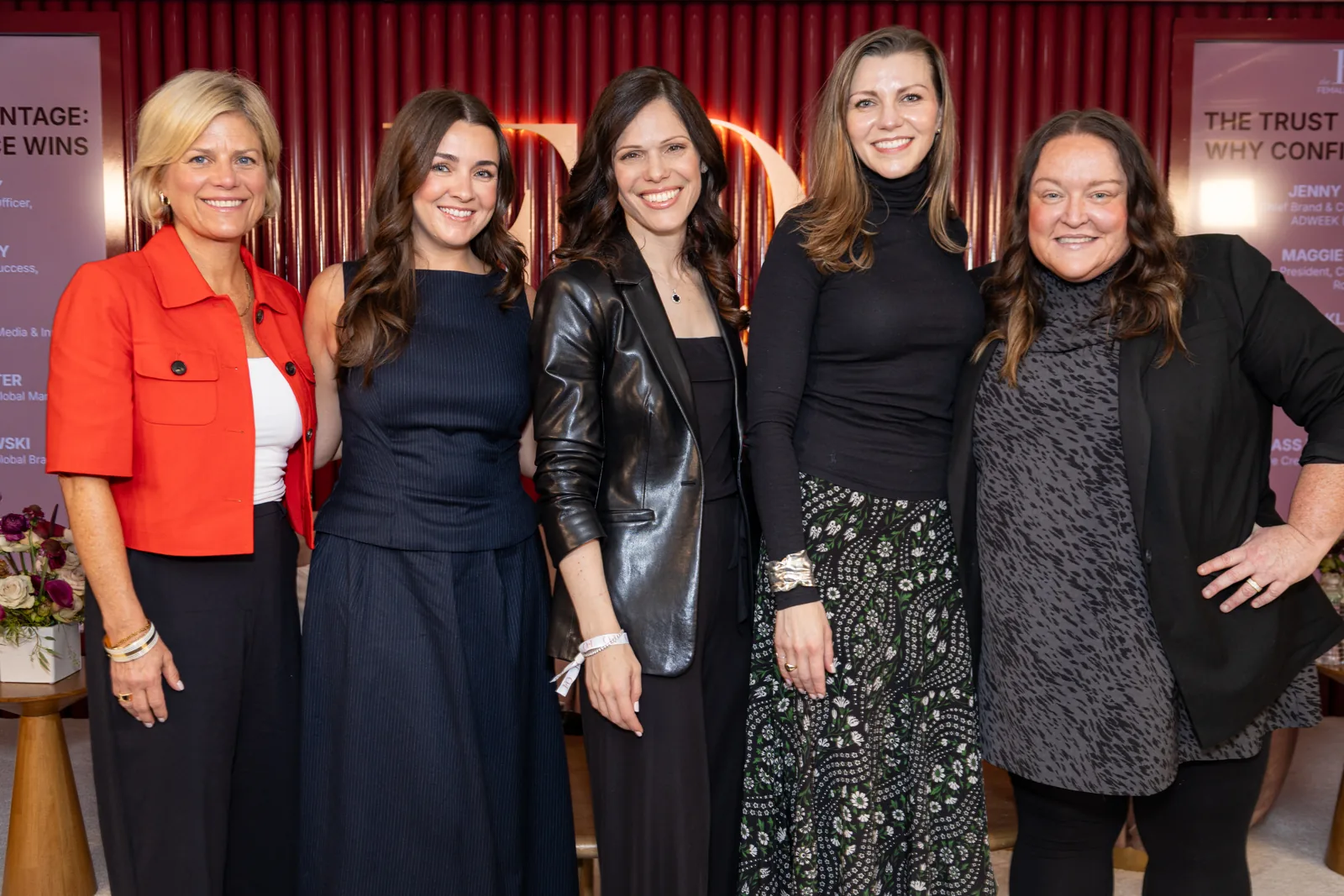
Maggie Carney, Vice President of Customer Success at Rokt, spoke with Nili Klenoff, EVP of Mastercard Commerce Media; Christie Sclater, SVP of Global Marketing at Clinique; and Cass Zawadowski, Executive Creative Director of Global Brand at Lyft. They talked about how companies earn credibility as AI changes the way people judge brands. ADWEEK's Chief Brand and Community Officer Jenny Rooney moderated.
Christie opened with a lesson from ancient Greek, which uses the same word for trust and belief. Customers won't believe in a brand until its own people do. She also warned about brands that assume too much too soon. She compared it to a blind date who orders for you before you've said hello. Asking is better. Nili said trust comes from consistency, so Mastercard builds it into every interaction, from tapping to pay for a coffee to checking which advertisers and publishers can join its network. Cass said trust at Lyft starts with the product, because people get into cars with strangers every day. Her team is open about how it uses AI in creative work and moves at what she called "pace with purpose."
Maggie spoke from Rokt's place in the Transaction Moment™. That's where three parties meet: the business someone is buying from, the brands advertising there, and the customer. Earning the trust of all three comes down to relevance. If a message won't feel meaningful to the customer in that moment, it may be the wrong time to show it.
Trust has never been more important, but it's also never been harder to hang on to.
Maggie Carney, Vice President of Customer Success, Rokt
Explore Maggie's conversation: The Trust Advantage
This transcript has been edited for length and clarity.
Jenny Rooney (ADWEEK): Hi, everyone. It's great to see all of you here. I'm Jenny Rooney with ADWEEK, and I'm excited to be here in the lovely Female Quotient Lounge. Let's give it up for The Female Quotient. They always do such an incredible job. I'm excited to dive into this conversation around the topic of trust: The Trust Advantage: Why Confidence Wins. We're going to peel back what all of that means in a minute. But to kick it off, I'd love for you to introduce yourselves. One of the things I always love to hear is not just where you are and what you're doing now, but a quick sketch of where you've been before your current role, because I think that context is always really helpful. Christie, I'll start with you.
Christie Sclater (Clinique): Hi, everyone. I'm Christie Sclater, SVP of Global Marketing at Clinique. Prior to that, I've been in tech. I was at Apple. I was in consulting and behavioral economics. So I'm just fascinated by people, how people work and how people connect, because at the end of the day, that's all this is, right? It's about people and connecting with trust.
Jenny Rooney (ADWEEK): Awesome. Nili?
Nili Klenoff (Mastercard): I'm Nili Klenoff, EVP of Mastercard Commerce Media. I come at media and advertising from a payments background. I have built and scaled consumer-facing technologies all over the world, whether that's digital wallets, contactless payments or biometric identity solutions. I think that gives a different lens and a unique perspective, especially around trust and what it takes to build consumer adoption of new experiences and technologies in a global capacity. So it's good to be here.
Jenny Rooney (ADWEEK): I love that. Maggie?
Maggie Carney (Rokt): I'm Maggie Carney, Vice President of Customer Success at Rokt. Prior to my time in tech, I've always worked within the digital media space. So I've really seen how programmatic, display, video and all the ways media is evolving have shifted over the past ten years, and I think there's never been a more important time to talk about maintaining trust through that evolution.
Cass Zawadowski (Lyft): Hi, everyone. I'm Cass Zawadowski, Executive Creative Director of Global Brand at Lyft, which I'll tell you all about today. My background before going brand side was many years on the agency side. I think that's relevant, because having the chance to lead different brands in different spaces, and then taking all of that experience in-house and channeling it into one brand, has been the best experience, especially in this day and age.
Jenny Rooney (ADWEEK): I was telling the panelists before we came up here that, honestly, any of these questions could have been asked of all of you five, ten, even fifteen years ago. Obviously some things are timeless, but the context and the forces you're dealing with are what constantly shift. So we'll go through the questions against the backdrop of the incredibly AI-obsessed world we're living in, across marketing, advertising, creative and customer experience. That will sit in the background and be the assumption going in.
Against that, trust is increasingly a competitive advantage. I would say it always has been, but the difference is now... Christie, define how we're talking about trust now. What does it really mean against all of that context?
Christie Sclater (Clinique): I learned this maybe ten or fifteen years ago, and it blew my mind then and it still does now. Bear with me for a second. In ancient Greek, trust and belief are actually the same word. So you can't have trust if you don't have belief, and you can't have belief from a consumer if you don't have belief from an employee. As we're talking, we have to talk about AI. We were saying, "Oh, AI, it's everywhere," and it is. But you have to build that belief truly and authentically within your company in order for the trust to extend to a customer. That means the AI piece, or whatever it is, has to be grounded in that deeper understanding.
Jenny Rooney (ADWEEK): I love that. Other thoughts? Nili?
Nili Klenoff (Mastercard): Sure. I think trust is really built through consistency. Brands need to know what they stand for, and then they need to connect with consumers in a really consistent way across every interaction the consumer has. At Mastercard, our business is about managing trust, right? Whether you are facilitating a payment, protecting data or helping a brand reach a consumer, it's all underpinned by the same guiding principles of trust, privacy, safety and security.
I referenced contactless before, just as an example. Whether you're tapping to get your coffee in the morning, tapping to pay on the London Tube or tapping to get out of your taxi in Dubai, it's the same consumer experience. And you know that if something goes wrong, you know what to do. You know to call your bank, and you know your bank is going to have your back if there's fraud. So when we think about trust in a marketing context, we think the same principles apply, and it becomes a competitive advantage. That's how we thought about our commerce media business: weaving trust into the system itself, verifying the environments that participate, the advertisers that participate and all of the data behind the scenes. That's all woven into the system itself.
Cass Zawadowski (Lyft): I'm happy to bring it back to creative for a second, because if you think about Lyft, trust is not just a brand campaign we can run. Trust is in our product, and it has to be. People get into cars with strangers every day, so we need to make sure we are living trust through the experience. Taking it back to the creative space, when we think about brand work and all the ways we've been encouraged to explore AI in brand work these days, Lyft has been very committed to maintaining trust outside of the product, in the brand-building space. If we are using AI, we are being honest about how we're using it. We've also decided with our business affairs team how far we want to go with it in order to maintain trust with our riders and drivers. So there's a fine line: using it, being honest about how you're using it, and then making the rules about how far you want to embrace it or not. That's okay too.
Jenny Rooney (ADWEEK): Just to build on this question a little bit, Maggie, is trust transactional?
Maggie Carney (Rokt): I would say it's not transactional. I would say it's inherited and built individually between parties. At Rokt we talk about this a lot, because trust has never been more important, as we discussed with the evolution of AI, but it's also never been harder to hang on to. When we talk about transactional, typically trust is between two parties. But at Rokt, we have a unique perspective because we operate a three-sided network: the businesses where people are shopping, the brands that are looking to advertise, and the end customer who's ultimately purchasing with those merchants. So we're able to see what that mix looks like between three parties, not just two.
At the end of the day, I feel like it comes down to relevance. Is what you're showing meaningful in that moment? Is there a positive experience and benefit across all three parties? So it's less about the transactional piece and more about whether there's the same consistent foundation people are building on.
Jenny Rooney (ADWEEK): I love what you're saying about consistency, and Nili, you said this too. The reality, though, is that you don't gain somebody's trust out of the gate. It's built over time, so you need runway. The consistency comes through repetition and proving yourself over and over again. But we live in a world where timelines are so short and people's patience is so low. You don't always have the benefit of a runway to build that consistency over time. So how are you thinking about balancing that? It's quite a challenge, and yet you know what the outcome needs to be as a marketer.
Christie Sclater (Clinique): I think that's part of why consistency, like you were saying, is so important. And speed. Consistency and speed. But at the end of the day, it's not just going to be brand to consumer where that trust relationship has to be built. You think about all the creators, all the voices, the whole community that is also building that trust. So yes, it's fast in terms of the moment the brand might have with the consumer in that little segment, but there's a whole ecosystem of people who are part of the trust equation. You have to make sure your brand is so strong and your presence is so felt that even if you're not there having the conversation, you're still building up that trusted identity and presence. And a person knows that at the end of the day, they can go right back to you, or to anyone, and it's a consistent expression.
Maggie Carney (Rokt): When we talk about how fast we're innovating now, and that speed, it does come down to maintaining those core brand values. As long as you're working through this innovation and trying to build trust at speed, you stick to, one, your brand's core values, and two, constantly asking: am I keeping a pulse check on the customer experience? At the end of the day, the customer experience is what fuels trust between brands, networks and customers.
Cass Zawadowski (Lyft): On consistency, I think it's a very interesting point to bring back to what you just said: the team of people that ends up touching a brand can be external. When we think internally about how people are also perpetuating this notion of trust, it's about scaling creativity. Across the multiple touchpoints and all the channels we're showing up in, how can anyone who's intimately touching the brand or creating for the brand know they're creating from a place that will add up to trustworthy assets, for example?
Nili Klenoff (Mastercard): I think there's a piece about being intentional: knowing what your values are as a brand, and then being intentional about weaving them into all of the different places and moments where the consumer is going to engage with you. Of course, that's your initial creative, your messaging and your engagement, but it really has to run through the fabric of every one of those points of interaction.
Jenny Rooney (ADWEEK): Well, you could really close the timeline gap, right? The way you're talking about it, the trust build happens in the aggregate. It's not linear. There's a network effect, if you will, of all the partners you're working with, creators and so on. But you can't cut corners, right? That's why it's a challenge, I'm sure.
Let's talk a little bit about personalization, because this has been an oft-discussed topic, but the context continues to change. Personalization done right also builds trust. But there's a fine line between that and feeling intrusive or crossing boundaries. How are you thinking about that right now?
Maggie Carney (Rokt): With the way data has evolved, personalization has never been easier to do, and I think you're right to flag that some people are taking advantage of that the wrong way. The last thing we want to do is create an uncomfortable or unnatural experience for customers. Going back to what you just said about intention, the way we speak to customers has to feel intentional. At Rokt, we sit at one of the most personalized moments for customers: when they're making a transaction online. It feels very personal already, and there's a lot of sensitive information there. So we've always had to be very thoughtful about how we curate that experience so we don't take a step too far and it still feels native to the customer.
At the end of the day, you have to make sure you're showing the right message to the right person at the right time. If you're not delivering the right experience, and it doesn't feel meaningful to them in that moment, you should reconsider whether it's the right time to message them.
Nili Klenoff (Mastercard): I think there are a few other dimensions too. Again, trust has to be there. It's the foundation of any consumer relationship, so it's got to be built into the experience from the start. When you bring it to a content and advertising standpoint, having trusted signals that allow you to do the targeting and drive relevance is key.
There's another piece we've been thinking a lot about in our business. We help brands reach consumers through our platform, with Mastercard insights leveraged across our network of premium publishers, and then of course closing the loop from a transaction standpoint, connecting the media exposure to the sale itself. But we started off as a loyalty program, where it was all about value: offering incentives and discounts to consumers, personalized through our insights, and connecting those to customers across different environments and touchpoints. So for something to be personalized in a meaningful way, it needs to be relevant. It also needs to be valuable, useful and accretive to the consumer. That doesn't mean there needs to be an incentive or a discount in every interaction. But when you have the flexibility to bring those different elements in, and again, that can be unique to your brand and how you're connecting with the consumer, that's another layer of personalization that really helps it land differently.
Jenny Rooney (ADWEEK): Christie, with beauty brands, for example, there's nothing more personal, right? What you use, how you use it, everything else. What are your takeaways from that experience relative to personalization?
Christie Sclater (Clinique): It's interesting, because I think there's an element of speed. You have to ask questions. Sometimes brands try to speed it up way too fast. Right away it's, "Oh, I know your name, I know what you want because I've analyzed all your data," instead of, "That's actually not my name. That's my husband's name, because he has the account." It's like being on a blind date where they've gone ahead and said, "Hi, it's so nice to meet you," and just assumed I want the Pinot Grigio, and I do not want the Pinot Grigio.
So I think there's this element of needing to ask questions. One of the things that's so beautiful about the brand is that it started back in 1968, and it was about a question. It was about understanding what your skin needs and what your skin goals are. That's something we've tried to carry forward. At the end of the day, you can ask the question, and the person can share, and that's the best personalization, right? Because it's truly personal. Personalization that just comes from checking a box or a digital this or that might be brilliant from a brand point of view, but it doesn't feel like you know me or see me. And I think that's all we want. We want to feel seen.
Jenny Rooney (ADWEEK): And there's an element in there of letting it roll out, letting the person own what they're sharing with a brand or institution.
Cass Zawadowski (Lyft): Just a slight build, but I think it speaks to what was just said: deep personalization can also come from deep listening through the data. A great example from the Lyft side is how Lyft Silver was born. It's a product specifically for an older demographic that needed different types of cars and different types of ride experiences. That didn't come from some survey we gave everyone. It came from listening to the data and the things we were seeing, and then creating something personalized for an audience that was telling us what they needed through the data.
Jenny Rooney (ADWEEK): Any other examples of things you've created that you had no idea were coming, but you listened, and there was a new use case for your products and services?
Nili Klenoff (Mastercard): For us, where I would go with listening is intent. We've created many different products based on our insights. I even think about the launch of our business, Mastercard Commerce Media. That was very much a function of problems in the industry around media efficiency, transparency and accountability. That was the insight that led us to say, "Wait, there's a better way to do this. There's a better solution." We have a ground-truth layer of 175 billion transactions that we see across our network every year. There's a powerful way to take those intent signals and build a better system and solution that helps brands connect directly with consumers across premium environments, in a way that's structured to respond to those signals in real time. Then, when you have verified purchase outcomes, they help strengthen the intent signal, and it creates a continuous feedback loop. So the very genesis of the business we launched a year ago was in response to needs we identified in the market, and a way to solve them because of the position we were in.
Maggie Carney (Rokt): Very similar. Also operating within the transaction space at Rokt, listening has driven all of our product innovation. When I think about where we started, we were traditionally just in the post-purchase moment, after you made a purchase, creating a network of offers there. Through our integrations with all of the businesses we power transactions for, we were able to see that customers were actually looking for a better experience much further up the funnel. So today we power optimizations across everything: from when you start shopping, to when you're choosing what to pay with, to when you're deliberating a potential upsell. All of that has come from seeing how customers have acted in that transaction moment and listening to what they were indicating to us about where there was friction and where we could make the experience better.
Jenny Rooney (ADWEEK): The opposite of speed, in some cases, is pacing, right? That's kind of how you're thinking about it. In the conversation we were having before this, one of you said that younger generations notice when you're trying too hard. Talk about a nuanced thing to have to deal with. Thoughts, reactions? Because the last thing we want is to be the brand that's trying too hard. Trust goes out the window. There's no appetite, or I would say patience, for that.
Christie Sclater (Clinique): I teach an advanced marketing class, and this is my first time teaching. I have all these students who are twenty-five, thirty, and I'm putting up a bunch of campaigns for them to evaluate. Right away they're like, "Trying too hard. Nope. I see right through that." It was just amazing.
Some data was just released from Gallup this morning, I think, showing that from a well-being standpoint, the youngest generation has fallen off a cliff. They used to be the highest about fifteen years ago, and now they're the lowest by far. When you don't feel like you're in a great place, your trust is low and you're inherently skeptical of what you're seeing in front of you, in part, I'm sure, because of AI, and in part because of things just being thrown at you. So I think it's a real thing. There's a real skepticism, and it does make all of our jobs interesting. That's for sure.
Jenny Rooney (ADWEEK): It does. They come from that framework of skepticism. So the bar just becomes even higher. Is there anything you can share from a generational standpoint, where you see the trust build being either easier or harder?
Cass Zawadowski (Lyft): Easier or harder? I don't know if I have the right answer to that question, but I think it comes full circle back to consistency. I've been at Lyft coming up on almost two years now, and part of that journey for me has been our rebrand. You can imagine some of the reactions we had: "Well, that's not consistent. Where did the old brand go?" But we have maintained consistency in how we live and how we show up. You might tweak a pink or a purple, or no longer have gray as part of your mix, but that doesn't really matter if you buckle down on making sure that who the brand has always been is who you carry through the rebrand and beyond. We've seen a lot of positive reaction to that. You get a little chatter about some of the aesthetics, but people very quickly recognize, when you help stem that and make it clear, that you're still who you've always been. Again, consistency is the key theme of today's conversation when it comes to probably any audience age, truly.
Jenny Rooney (ADWEEK): Confidence. The name of this discussion is "Why Confidence Wins," and confidence creates permission for brands to keep evolving. Talk a little bit about where you're feeling confidence. What are the signals you're paying attention to that give you that permission? Because confidence begets permission to keep going. Where are you seeing a path forward in any of this, and what gives you hope as you go into the rest of this year and next year? Any of you.
Nili Klenoff (Mastercard): I'll bring it back to the heart of our solution and how we think about the space: the confidence comes from reading those transactions. There's a lot of signal noise and a loss of quality out there, and it's really hard to cut through the clutter. We think about transactions as providing the strongest signal, which will ultimately help brands reach consumers more efficiently, wherever those consumers are interacting, and then close the loop. There's so much pressure on brands today. Budgets are absolutely coming down, and there's a focus on, and a need to, prove the ROI of those investments. So when you have trusted and credible ways to verify that exposure actually translated into a purchase, regardless of where that purchase took place, I think that gives brands confidence in their investment decisions.
Maggie Carney (Rokt): I think at the end of the day, it comes down to the customer. At Rokt, all three parties have an aligned objective that ends in the customer having a positive experience. If that happens, both the brands we advertise for and the businesses that use us as part of their transactions are happy, and there are positive outcomes. So wading through all of the data we have at our disposal, and all the different ways you can measure that trust and see whether there was an impact that gave back to the customer, making sure we're seeing that positive outcome, and on the brand side, seeing the brand improve as a result of what you're doing: that's what builds confidence.
Jenny Rooney (ADWEEK): Cass, same question for you. What gives you confidence?
Cass Zawadowski (Lyft): What actually gives me confidence is the slightly changing view of AI. I think a lot of us, ourselves included, jumped in from a creative perspective, not as it applies to our product, but from a creative perspective, thinking it was quickly going to be a solution to so much. One of you used the word "pace" earlier, and I think that's the big lesson we've learned on our journey: pace with purpose. I'm not saying we're not embracing AI, but we're not as all in on what we thought it could do, should do or will do. So that's my focus too. We're using it, but let's use it with purpose and at pace, so that internally we're, A, learning as we go, and B, continuing to build brand assets that are confident, trustworthy and on-brand. So hopefully that's helpful.
Nili Klenoff (Mastercard): Just to build on that, and to go back to what you said at the beginning, Jenny: you said these are questions you could have asked five or ten years ago. I think that's one of the things that gives me hope. We're talking about the timeless things that matter, and in a world of AI, the pressure is on, so we're all examining what values underpin all of this. What does a trusted relationship look like? We're thinking about it and interrogating ourselves on it, and I think that's really healthy for brands, and really healthy for the future, period.
Jenny Rooney (ADWEEK): Well, on that positive note, we're going to conclude. Thank you so much for joining me. This has been incredibly enlightening.
The Discovery Economy: Winning Before the Search
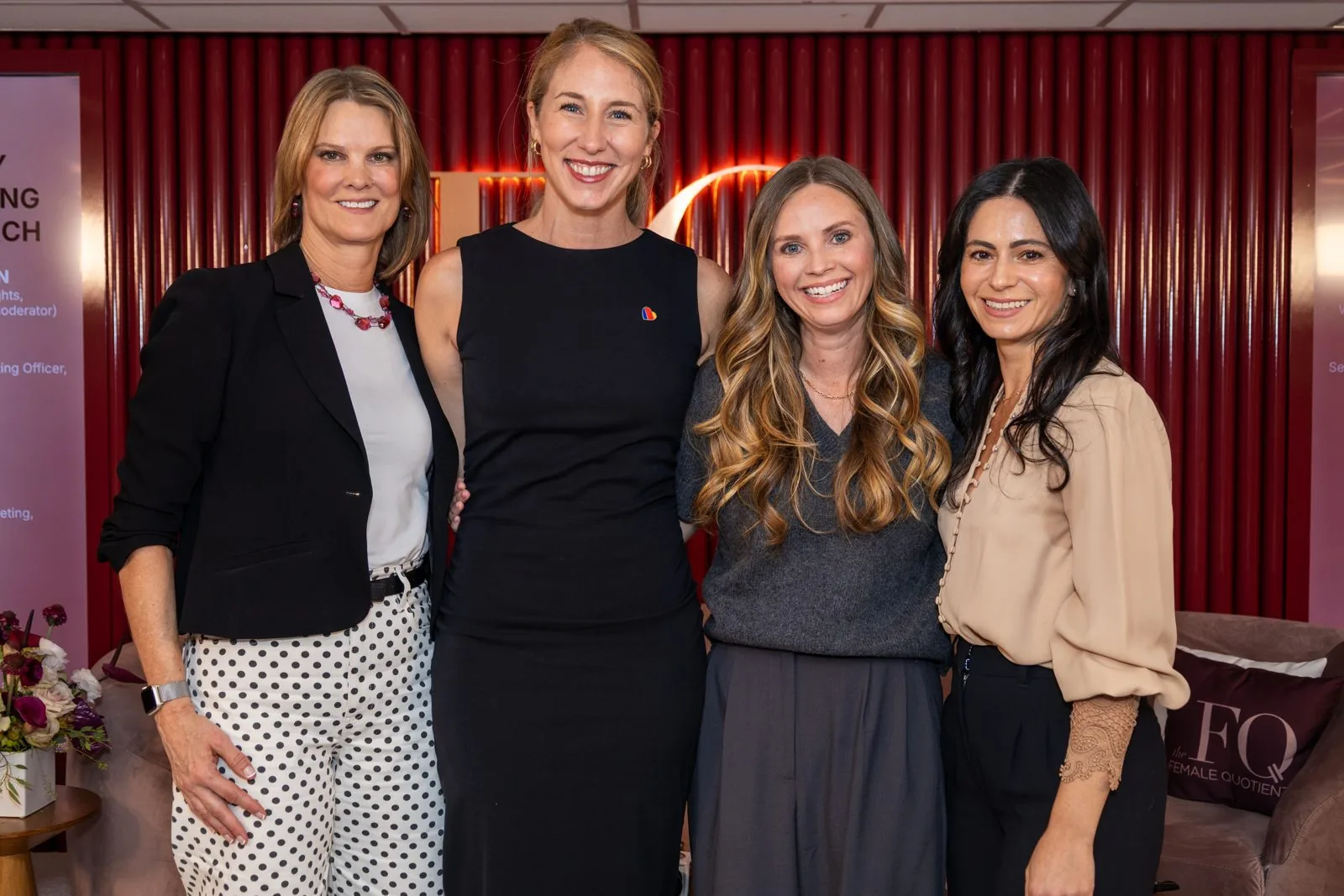
Allison Repetto, Vice President of Customer Success, Retail at Rokt, joined Sabrina Callahan, SVP, Chief Digital & Marketing Officer of Southwest Airlines, and Diana Tomasetti, Senior Director, Brand & Product Marketing of Carnival Cruise Line. They unpacked how consumers now find brands through AI assistants, creators, and communities long before they search. Debra Aho Williamson, Founder and Chief Analyst at Sonata Insights, moderated.
Sabrina said Southwest competes with every brand in a traveler's day for attention, from podcasts to billboards to social feeds. Its answer is hospitality and entertainment. One example is Live at 35, which brings live music and comedy to 35,000 feet. That same morning, Southwest had launched the first U.S. airline plugin in ChatGPT, which helps travelers find flights before they book on Southwest.com. Sabrina added that search still matters. What's changing is which KPIs teams prioritize.
Diana described how Carnival shows up where people are already having fun, from New Year's Rockin' Eve to creators chosen for each stage of the funnel. Carnival is also investing in press coverage and in communities like Reddit, where one of its cruise directors is hosting an Ask Me Anything. AI assistants draw on all of that content when they recommend a vacation.
AI can buy you a spot in the conversation, but it can't buy you a recommendation.
Diana Tomasetti, Senior Director, Brand & Product Marketing, Carnival Cruise Line
Allison told a story from checkout. A friend buying concert tickets online was offered a way to pay with an account she already had. Next came an offer for parking she hadn't thought to book for her drive in from Connecticut. Allison said more businesses now want to connect identity across chat, web, and stores so that relevance follows the customer wherever they shop.
Relevance is king at this stage. Having a really strong identity foundation will set you apart in how you show up for your customer across different surfaces.
Allison Repetto, Vice President of Customer Success, Retail, Rokt
Explore Allison's conversation: The Discovery Economy
This transcript has been edited for length and clarity.
Debra Aho Williamson (Sonata Insights): We have a super exciting session for you. We're talking about the changing path of discovery, not just with AI, but with social media, with creators, with all sorts of things that are changing the way discovery is happening. I'm Debra Aho Williamson, founder and chief analyst at Sonata Insights. I spend a lot of my time researching and thinking about how AI is changing how brands reach, engage and advertise to consumers. Let's start with a brief round of introductions. To my left is Sabrina Callahan. Sabrina, why don't you introduce yourself?
Sabrina Callahan (Southwest Airlines): Sure. I'm the SVP and Chief Digital and Marketing Officer at Southwest Airlines.
Debra Aho Williamson (Sonata Insights): And Al?
Allison Repetto (Rokt): Hi there. I'm Al Repetto, and I'm the Vice President of Customer Success, Retail, at Rokt.
Diana Tomasetti (Carnival Cruise Line): I'm Diana Tomasetti, Senior Director of Brand and Product Marketing at Carnival Cruise Line.
Debra Aho Williamson (Sonata Insights): Welcome, everybody. We're talking about the discovery economy, and how it's all about winning not just the search, but before the search. Discovery is no longer linear. Consumers are finding brands in lots of different places, and we're here to find out how they're finding your brands. Sabrina, let me start with you. You are relatively new to Southwest. Tell us a little bit about your role, but also how discovery is changing for Southwest as a brand, and how consumers are finding you now that might be different than before.
Sabrina Callahan (Southwest Airlines): Sure. I'm eight months into Southwest Airlines, and if you know anything about Southwest, that tenure is very short. People have worked there forever because it's notoriously one of the best cultures to work for. So I have a lot to learn. I'm still in listening mode eight months in, and every time I start to think I'm understanding the airline industry, I am immediately humbled.
But I do know marketing, and I do know digital. This is the first time in my career that I've had the opportunity to put both of those sides together. I've always had either marketing, advertising and brand, or the digital, ecommerce, UX, CX and product world, running a P&L. This was also the first time Southwest put the roles together. It's the first-ever digital and marketing officer, not just at Southwest, but in the airline industry. So it's an amazing opportunity, and I think it goes back to watching the way customers are evolving, how to get in front of them and how to make that experience more seamless.
One of the things we've gotten really into is understanding customer behaviors: where they're going and why, and who we're competing with to get in front of them. We keep quoting a stat internally from Forbes that says the average American sees six to ten thousand advertisements per day. Every time I use that stat, people say, "Oh, that can't be right." And I say, "Okay, but think about it. You wake up in the morning, you're listening to your podcast, you have your emails, you're getting push notifications. You might drive in, and you've got all the out-of-home boards. You're scrolling social media for four to six hours. How many are you going through and seeing? You don't even pay attention to them anymore. It feels like second nature."
So at Southwest, we're not just trying to compete with the other airlines. You're competing with any brand that wants to get in front of a consumer and get them to take the next step toward purchase. That really has to take your brand in a different direction and challenge the status quo of how things have always been done.
What we're talking about at Southwest is: Where do we have credibility? Where do we have the right to play? Hospitality and entertainment are a unique and special strength for Southwest. So one of the ways we're going about it is through culture and entertainment. We do something called Live at 35, which is live music or a live comedian at 35,000 feet. That's not new. We've been doing it for over fifteen years, but it had always been lesser-known artists, and we just hadn't done it in a while. When I came in, I said, "Oh my God, that's amazing. Why don't we do that anymore? We should be doing that." So this year, we brought in Bowling for Soup and Plain White T's, and Jon Lovitz did a full stand-up set. We put creators on there, we put our employee ambassadors on there, and we captured the content.
Debra Aho Williamson (Sonata Insights): What you're doing is showcasing entertainment and experiences, a different way of bringing your brand to life that's not just a traditional linear ad. That's such a powerful message of discovery. Al, how are things looking for you at Rokt?
Allison Repetto (Rokt): Building on something Sabrina said, relevance is king at this stage. Identity, and having a really strong foundational layer, is what's going to set you apart in how you show up for your customer across different surfaces.
For those who aren't familiar, Rokt is an ecommerce marketing technology platform. We support brands in optimizing their transaction flow, from the payments page all the way through to the confirmation page, helping them message relevant offers in the moments they want their customers to remember. Paired with a strong data layer, you're creating a new, very personalized, one-to-one experience for your customer every time they show up to your brand.
Debra Aho Williamson (Sonata Insights): Diana, how about you at Carnival? How is discovery changing for your brand, and what are you doing differently now?
Diana Tomasetti (Carnival Cruise Line): For those who aren't even thinking about a vacation, we try to be present in moments where people are already enjoying themselves. For example, through our New Year's Rockin' Eve partnership, we're part of a celebration that millions of people are watching at the same time. With creators, we show up in content that people turn to every day from a trusted source.
But we know that paid media doesn't build all brand equity. It's really about the experience, and what people say about the experience when the brand isn't there to explain or defend it. What's unique for Carnival is that the experience is the vacation itself, and our guests are constantly discovering experiences on board, from new dining venues to destinations to shows and the casino, things they didn't know existed. Then they share that, and it becomes part of the next person's discovery.
We know that's where decisions happen: when people are reading reviews and scrolling through content four to six hours a day. It's scary. But that's where people are listening to their trusted sources, so we're putting a focus there. As an example, we're doing a Reddit AMA, an Ask Me Anything, with one of our cruise directors. Anyone, whether they have any interest or not, can ask the person who runs all the fun on board for tips and tricks or anything they want. And the great thing is that content lives on. Those answers become part of the next person's discovery.
Debra Aho Williamson (Sonata Insights): I love the idea of an AMA with the cruise director. I've done a lot of cruising, and cruise directors are really energetic, wonderful people to talk to. They are personalities. They have to be. They have to entertain thousands of people every single day.
Diana, let me continue with you. We're also seeing that the path from inspiration to action is getting a lot shorter. People may be making decisions more quickly. We'll talk about AI in a bit, but AI is having a huge impact on decision-making. It gets people places a lot quicker, sometimes without the signals you might have seen in previous types of digital media. So what makes a discovery moment powerful enough to move someone from "that's interesting" to "that cruise is right for me"?
Diana Tomasetti (Carnival Cruise Line): With travel, people want to see themselves on a vacation. They want to look at someone and say, "Oh, that's me. That's relevant to me." When they see that content, it goes from "that's interesting" to "that's for me." And the great thing is we have experiences for every type of vacationer.
You mentioned social, creators and AI. For the travel category, social media is where people go. Seven out of ten cruise travelers use social media to plan their vacation. We have a strong experience on board, but we leverage creators to tell that story, because it looks different for everyone. For a young mom with a family, it might be about an easy vacation to plan. For a girls' trip or a bachelorette, it might be the entertainment, the casinos and the shore excursions. So it's really about creating relevant content. We have all of those experiences, which I think makes a Carnival cruise unique, and we use different channels to tell those different stories.
Debra Aho Williamson (Sonata Insights): And Al, how are you at Rokt helping brands create content and experiences that are not just interesting, but really relevant?
Allison Repetto (Rokt): A great example is actually a personal one. I had a friend who was buying Harry Styles tickets for us. Hopefully some folks in the audience have seen him live. She was buying them on a ticketing site and going through the checkout flow. She's based in Connecticut. On the payments page, she saw a relevant offer: "Use PayPal to make this purchase, and you'll get a credit back into your account." Initially she thought, "Oh, I actually have a PayPal account. Great." It was a surprise-and-delight moment for her to be able to switch and quickly use that. So again, a personalized touchpoint in that moment.
Then, as she's going through the flow, and you want to move pretty quickly when you're buying something like Harry Styles tickets, she immediately saw a parking add-on. She was traveling in from Connecticut, and she thought, "Oh my God, I didn't even think about parking." Right there in that moment, it was such a great customer experience for her, because now she could simply add her parking and get the full experience in that moment.
Debra Aho Williamson (Sonata Insights): That's very similar to what you're doing at Carnival, and what Southwest is doing: creating that full experience, not just fulfilling the initial intent to buy.
Well, let's talk about AI. Based on everything I've seen in my research and the work I do with brands and clients, AI is fundamentally changing the way consumers are discovering things. I've discovered new brands simply by asking AI, "I don't like what I'm currently using. Tell me something else," and I get introduced to new brands that I then go on to purchase. That is a profound thing that I think every company has to get their arms around.
Sabrina, we had a really interesting conversation when we met before about your journey at Southwest. How are you thinking about AI as a discovery channel? Diana, it comes up for you too, but travel is such a category. Everybody brings up travel when they talk about AI and discovery, so I'd love to hear how Southwest is thinking about it.
Sabrina Callahan (Southwest Airlines): Absolutely. It's interesting, because I think we all had to figure out how to show up on social. Whether it's TikTok or Instagram, wherever people are going, they're seeing and being inspired by where people are traveling, how they travel and why they travel that way, and then they immediately want that. But it's hard to connect the dots between what you want and how you actually make it happen. With social, we're trying to figure out how to make that easier. Southwest launched Southwest Getaways because we knew there was a ton of demand to package it up and make it easier.
The next way we're thinking about making it easier for customers, with that customer-first hospitality approach, is understanding where their inspiration and discovery are starting. The more AI becomes the platform where inspiration and discovery start, the more we have an opportunity to say, "Instead of being afraid of this thing, how do we jump in, help our customers connect the dots and put Southwest into the conversation they're already having?"
Funny enough, with this timing, we just announced this morning a partnership with OpenAI and Amazon to make the first-ever US airline ChatGPT plug-in. Now you can do all of the discovery shopping through the conversation, and it gets everything ready for you, versus you having to do all of the steps yourself. Then right at the end, it deep-links you straight into the actual booking experience. That's one example of how, when we know customers are there, we show up, lean in and make it easier for them to continue building that relationship with Southwest.
Debra Aho Williamson (Sonata Insights): That is amazing. Diana, every company is at a different stage when it comes to using AI for discovery, and I think it's important that any company, no matter where you are, pays attention to it. Tell me how things are looking right now for you at Carnival. I'd love to hear what your journey is like.
Diana Tomasetti (Carnival Cruise Line): It's the hot topic everywhere, and I think we're all a little bit scared of it, but we have to embrace it. We know AI can buy you a spot in the conversation, but it can't buy you a recommendation. It really cares about press coverage. It cares about communities of travelers, like Reddit, who are talking about your brand, and it puts a lot of emphasis on that. The humbling part is that your boss, the CEO or anyone can go on ChatGPT or Claude and ask for a vacation recommendation, and they may not always love the results that come back.
And it's not easy. It's not like media, where you can optimize and fix things overnight, which we're used to. This takes time, because AI gathers everything that's been said and written about your brand. For Carnival, a brand that's been around for more than fifty years, that's a lot of content. So we're working quickly to make sure our content is up to date and that we continue to receive press coverage. The great thing is that Carnival is at a point where we're launching new ships, destinations, products and experiences. The more we talk about them, the more that feeds the AI recommendation, and we're making sure we give our guests new things to talk about all the time. It's not an overnight thing. Our sister brand, Princess, just launched a plug-in as well. There's a lot happening, it's moving really, really quickly, and we have to get on board.
Debra Aho Williamson (Sonata Insights): Absolutely, it's moving very quickly. Al, what are you seeing from the work you're doing?
Allison Repetto (Rokt): Naturally, this is a very popular topic with our partners as well. We're supporting them on data unification, to help with identity and personalization across these different surfaces. Whether a customer is going from digital to in-store, or from chat to digital and then to in-store, how can we help these brands unify that experience? Maybe someone was shopping digitally, decided not to complete the cart and went in store instead. When they scan their loyalty code to see if there's something on sale, the brand can say, "And don't forget these," as a friendly reminder: "Oh, I was going to get that online, but I pivoted because I knew I wanted to get something else in store." Or if it was out of stock online, they can go in store. We're really helping brands orchestrate that so they still show up in a personalized way, even when the customer isn't on their actual .com site.
Debra Aho Williamson (Sonata Insights): I think that's so important. I'm really impressed by everything all three of you are doing. Again, I spend a lot of my time researching this, and brands are at all different stages. Some are more advanced than others. I think being experimental, trying and learning is the most important thing you can do when it comes to AI, because, like you mentioned, it's changing so quickly. You just really need to be a part of it.
I'd like to turn back and talk a little more about creators. Diana, you shared some interesting things about how you're working with creators, and we know creators are such an important part of discovery. I think about it through the lens of AI as well, because in some ways AI is like an influencer or a creator. It can be treated that way. But thinking about human creators, how are you evolving your use of creators in your discovery process? You've already talked about it a little, but is it becoming more important for you? Are you continuing to support a lot of activations with creators?
Diana Tomasetti (Carnival Cruise Line): Yes, it's definitely becoming a bigger emphasis of the plan. We used to think of it as, "We're going to partner with these influencers," but it's different now. We refer to them as creators because they're actually making content that's interesting and relatable. And we look at creators throughout the funnel, because the creator you work with to drive interest, awareness and understanding of what a Carnival cruise is, is very different from the creator you work with when you know someone is in the vacation consideration process. They may live in Miami, really close to a port, and the content their audience sees is really local.
So when we think about creators at Carnival now, we're thinking about who their audience is. First and foremost, there has to be audience alignment, and we spend a lot of time vetting that, because if the content isn't relatable and doesn't feel like it's talking to your guest, it's doing a disservice to your brand. Where creators sit in the funnel really determines the message we're delivering, based on where their viewers are in the consideration process. So it's a lot of different content, and it's amazing how different a video or an asset can look from someone telling you something you may never have thought of about Carnival versus someone telling you, "There's this three-day cruise that leaves every Sunday from this port."
Debra Aho Williamson (Sonata Insights): So it's really similar to how you'd think about a regular media plan: different messages, different parts of the funnel, different audiences. Very curated.
I'm going to put you all on the spot a little. I wasn't planning this, but I'm realizing as we talk that we haven't discussed traditional search, and I think that's something everybody in this audience is probably thinking about as AI, creators and everything else change discovery. Sabrina, can you talk about search and how it fits into your marketing strategy as everything is changing?
Sabrina Callahan (Southwest Airlines): Sure. It's easy to put search in the bucket of old school, but the reality is it's still incredibly important. Our team looks at it as one of the primary channels of execution. The difference is which KPIs we prioritize as we learn the behaviors coming off of that search. Are we focused on cost per booking, or on the ability to convert somebody with a higher LTV after we've already reached them with all of that brand messaging? It's about the way you use search, rather than it just being an always-on piece. You can figure out how to segment and nurture those campaigns, knowing that search can play the last piece of the puzzle as long as the data is connecting.
Debra Aho Williamson (Sonata Insights): I hear that from a lot of brands too, that search is still very important even as all these other discovery surfaces emerge, and I see lots of heads nodding in the audience. Al, how are your clients looking at this?
Allison Repetto (Rokt): I think they're thinking about it in a very similar way to what Sabrina shared. It's still very important, so how do we continue to grow with it and invest in it, while also looking at the fuller landscape of other surfaces where we want to acquire new customers? It's really about balance. Certainly, some bets are being made on different surfaces and acquisition channels, so what's the right balance to make sure you're still keeping engagement with those customers in search?
Debra Aho Williamson (Sonata Insights): And Diana, how is search...
Diana Tomasetti (Carnival Cruise Line): I'll just add really quickly: it's incredibly important, and it looks different now with AI summaries. It's even more important that your pages are up to date and that you have that linking and attribution. I was literally having this conversation with our SEO manager last week. Again, for a brand like Carnival that's been around for so long, there's a lot of content and a lot of pages that were developed over time. So you have to make sure, even more so now, that everything is up to date and accurate, because the AI summary may not recommend you if you're not showing up in the right places and your content isn't what the search engine is looking for.
Debra Aho Williamson (Sonata Insights): That is so true. Having everything up to date and accurate is probably one of the most important things you can do.
We've talked about a lot of change, and things are continuing to change. I'd love for you to look into a crystal ball, say six months to a year from now, though who knows how quickly things are moving. What do you each see as the most exciting new frontier for brand discovery, maybe something we haven't talked about yet? Sabrina, would you like to start?
Sabrina Callahan (Southwest Airlines): Sure. For Southwest, it comes back to how we started the conversation. First of all, it starts with knowing which customers you need to go win: your growth segmentation. Coming in, we did a lot of that work, the science behind the marketing. Who do we want to grow with? What do they care about? When it comes to value propositions, different customers care about different things. Do they care that we added new destinations, or extra legroom, or Starlink? When you invest in those products and experiences, it allows you to reach new customers for growth.
Once you get that right, then you can ask, "How do they consume content, and how do we get in front of them in a way that's not disruptive?" Trust me, I'm also a consumer. I'm a mom of three kids. I'm getting inundated constantly, and my goal is not to be the brand that's bothering me, but the brand that makes things easier for me and enters my day-to-day in a way that feels a lot more natural. Where you already have my attention, you're not competing for it, and it has to be credible and authentic to the brand.
So hospitality is our anchor. It's what got us here for the last fifty-five years, and it will carry us forward. We also have a maverick founder, so we have a lot of room to play with those two pieces. The world of entertainment and fun, with that maverick spirit, is where you'll start to see Southwest.
Debra Aho Williamson (Sonata Insights): That's exciting. Al, what do you see ahead for brand discovery?
Allison Repetto (Rokt): I actually had an experience the other day. I have a one-and-a-half-year-old, and she's in her snack era. When I show up to daycare, it's a beeline right past me: "Snack, snack, snack." So I was on Target, needing to replenish. On the homepage, there was a reminder: "You bought diapers and wipes three weeks ago. Add these to your cart, because it's probably time again." I was blown away, because it was almost like Target had my back. It reminded me, "Oh, shoot, that was on my list. I should just add it now." And the result for them as a brand is that I checked out with a larger basket size. So, similar to what Sabrina said, it's an aid to help you, and that full, complete experience on the site is what I think everyone really needs to lean into.
Debra Aho Williamson (Sonata Insights): Diana, close us out with your thoughts on brand discovery.
Diana Tomasetti (Carnival Cruise Line): I don't know how long this will take, but probably less time than we think. The other day I was in a Waymo, and they have all these ways you can play your music. It was a short trip, maybe ten minutes, and we were just using Spotify. But it made me think: when we all transition to autonomous vehicles, what do we do with all that time? What other places and experiences are we not even thinking about now where people will want to be entertained, whether through great content or storytelling or whatever it is? There's going to be a lot more opportunity to get in front of people, but in a way that doesn't interrupt and feels integrated into their everyday lives. There are things we're not thinking about yet that are going to come forward quickly, and that will be another opportunity to reach people.
Debra Aho Williamson (Sonata Insights): That is super exciting. Thank you so much. Give it up for these wonderful panelists.
Cultural Gravity: Why Some Ideas Pull People In

Laura Cosgrove, SVP of Retail Partnerships at Rokt, joined Laurie Lam, Chief Brand Officer at e.l.f. Beauty, and Haley Paas, SVP of Media, Marketing Effectiveness & Agency Management at Verizon. They examined why certain brands and ideas hold an audience long after launch. Luz Corona, Executive Director of Content at The Clios, moderated.
Laurie told the story of e.l.f.'s pickle collection, which sold out in eight minutes. It came back with new flavors because the community asked for it. She also described Cosmetic Criminals, a parody documentary inspired by customers whose relatives kept stealing their lip products. Every e.l.f. idea has to pass the same test. Does it connect with the community? Does it fit the brand's ethos? Is it credible coming from e.l.f.? Haley said disruptive work should make you a little uncomfortable, like Verizon reuniting the cast of Austin Powers. Her team tests ideas with reviewers from different backgrounds, uses AI to check its own biases, and reads the news cycle again on launch day.
Laura explained how Rokt can tell when a moment is turning into a movement. She pointed to New York Knicks fans. It started with game tickets. Then people booked tables for viewing parties, ordered wings for watch parties at home, and bought merch.
When you start to see something go across category, you know it's becoming a lasting moment.
Laura Cosgrove, SVP of Retail Partnerships, Rokt
She also had a warning for marketers. Brands work hard to bring people in, and an irrelevant offer at checkout can break that trust at the last step. Sometimes the most relevant thing to show is nothing at all.
Explore Laura's conversation: Cultural Gravity
This transcript has been edited for length and clarity.
Luz Corona (The Clios): Thank you so much for joining us. We're here to talk about cultural gravity, and you're all at the forefront of this work across your brands. But I'm going to start with a fun one. Is there a creator or account that you follow for cultural commentary? I'll go first: I love the Hoops for Hotties Instagram. They cover sports from a very female-forward perspective, analyzing sports through pop culture. Laura, let's start with you.
Laura Cosgrove (Rokt): I shared mine backstage and got called a teacher's pet. Mine is actually The Female Quotient. I love their Instagram and their LinkedIn, and they always have great content to follow. Shout out to Shelley and the team.
Luz Corona (The Clios): Their social game is good. Laurie, what about you?
Laurie Lam (e.l.f. Beauty): One I really love right now is NPR's Pop Culture Happy Hour. For anybody who doesn't have time to follow all the movies and shows but wants to be part of the conversation, it's a great way to stay in with entertainment.
Luz Corona (The Clios): I love it. Haley, what about you?
Haley Paas (Verizon): I'm a bit more chaotic with my following. I'm deep in social, and anything that's interesting, I follow. Then your algorithm becomes more interesting, you go down the rabbit hole, and you end up curating your own algorithm. A lot of the time that's how I find out about new things, whether that's AI or pop culture. I also follow a lot of queer-forward accounts, because we know that's where culture is happening and being started, and I get a lot of inspiration from that community.
Luz Corona (The Clios): You find the best things in the weirdest places, which brings me to my next question. Something I've noticed about buzzy brand moments, especially for Verizon and e.l.f., is that they're about showing up in completely unexpected places. I was going to reference e.l.f.'s Liquid Death collab, but we were talking so much about pickles backstage that we have to talk about pickles. And for Verizon, there's the spot with one of the stars of Off Campus, shot in the style of a high-fashion ad. Was there any hesitation in exploring these uncharted territories for your brands? Haley, let's start with you.
Haley Paas (Verizon): That example is from when we launched a new value prop called Simplicity, and we really wanted to do something bold and breakthrough. No one is thinking about telco every day unless they work in telco, so how do you break through and resonate with audiences? Off Campus had just started popping off on Amazon, and one of the stars of the show hadn't had a brand deal yet. We were the first to work with him. The work always comes together in about a week, from contacting the talent to getting it live, so that we're really catching the moment. But I can tell you we had a lot of conversations and a lot of texting while reviewing the work: Is this too sexy? Is this sensual, not sexy? How far do we push it? There were some things we did edit out. It actually got more risqué than you can imagine. But if you want work that's disruptive, it's got to make you feel a little uncomfortable.
Luz Corona (The Clios): Mission accomplished, but uncomfortable in the best way. And e.l.f. has shown up with coffin lip balms with Liquid Death, and now in grocery carts for the pickle collection ads. Laurie, was there hesitation in those spaces?
Laurie Lam (e.l.f. Beauty): Absolutely no hesitation, and I'll tell you why. For anyone who hasn't shopped it yet, it's still available. We launched a pickle collection, and we brought it back after it had sold out in eight minutes. That was a very big situation at e.l.f., because when we sold out in eight minutes, the first phone call I got was from our president asking, "Do you not know how to forecast?" We actually do. We just didn't know. There is pickle culture out there. How many of you are pickle enthusiasts? Raise your hand. We've got a big pickle culture here.
We knew Gen Z were big fans of pickles, but we underestimated it. We disappointed people the first time around, because people didn't get their pickles and were so upset. So we decided to do a second round, and we didn't bring back just one flavor. We brought back two others, because our team happened to be in Germany and realized pickles are a thing there too. We started doing taste tests, and we came up with a spicy little dill, which has a little kick and also gives a little plump to your lips, and an e.l.f. on dill for our German customers. What was so interesting is that it brought a lot of new consumers to e.l.f.
So the first signal was that we sold out in eight minutes. The second signal was our teams in Germany telling us people love pickles, that this is not just a U.S. phenomenon. And Gen Z, the genesis of that moment, told us to absolutely lean in even further. Your community is almost exerting a gravitational pull, bringing you in to tell you what they want, and you respond in a way that only e.l.f. can.
Luz Corona (The Clios): I think it's hilarious that you got dinged on forecasting, because how would you know the youth swear by pickles? Laura, I want to talk about timing. For anyone who's not familiar, can you tell us how Rokt plays a role in the consumer journey for buzzy campaigns like the ones we just heard about?
Laura Cosgrove (Rokt): Rokt is an ecommerce relevance technology. We partner with the largest brands, and it's all about helping them unlock more from their transaction moments. When you have the customer's engagement and intent, and they're about to purchase, what is the most relevant message you can put in front of them? Or, sometimes, when should you show them nothing at all and just get out of the way? That's where we sit in the cultural marketing moment. We actually get to see when customers are buying and when all these marketing efforts are turning into commerce. We look for that signal from customers, and we integrate with first-party data to understand what we should show them, when we should show it to them, and how we can really amplify the messaging.
Luz Corona (The Clios): You have an interesting term, the transaction moment. I had to ask ChatGPT to explain it to me like a fifth grader, and the example is too good not to share: it's like if someone buys something from e.l.f. and you pop up and ask, "Do you want makeup wipes with this?" Genius. There's a gravity component there. What is the consumer's mindset in that moment?
Laura Cosgrove (Rokt): We're all happiest when we're purchasing online, right? We get that little dopamine hit when we're checking out. So we tap into that customer mindset to surprise and delight them with relevant offers. And what I mean by relevant is that it's not personalized. It's not, "Laura, you get this many points for signing up to this loyalty program." It's, should I even be shown the loyalty program at all, or could you be showing me something else? I'm buying my pickle lipstick, and now I need those makeup remover wipes at the end of the night. So it's really looking at each customer on a one-to-one level to determine the next best thing to show them.
To give you another example, with a ticketing partner, in their transaction moment we're determining: Should we show someone an upsell for parking because we know they intend to drive to the event? Should we show them a hotel offer? Or should we show them merch because they're going to the next game and want to be decked out in gear?
Luz Corona (The Clios): On behalf of forgetful moms, thank you for the technology. This next question is for all three of you. Are there other indicators that tell you when an idea, behavior or conversation has the potential to really resonate with people? In my world, it's when something comes up at the dinner table. Laurie, I see you nodding.
Laurie Lam (e.l.f. Beauty): That really resonates with us, because we like to keep our ears to the ground, and a lot of what we do is led by our community. It was happening at dinner tables, and it was happening in our social chats. Parents, daughters and grandmothers were coming into the chat telling us about family members stealing their lip products and eye products, and hiding skincare from each other. We're talking about something intergenerational. And they asked, "Do you know this is happening?" I said, yes, it's happening with my daughter. She's eight, and my lip balm mysteriously disappears every two seconds.
So we took that signal and launched a campaign called Cosmetic Criminals, a 14-minute whodunit parody documentary about intergenerational cosmetic crime. It started at the dinner table, moved into social, and got picked up by e.l.f. communities, and we said, we have to lean into this. I don't know that anyone told us to lean in with a 14-minute documentary, but we did, and it brought it to light. A lot of people said, "I feel so seen." That's because we have a multigenerational community.
Luz Corona (The Clios): It's a relatability component. Haley, what about you? On the telecom side, what are the indicators that flag cultural moments?
Haley Paas (Verizon): It depends on whether it's a broad-reaching moment or something meant to be really exciting for a pocket of the internet and a pocket of fandom. An example of something broad-reaching was, again, our Simplicity plan launch in June. We brought back the whole cast of Austin Powers, including the director. No one was asking for this, but we thought, we all kind of wish there were another Austin Powers movie. They're so magical together, and everyone has great memories and loves those films so much. So for that one, it's more of a lack of signal: Is it time for a comeback? Then you read the tea leaves of the internet to see whether this is the moment for something like that.
A more niche example is these smaller fandoms online. Just today we launched a new social campaign with Chris Briney from The Summer I Turned Pretty. Conrad, if you know it. The fans are asking, when is the movie ever going to come out? That season ended a while ago. This is where we give the fandom what they want. It's a little something for our customers, and the response is always incredible. But we're not putting that on TV. So it's really about what the right moment is with the audience and how much scale and reach it has, and then we design the campaign around that.
Luz Corona (The Clios): So you're creating those moments. Nobody asked for it, but the response is overwhelming.
Haley Paas (Verizon): Exactly.
Luz Corona (The Clios): Laura, you sit on a different end of this journey, and you're keeping an eye on the data. Is there a certain spike in consumer behavior that indicates something is about to pop off?
Laura Cosgrove (Rokt): Of course, the first signal is that it starts turning into sales. But where we know it's really turning into a cultural moment is when it starts to span categories. Take the Knicks example. It started with people buying tickets to the game. Then it turned into people booking a table for their group because they were doing a viewing party at a bar or restaurant. Then it turned into people ordering wings to their house because they were hosting parties, and then it turned into merchandise and fashion. When you see something go across categories, you know it's becoming a lasting moment.
Luz Corona (The Clios): Did you look into my shopping behavior? I check all those boxes. Laura, another question for you. Haley and Laurie are behind some really big, buzzy campaigns. Does that impact what you're seeing in the consumer journey? Does it just stop at the big cultural moment?
Laura Cosgrove (Rokt): What Laurie and Haley are working so hard to do is bring that customer into the experience and engage them. What that means for us is that you need to carry it through the digital experience all the way to the purchase and beyond, and you do that by being relevant to the customer. It's really important that you don't break their trust in that moment, when you've worked so hard to get them there. And you break their trust, frankly, by not listening to them and not using all the data you have on your customer to put something relevant in front of them. Our job is really to be the custodian of the customer, and to make sure that in real time we're reading those signals and what we know about them to create a seamless experience.
Luz Corona (The Clios): Let's talk about some of the cultural themes in advertising: the nostalgia play, heartthrob marketing, beloved entertainment IP reunions. I think I saw two reunions during the World Cup, and Verizon was one of them. What makes you stop scrolling, or stop and actually watch a commercial until the end? Laurie, what about you personally?
Laurie Lam (e.l.f. Beauty): Anything that relates to what you're interested in as a woman. For me personally, it's being a working parent and figuring out how to juggle that, especially in October. We all just got our kids back to school, and now it's fall festivals and planning for that. It's whatever is relevant to you in the moment. That's what we always strive to do at e.l.f., and it's why you gravitate toward any brand: you feel like they understand you and relate to you. There's emotional resonance married with culture. I think that's where the magic happens for a lot of people.
Luz Corona (The Clios): For sure. Haley?
Haley Paas (Verizon): This is a very basic answer, but something surprising. Why are those people together? There has to be a hook within the first three seconds. I'm addicted to Page Six on Instagram, and I'll be scrolling and think, wait, why are those people together? There was a Dua Lipa and Nicole Kidman one, and I thought, wait, why are they together? There has to be something to get me intrigued early on.
Luz Corona (The Clios): So it's relatability, curated feeds, and the first three seconds. That's a great watchout, Haley. Attention spans are so short now. Laura, what about you?
Laura Cosgrove (Rokt): To build on that, it's surprise and delight, almost a shock factor: I didn't realize I needed this, and now I need it. I engage with anything that's relevant to my life. I'm also a working mom, so when I get shown rain boots for my toddler, I think, yes, it is raining this weekend. I need them ASAP.
Luz Corona (The Clios): A lot of our friends in the audience are marketers, and there's a fine line between shaping culture and interrupting culture. The latter can have side effects and really impact brand perception. What are some watchouts the audience should keep in mind when considering entering these cultural conversations? Laura, I'll start with you.
Laura Cosgrove (Rokt): I think it's exactly that. It's knowing your no list. Sometimes your no list is as important as your yes list: what you're going to focus on and what you're going to stand for as a brand. We firmly believe it is so much better to show nothing at all than to show the wrong thing. You should just get out of the customer's way rather than adding friction with something that isn't relevant and should never have been there in the first place.
Luz Corona (The Clios): So it's a firm understanding of where you belong, and where you don't.
Laura Cosgrove (Rokt): Yes, and what your customer is going to engage with. And that answer can be different depending on which customer you're speaking to. What I want to see is different from what Laurie wants to see. So how do you activate your data to know what to put in front of each of us in those individual moments?
Luz Corona (The Clios): Haley, you have some interesting campaigns. What are the watchouts on your end?
Haley Paas (Verizon): We review the work a lot internally with people from different backgrounds, industries and profiles. We really ask: What do you really think about this? Are you concerned? What could go wrong? What could go right? On top of that, this is also where AI can be helpful. I'll go back and forth a little to check my own biases and ask, if you were these eight different profiles, what would your initial take be? Any concerns? What flags do you have? Between all of that, you get a good understanding. We also pay close attention to the current news cycle, because things come and go so quickly, and the news is so evocative, good and bad. Our ads live in the context of the world we live in. So on the day we launch a campaign, we check in: Should we still launch this today? What's going on in the world? Are there any flags? It's a small committee of trusted, culturally in-touch people really reviewing whether the work is going to be on the wrong side of culture.
Luz Corona (The Clios): And who better than the folks within your own walls, the ones closest to the brand? Laurie, you have some ballsy campaigns out there, and they work. What are the watchouts in your world?
Laurie Lam (e.l.f. Beauty): To avoid the watchout, or not even go there, there's actually a framework my team applies to the work. First, does it actually connect with your community? You can tell from the examples I'm sharing that e.l.f. is really connected to our community. There's zero distance between us and what our community wants, which is why e.l.f. is a brand for people, by people, with people. Second, it goes back to our ethos. As a brand, you don't want to chase every single trend, but if something marries up to your ethos and purpose, that's the filter for whether it's applicable to the business. The third part is whether it's actually credible and authentic for us to play in that space. Take sports marketing, which is a really big factor right now. Are you a brand that's always been rooted in sports? Have you been talking about girls playing sports? Have you actually been trying to level the playing field, or are you just jumping into this moment? Your consumer can see the difference and smell the difference. So it's less about what not to do, and more about whether it passes through this framework for how we approach content.
Luz Corona (The Clios): So it's also about having an internal process in place and having those conversations early on. Love it. You three are keeping an eye on trending conversations and social chatter. What are you most excited about as you think about the next era of culturally resonant marketing? More nostalgia plays? More reality TV collabs? Haley, let's start with you.
Haley Paas (Verizon): I'm looking forward to continuing to do new and different work and trying out new platforms, new talent and new IP. We're constantly learning new formulas for how we want to go to market. I couldn't even tell you what it's going to be, but I know it'll be new and different, and exciting and exhilarating to work on.
Luz Corona (The Clios): New and different. Stay tuned. Laurie, what about you? Are you going to be doing an olive lip balm?
Laurie Lam (e.l.f. Beauty): If there's anything you want, go into our chats. We read them. Every single email that's sent in comes to the leadership team, and we read every one. One thing I'm most looking forward to is the movement toward analog. You mentioned nostalgia, but it's about real people, real touchpoints, and human touch and connection. That's what I'm looking forward to most, whether that's connecting with our community from a work standpoint or a personal one.
Luz Corona (The Clios): My hot take is that print will stay alive because of that shift to analog. We want things we can touch, and we need a break from the screen. Laura, what about you?
Laura Cosgrove (Rokt): I'm excited about partnerships. I love seeing two very distinct brands leveraging their data and coming together to serve something really unique to the customer. Ticketmaster and Spotify, for example, are both leveraging their superpowers to put forward Spotify Reserved, which I think is really cool. If you're a Beyoncé superfan and the Spotify data says so, you get access to Beyoncé tickets first through Ticketmaster. Ultimately it's a marketing campaign, but the two brands came together to put out a really cool product.
Luz Corona (The Clios): I love that, and I had no idea, so I need to update my Spotify. Ladies, we're at time. I know we could keep talking about this, but thank you so much, and I'm looking forward to what you do next.
The Media Shift: Following Audiences Wherever They Go
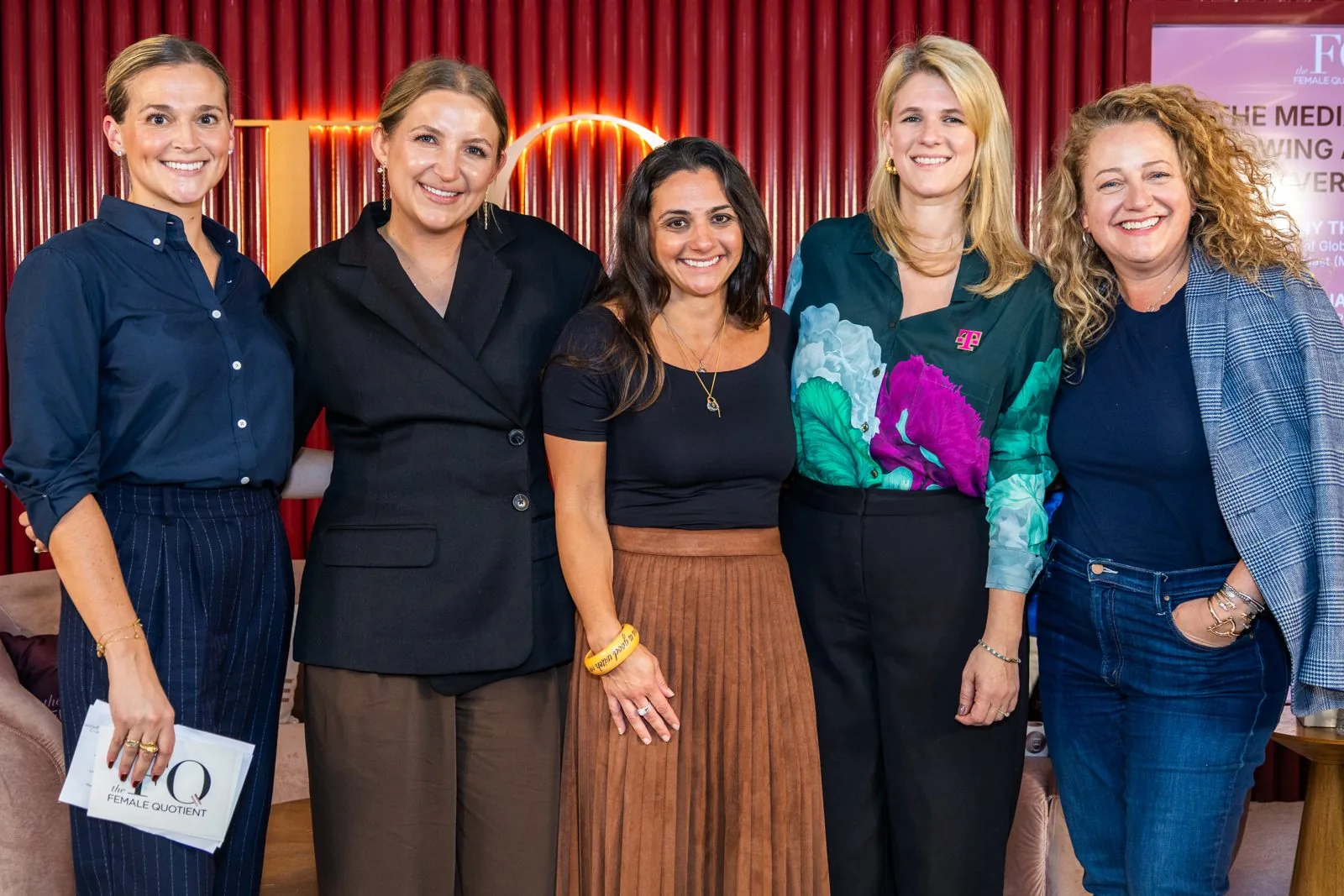
Nicolina Duhs, Head of Retail Partnerships at Rokt, discussed how brands reach audiences whose attention is spreading across more platforms. She was joined by Lauren Gabriele, VP, Enterprise Business Development at TripleLift; Leslie Lee, VP of T-Mobile Advertising Solutions; and Jacs Wyatt, MD, Global Advertising at American Airlines. Brittany Thompson, VP, Head of Global Enterprise Innovation at Condé Nast, moderated.
Brittany set up the session with one line. "Attention isn't disappearing, it's dispersing." Leslie said fragmentation is an insights problem as much as a reach problem. She urged brands to make their creative as flexible as their media plans and to know when to use their "indoor voice." Lauren said consumers don't think in channels. She sees agentic tools helping teams move budget and adapt creative as fast as people's interests shift. Jacs said every campaign needs a clear objective. She warned that when a premium brand buys media only because it's cheap, people can feel it. Her advice on new ideas was "fail fast, fail cheap."
Nicolina said ad fatigue is real, and brands do best when people are already engaged, such as right after a purchase. The creative has to fit the moment. A new streaming show might lead with imagery, while a credit card offer needs clear reasons to choose it. A small, well-timed gift adds something people remember.
Context is pretty much everything. Know who you're targeting, and then show up in a way that makes sense for your specific brand.
Nicolina Duhs, Head of Retail Partnerships, Rokt
Explore Nicolina's conversation: The Media Shift
This transcript has been edited for length and clarity.
Brittany Thompson (Condé Nast): I think we can all agree that there is a common narrative out there that consumer attention is shrinking. However, I'd argue the opposite. Attention isn't disappearing, it's dispersing. People are spending time across more platforms, formats, and experiences than ever. For brands and media companies, that means our old playbook just isn't cutting it anymore. The challenge now is showing up in the right place with the right message wherever audiences are. So today, we're going to discuss how media strategy is evolving, where smart investment is going, and what premium really means today. I'm joined by an amazing panel, and I'll have them all introduce themselves before we get started.
Nicolina Duhs (Rokt): Hi, I'm Nicolina Duhs. I've been at Rokt for two years, heading up retail partnerships. If you're not familiar with Rokt, we allow brands to advertise in the transaction moment. I know you've heard from a lot of Rokt people today, but we help you promote your brands and your services when people are checking out on premium sites.
Lauren Gabriele (TripleLift): I'm Lauren Gabriele. I'm the VP of Enterprise Business Development for TripleLift, so I head up all of our supply partnerships and cross-platform partnerships. TripleLift is an SSP that focuses on creative and cross-platform connection.
Leslie Lee (T-Mobile): Hi, I'm Leslie Lee. I'm VP of T-Mobile Advertising Solutions, which includes our omnichannel DSP, our out-of-home programmatic technology, and T-Mobile's owned media inventory properties.
Jacs Wyatt (American Airlines): And I'm Jacs Wyatt, and I have the luckiest job in the world. I'm MD of Global Advertising for American Airlines.
Brittany Thompson (Condé Nast): What a crew. All right, let's start with the big picture. With media consumption spreading across more channels than ever, how does that change the way each of you thinks about building a modern media strategy? Nicolina, we'll start with you.
Nicolina Duhs (Rokt): I think ad fatigue is very real. Today I was scrolling through Instagram and went through a number of ads. Walking down the streets of New York, we saw so much out-of-home that I didn't even look at. So I think it's a real problem that attention is scarce. How do brands show up when it really matters, when customers are engaged?
I think that's what makes Rokt so special. These brands are showing up right when a customer has just made a purchase. Maybe they bought an airline ticket, hopefully from American Airlines, of course. Maybe they bought a new phone, or a dress for their best friend's wedding. They're in this joyful moment, they have their credit card out, and that's when brands really thrive, because the customer is engaged, willing to interact with that ad, and ultimately convert on the site.
Brittany Thompson (Condé Nast): How about you, Lauren?
Lauren Gabriele (TripleLift): We talk about cross-channel, but when you're buying ads, or when you're the consumer yourself, you're not thinking in terms of a channel or a platform. We're living our lives, following these very circuitous choose-your-own-adventures, and part of the job is being able to follow the audience through that entire path. So for us at TripleLift, and for me as a consumer, a lot of this is thinking not about the channel, but about how you attract that audience. How do you make sure you're capturing that attention so you actually have impact at the end of the day?
Leslie Lee (T-Mobile): I think through a similar lens. We talk about fragmentation as a reach problem, but it's also really an insights problem. If you're only getting data about behavior from one platform, one app, one publisher, or one part of the ecosystem, you're only getting a platform-by-platform definition of your audience. So more than ever, it's important to have insight that spans everything your consumer is doing, because they don't live their life in terms of a channel. They're not one person on a social platform and a different person when they're walking down the street. Having insights that stretch across all of that allows you to be smarter when you're stitching together the media plan to reach them through all those different environments.
Jacs Wyatt (American Airlines): For me, we're all talking about these really cool digital things and out-of-home. I love shiny objects, and I love to chase shiny objects, but one of the challenges we have as marketers is that everybody thinks they're a marketer. So as we talk about all of these great things and how you approach the marketplace, now more than ever we have to focus on what makes things successful, and that's having a clear objective. Even if you do all of these incredible things, if you don't have a clear objective with your agency and your business units, it all unravels pretty quickly. We're all here to drive revenue. Now more than ever, before you kick off any campaign, make sure everybody is clear on what success looks like.
Brittany Thompson (Condé Nast): That leads me perfectly into my next question for you. Knowing that people are just living their lives, consuming content and transacting in all these different places, and being very clear about your objectives, how do you decide where to invest to reach that audience across streaming, general media, commerce, or any emerging channel? What's the thought process at American Airlines?
Jacs Wyatt (American Airlines): I don't want to speak for the whole team, because they're all here, so I'm a little nervous to answer, because they're going to say, "That's not what we do." For me, again, it's being very clear on your objective. I can't say that enough. Do not start a project unless you know what your objective is.
And to your point about premium, as we were talking about earlier, let's not be cheap. The team knows I hate cost-per as a primary KPI. I'm sorry. We are a premium airline, and if I want to say that we're a premium airline and I only buy media because it's cheap, people feel that. Of course we have to watch our costs. The CFO is in here, so hopefully he didn't hear me say that. But be smart, and be thoughtful about whether your brand would show up there, not just your campaign. That's one of the things you have to think through.
And I think everybody's having this problem, and you said it so well before: we're all so complex. The team knows we're trying to move away from business versus leisure. How many of you traveled here for business? And how many of you are also doing leisure? Something tells me you did both. So if I have a campaign for business versus leisure, you as a human being getting on a plane are like, "What am I today?" That's a really exciting challenge for our team. It means looking at our first-party data and the signals that drive somebody to book a flight, and approaching it in a whole new way, as long as we're clear on that objective.
Brittany Thompson (Condé Nast): Sorry, I'm jumping in here, but I think that ties into the fact that context really matters. You can follow this audience all around, and that's part of the equation we're trying to solve. But if at the end of the day you're hitting the person in the wrong context, the message is spent. Nicolina, how do you think about balancing context and quality at Rokt?
Nicolina Duhs (Rokt): I think context is pretty much everything. Rokt fundamentally works on the first-party data signals we get from our publishers. From a retailer to a food delivery service, they're integrating a number of data attributes so we can determine what to show each customer. And from a marketer's perspective, they want to know who they're targeting as well. You don't want to show a streaming ad to someone who already subscribes. So identity is huge. Know who you're targeting, and then show up in a way that makes sense for your specific brand, to your point.
Brittany Thompson (Condé Nast): Leslie, what are your thoughts on that?
Leslie Lee (T-Mobile): With context, you need a lot of signals to truly understand the environment where your ad is showing up and who you're reaching, but also what their headspace and receptivity might be in that moment. And sometimes brands forget to think about how that translates to the message itself. There are environments where maybe you can be shouting, and others where you really need to use your indoor voice. So be aware of the trade-off. Are you interrupting that person from doing the thing they came there to do? Then your media needs to offer some kind of value or entertainment. Whereas if you're integrated into an environment more seamlessly, maybe you can claim a little more brand space.
It takes a lot of different signals to understand how a message will be received by an audience in a given media format or point in time. So you need that richness in the way you look at both the media you're buying and the people receiving it, rather than taking one slice and saying, "I'm reaching a business traveler in a business moment at 9 a.m." It's probably more complex than that, and that should show up in your creative and messaging as well as the media plan.
Lauren Gabriele (TripleLift): Sorry, I actually use this example all the time, and it dovetails with that. My children will be watching Hot Wheels on whatever ad-supported service they're watching that day, and occasionally an ad will pop up and they'll get really upset that there's an ad. But they get even more upset if the ad has nothing to do with them. My children, being my children, will start screaming, "Mom, the ad's not relevant!" Of course, that's my language coming out of my six- and ten-year-old's mouths. But they understand that it's not relevant to them. So now you're wasting ad dollars and you're not hitting home. Yes, you followed what you think is the person with intent, but you've missed the mark, because a Progressive ad doesn't match the context of Hot Wheels.
Jacs Wyatt (American Airlines): Would they be interested in a role at American Airlines? They could be your best marketers.
Brittany Thompson (Condé Nast): Speaking of things converging, media is becoming very multifaceted and has to reflect everyone's day-to-day life, which isn't linear. There's a lot of duality to that. Commerce and media are becoming increasingly connected. We're seeing this at Condé Nast in particular. These two worlds are starting to collide, and it matters that they live harmoniously together. We're very excited about it at Condé; it's one of our larger initiatives at the moment. Nicolina, what excites you most about the growth of commerce and retail media, and how marketers can make the most of it?
Nicolina Duhs (Rokt): I think it's in the name. We used to call it retail media, and now we're calling it commerce media. It used to be retailers, where CPG brands came to spend their marketing dollars, and now it's expanding into so many different industries. From airlines to rideshare to grocery, they're all building out retail media teams. At Rokt, we've seen this quite a bit, across all of these different industries. So from a marketer's perspective, I think it's untapped inventory. You're able to show up more than ever in a spot that's highly engaging, where the customer is willing to click, explore more about your site, and buy. It's a really unique point in time, where there's more inventory to really get your brand out there.
Brittany Thompson (Condé Nast): And while we're talking about context, I think context matters in that space as well, because there's so much competition and everyone wants that "buy now, ship it to my house" moment. So context and storytelling in marketing are becoming more important than ever. Lauren, the next generation of media will give marketers entirely new ways to reach and understand audiences. What shift in media consumption or advertising are you most excited about, and where do you see the greatest opportunity?
Lauren Gabriele (TripleLift): When you look at how we're following people across all these different platforms and channels, a lot of it is going to come down to how fast we can move. A consumer's attention is fleeting, and we know their tastes are going to evolve very quickly, often faster than the ad budget can shift or the creative can change. Not to use the buzzword, but agentic is certainly going to play a part in how you reallocate budget and repurpose creative, so you can take a standard display creative and hopefully transform it into a podcast. Now you're able to go cross-platform and cross-device, and at the same time shift that budget really quickly. So it's about being really flexible, and understanding that at the end of the day, you have to design things for impact as opposed to just creating something static.
Brittany Thompson (Condé Nast): Jacs, how do you think about creating things for impact at American Airlines?
Jacs Wyatt (American Airlines): I love this. You mentioned AI. It only took ten minutes. Nice job. It's super exciting, but I think what's so powerful about what we do is that we bring people together. That's what American Airlines does. You take a flight, you're here today. Maybe it's for something with your family or friends, or you're going to watch, I don't know, the Cincinnati Bengals win the Super Bowl someday. These are all dreams that humans have. So how do we show that story digitally? To be honest, I don't think we've figured it out yet. AI can help in so many ways with building that creative story, but my challenge is: how do you share that moment in a fifteen-second ad? What are the other ways we can play with it and surround-sound it?
A good example is that we're looking at some podcasters who fly American Airlines. Imagine them talking about their experience flying with us. We recently sponsored sports talk radio in Dallas. We have all of these sponsorships in Dallas, and you have all these hosts flying to all these games. And you know what they do? They talk: "Well, I got on my American Airlines flight, and I love this." That's another way we market and tell that story. So, long answer to say I don't think we've figured it out yet, but what we do know is that we have to find ways to talk to people where they're at and have them prefer us.
Brittany Thompson (Condé Nast): I think that's one of the biggest challenges, honestly. I don't think anyone has really figured it out, because we're trying to reach consumers exactly where they are. But where I am and where you are are very different places, and ideally we want a similar outcome. So how do you match the right message, format, and creative to the context in which someone encounters it? Nicolina, we'll start with you.
Nicolina Duhs (Rokt): Within Rokt's ecosystem, it happens in a number of ways. Creative is really important, and to your point, more than ever, storytelling is really important, and getting it right matters. Experimentation is huge, and I think we all need to be doing a bit more of it to prove out success. Within Rokt, one example is our streamers. Maybe they have a new show coming out. Maybe it's about showing creative for when that's coming out, or making it more image-forward than a traditional text ad. For our credit card advertisers, you need to be more prescriptive about why this credit card is better than the next, so maybe it's bullet lines of text that make it super clear to the customer why they should choose that card.
Maybe it's as simple as adding that first name, that personalization. We all talk about it, and we see it in the real world. When we go into coffee shops and they remember our name, we feel so loved and cared for. How do we bring that into the digital ecosystem? "Hi, Nicolina, here's a gift for you. Here's a meal kit on us." That goes a long way. Joy and delight in a world of chaos, in a world of AI, is very telling, and it connects you back to the brand really easily.
Brittany Thompson (Condé Nast): Leslie, what about you?
Leslie Lee (T-Mobile): Dynamic creative certainly helps a lot at a technical level, making it much more possible to be segmented and nuanced with your creative. It's somewhat shocking how many advertisers invest so much in understanding and segmenting their audience, and then serve the same ads to everybody. So lean in on making sure your creative strategy is just as dynamic as the media plan. Dynamic creative itself is becoming much more sophisticated and available, even in physical media, just as it is in digital. There's so much more opportunity now to use all those insights about the context, the mindset, the audience, and the environment, and make sure they actually show up in the ad itself. That sounds obvious, but it's often overlooked in favor of a grand, overarching, compelling storyline. Sometimes it's more about tweaking your message to meet the exact moment it's going to show up in.
Brittany Thompson (Condé Nast): Nuance definitely matters, I would say. What about you, Lauren?
Lauren Gabriele (TripleLift): I think that's part of the real challenge. You're looking for the sweet spot in the Venn diagram. You're trying to find the context, the person's mindset, the audience, and the creative all at the same time, and finding that exact nexus point is the challenge. When you're thinking about your audience and their mindset, Jacs, you said it really well: if you have somebody traveling for business, are they always going to be thinking about business? Are they always going to be thinking about leisure? No. You have to be able to identify exactly what the context around them is. That's really where we're looking to find people cross-platform, and the ability to follow your audience from one device to the next becomes really important.
Brittany Thompson (Condé Nast): Jacs, do you have any thoughts on that?
Jacs Wyatt (American Airlines): Right time, right message, right context. And don't be afraid to fail. We're marketers. We're going to screw up, so give it a shot. To your point, all of it: dynamic, all of that. A phrase I was very lucky to learn early in my career is "Fail fast, fail cheap." That's where you want to go cheap: trying something, having a hypothesis, and seeing if it works.
Brittany Thompson (Condé Nast): I think testing, learning, and iterating quickly is critically important, especially as all these emerging ways of working, buying, and advertising become more and more prevalent. It's key to all of our success. So, one last thing before we wrap: what is one word each of you would use to describe the future of media? It can be funny if you want it to be.
Nicolina Duhs (Rokt): Thrilling.
Lauren Gabriele (TripleLift): I think chaotic would be the word of the day.
Leslie Lee (T-Mobile): That would be my word too. Complicated.
Jacs Wyatt (American Airlines): How do you say this in one word? Help me, team. Full of opportunities.
Brittany Thompson (Condé Nast): Opportunistic?
Jacs Wyatt (American Airlines): Perfect. Love it. English wasn't my strong suit in school, if you were wondering.
Brittany Thompson (Condé Nast): And yet you ended up in marketing. Go figure.
Jacs Wyatt (American Airlines): I'm in marketing because I have DCO to help with the words.
Brittany Thompson (Condé Nast): Well, I think one takeaway from today is that attention isn't going anywhere, it's just moving, and the brands that win will follow it with the right message at the right moment. Thank you all so much for your time and your thought leadership.
What this means for your next plan
Earn trust in small interactions as well as big campaigns. Show up where discovery starts, in communities, creator content, and AI answers, long before anyone types a search. When your customer is ready to buy, show them something relevant or show them nothing.
Thank you to Shelley Zalis and The Female Quotient team for hosting, and to every panelist and moderator for a day of honest, useful conversation.