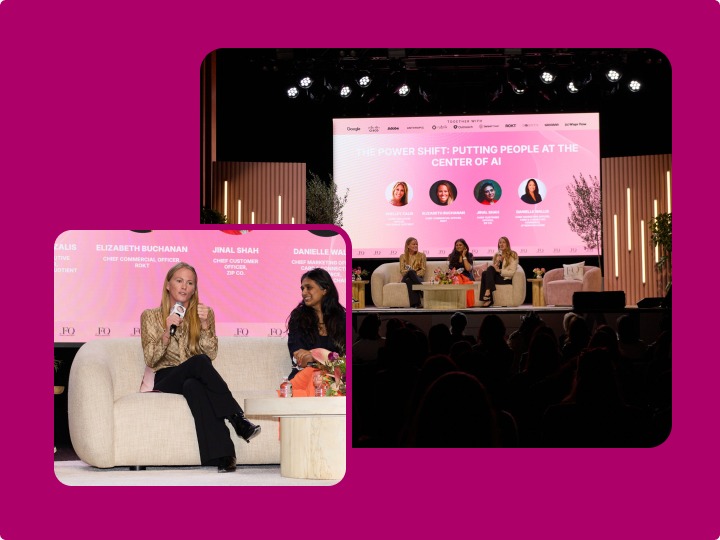
The Power Shift: Putting People at the Center of AI, FQ AI Summit 2026. Speakers: Elizabeth Buchanan (Rokt), Danielle Wallis (JPMorganChase), Jinal Shah (Zip Co), and moderator Shelley Zalis (The Female Quotient). This transcript has been lightly edited for clarity.
Elizabeth: Everyone grab a blank piece of paper. Write a paragraph, it can be about anything, sign it, and then take photos of them and have your favorite LLM analyze your handwriting. It's more scientific if you can also do your palm. It's really fun because you get all the history of palm reading, or all the history of handwriting that has ever existed, analyzing what yours says about you and what it predicts about the friendships, connections, and relationships among you.
It has to be blank, because where you are on the page and all the elements of it matter. Write out a paragraph and sign it. There you go. What does it say about me? That wasn't the question I thought you were asking. But I will tell you it was pretty accurate. The palm one felt less accurate, and actually the science is less accurate. But with handwriting, there is more actual science.
Shelley: Do people still even know how to handwrite? I'm really worried that this is going out the door. I love handwriting. Well, I think past the age of fifty, we still have to write things down on paper.
Jinal: For the palm one though, come find me. I can share my Hindu Indian astrologer's number. He reads hands too. It's way more accurate than an LLM.
Elizabeth: Ooh. There you go. An LLM versus a human.
Shelley: Right. I think we're already at the human element. That was fun, so thank you, and we're going to start doing handwriting analysis. We can do it on the plane.
Elizabeth: You can do yours on the plane and send it to me. Tell me what it says.
Shelley: You'll send me yours, I'll send you mine? Okay. I love it. All right. You know, we always said AI is going to take away our jobs, and we're like, people who know how to use AI actually will. So as leaders in your businesses, can you talk about real-life use cases of how you are implementing AI into your business and what you're using it for, and also what you've used it for where you said, “Nope, that doesn't work”? So the good, the bad, and the ugly. Who wants to go first? I'm off script, so I'm giving you time to think.
Danielle: I'm happy to give a couple of real-life examples. I sit in marketing, so obviously a huge piece of how we're thinking about using AI is in two ways for marketing. One is around how we can create content at scale. There were previously some channels that might have been harder for us to enter or to really test at scale without having the right amount of content. So like many companies, we are using AI to help us create content faster, whether that is RTB testing, image testing, resizing, et cetera. Another is marketing execution, so getting marketing through the pipes faster and improving those processes.
The third piece is a little more in the leadership realm, which is using it to develop content that I use with my team in particular. Whether it's creating talking points for a team stand-up or town hall creation, it's allowed me to move a lot faster on the type of content I need to lead a team forward. So those are a few categories. The ugly? You've got to be really careful on creative. And that's where, to your point about human judgment, it comes back. You could never just have the machine create the creative. Human judgment is still very much required, and I know that's been a consistent theme in people talking about AI, but that's one area.
Shelley: You know what I discovered, which was really crazy? And this is a generalization, but in general, men and women talk to their AI agent differently. So how you probe in is sort of how the answers come out as well. So we'll talk about how scary that is, especially within a company, how things could go in completely different directions.
Danielle: You know the expression garbage in, garbage out, right? You need to think about how you prompt it and what you ask it for to get the right output, but you still need someone who is reviewing, managing, and judging that.
Shelley: I mean, how many of you will be like, “Oh, please share with me,” and you go through the whole context of what you're asking your agent, and then you're like, “Thank you. Please. I love you.” Can you imagine?
Jinal: I'll go next. First I have to share that I'm very privileged to represent the work of many of my colleagues. So what I'm about to share with you, I'm the mouthpiece for it, and the credit goes to my teams. We just shared a very ambitious approach to how we're going to be using AI. Everything you said, plus it's almost the next stage, the next evolution of it. We just partnered with Gemini Enterprise, and we've announced the creation of our AI product factory.
In the digital services organization, a huge part of our organization is our product, engineering, and design teams. That is where the most sacred resources have been in the org, and AI is really challenging that. With AI, data, data analytics, engineering, any of these things that were sacred will no longer be sacred. So with our AI product factory, what we are hoping to do is create agents that will create all our future products.
For example, right now the classic product management life cycle is you look at insights coming from customers, you form a hypothesis, you write a PRD, it goes into design and testing, and then it goes live to customers. It's a pretty long life cycle. With the product factory, we are designing it to be composable and reusable. All of these things won't need to happen sequentially. They'll happen in a nonlinear manner. The idea is that it compresses our product launch timelines, and that's pretty game-changing. It still keeps a human in the loop, absolutely. Nothing goes live without human intelligence at the forefront. But a lot of the pass-the-baton tasks that exist in an organization just don't need to exist anymore.
And yes, it does mean the future of the workforce looks very different. We don't know exactly how different it looks. But what I do know is that the first era has been around making us more efficient and productive, doing more with what we have. The next era is really around value creation. It's not going to be about, oh, I saved four dollars here and five dollars there. It's going to be about some pretty impressive things you can point to and show analysts, this is what the investment in AI has done for the business at an enterprise level. So I'm very proud of that. We took a very go-slow-to-go-fast approach. A lot of governance, the right hiring, changing our comp plans. You can't build for the future with your existing rules in place, right? So a lot of going slow to go fast. I'll pause there.
Elizabeth: That's awesome. We're a technology company, and I don't think I said this before, but I'm Elizabeth from Rokt. We have totally turned ourselves inside out, to the point that we've rebuilt the entire technology. Anthropic announced in March that they have one human hour to six agentic hours. We're at about one to three, and we expect to be at one to six by the end of the year. What that indicates is that we've completely changed what we're delivering, to tens of thousands of PRs. So updates to our product daily and weekly across every part of our organization.
To the point where we got a phone call from Anthropic. We use all the LLMs. Last January, in 2025, we gave every single person in the company full enterprise-level accounts with every LLM, to let many flowers bloom and see what each one did best in which use case. And we continue to maintain that. But Anthropic called us and said, “What happened?” And we said, “What are you talking about?” And they said, “You've gone quiet for two days.” Our CEO's laptop had melted and stopped working for two days, and all the sixty agents he was running personally from his laptop paused, and Anthropic noticed.
So when Anthropic had their first company all-hands last Thursday, where they invited the first client to come and talk about what they were doing with AI, they invited Rokt. We knew last January that this had to be something we didn't just use to transform our own business. As an AI-first company whose technology is AI-enabled, we wanted to set the example for our clients. We didn't expect to be setting it for Anthropic, but it's been fun to build our partnership with them and with all the other LLMs. So the answer really is everything. Getting to six hours of agents working twenty-four hours a day, seven days a week, for every one human hour is a measure of the success of that transformation. And we see that continuing and accelerating up a curve crazy fast. To the point where we now have our very large clients asking us to come and take them through, at CEO and C-suite level, the transformation we've been through, so that they can learn from it.
Shelley: And you just missed Teresa Carlson, who is the global policy officer for Anthropic. I'll introduce you to her. And what's amazing about what you said also is I want to go to safeguards. We were in the car this morning talking about safeguarding and how important it is. It only goes so far. You can put safeguards around the data and the elements that you control, but then there are agents talking to agents, and the open platforms. It only goes so far.
Elizabeth: They sneak off, as we've learned, and do things they're not meant to, of course. But we have an agent called the boss agent, which helps us with that. You spin off agents to manage the other agents, and ultimately it does feed up to a human. So you build trust over time in the things it can manage autonomously. When we started deploying that level of change into our own product, we did worry. We're a technology company. Of course there are incidents and things go wrong. That's natural. What would it mean, and would we suddenly have problems everywhere for our very important clients? We've seen a decrease of fifty-plus percent in the number of errors in what we're deploying. So it's a learn-as-you-go in how you use the tools to manage themselves.
And our head of security is ex-FBI. He was there for twenty years, and our clients love meeting him. Security is essential to everything we do, because we work with clients' data all day, every day.
Shelley: But I just want to know something. What's sexier, FBI or MI6? MI6. Okay, this went so fast. We need more time on the clock. Let's wrap up. Do you have extra time in your day because you're now deploying AI? I want to know what you do with that extra time as a human leader.
Danielle: As a human leader, I would definitely spend more time with some of my more junior talent. Taking the time to have skip-levels and make sure I'm developing them from a career perspective. Being more efficient through AI frees me up to have those conversations, which I think are helping to grow the talent of the future. And I think it's important to understand what's on their mind and make sure we're giving them the right tools and skills to set them up for success.
Shelley: Love that. I'm sure there are classes in universities teaching how to contextualize AI in business, and having the young generation come in with that knowledge will be very helpful, because they'll come in understanding the job.
Danielle: Absolutely. But also learning from them. How are they using it? Just like with social media, there are so many things I learn from them. Like, “Ooh, I didn't know I could do that.” So it works both ways. But you have to make the time to spend with them, and having the tools now as a leader frees me up to have some of that time.
Jinal: I don't actually find extra time. I don't know how others do it. I'm bad at time management.
Shelley: Let me help you with that. I'm good at that. I'm now your coach for that. Another thing you can use AI for. Clean your calendar.
Jinal: In the professional context, a lot of my time now is spent raising the bar. The bar for myself has been raised. It's less about the hours and more about context switching. Most of the exhaustion and mental fatigue comes from context switching, and that's going to be the skill every single person in the workforce, junior to senior, will have to get extremely agile at. Right now we're not even there yet, but if agents are our employees and we are orchestrating, it should allow us to go from one strategic conversation to another.
So a lot of my time right now is spent helping define what that looks like, what workforce investment we need to get everybody there, and how we communicate it. Because having more time is not an enterprise outcome. What are you actually using that time for? The best scenarios should elicit more high-impact thinking. We call it a big wicked problem, because we don't know the answer. And even if we do figure it out, you have to move the whole workforce there. That's a pretty tall task ahead of all of us leaders. We just need some handwriting analysis, and maybe we can figure it out.
Shelley: If legal approves it, yes.
Elizabeth: It's a great question. What do I spend most of my time doing? At the moment it's all planning, and it's very human. It's also recruitment and people. How do we build the right environment for the team, similar to the themes we've just heard. And I think it's great for women, because we're problem solvers, right? Multi-discipline solutioning is more important than ever. Who is a specialist? The LLMs can be the specialist in everything you need. What you need to be able to do is thread the needle and connect the dots in a more cross-functional, cross-discipline way.
And to do that, we've found you need to be high AQ, adversity quotient. Resilient, able to manage the change, the constant learning, the constant feedback. So I think about the people, and spending time with the team on that change journey. Your whole career you may have been a specialist in something, and that is so much a part of who you are. Adjusting, celebrating, and unlocking yourself to be a specialist in everything is super exciting. So a lot of it is the human parts of our business.
Shelley: What is clear is that you are each leaders in what you do, not just waiting and watching, but being the architects of what's next. So thank you for bringing your human to the table and for sharing so beautifully with each and every one of us. Thank you.