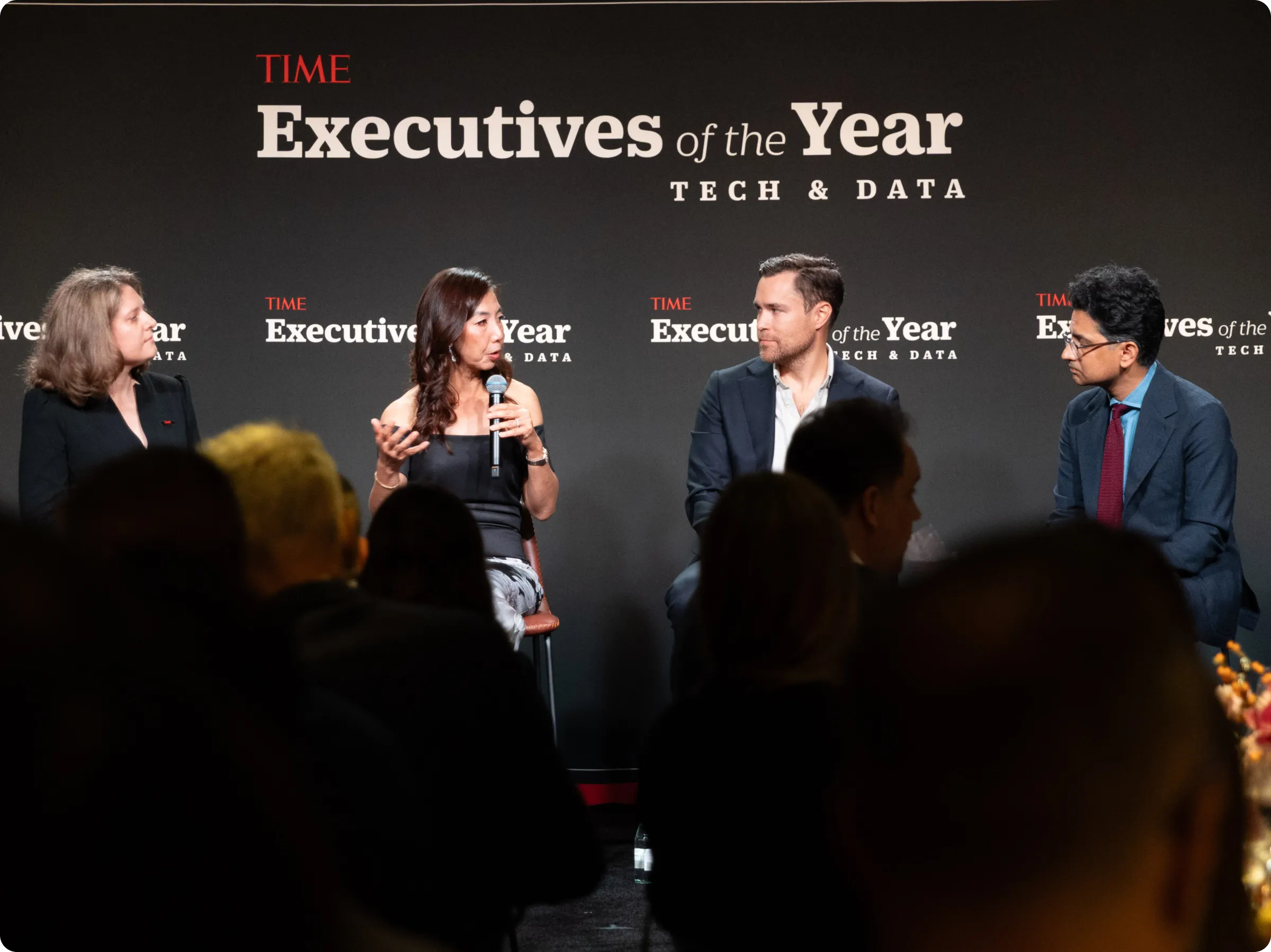
The Organization of the Future: Building the Modern Enterprise. TIME Executives of the Year: Tech & Data Impact Dinner. This transcript has been lightly edited for clarity.
Nikhil Kumar, TIMEThank you everyone, and thank you to all of you for doing this. I wanted to start off with something that Sam flagged earlier, which is that everybody in this room, everybody on this stage is making very important and critical decisions about how we use technology. And nowadays when we say technology, we're basically invariably talking about AI. It seems to me that there is a tension there, right? Because on the one hand you've got this amazing new technology that is doing extraordinary things, and there's a pressure, I suppose, on business executives like yourself to invest and make sure that you are ahead of the curve. And yet at the same time, it's not clear to me what the curve is, right? So how do you make that decision? Fiona, if I could start with you.
Fiona Tan, WayfairI thought you said you were starting with Fran, so surprise. Keep me on your feet. You know, I think there were certain things and I think most of us have leveraged sort of the previous generation of AI for some time. So I think it helped in terms of looking for the good opportunities for this new, you know, new flavor of AI. And I think a lot of it's also, you know, I think in the past you try something and you could stick with it for some time. Right now you have to be quite nimble and you gotta try again. If it doesn't work, you know, you might need to come back in a couple months and it might be actually working. So, you know, I think that's been one of those things where also, being open and looking at more opportunities and also being okay with just saying, you know, maybe you're flying too close to where the frontier models are at, but they're not quite there yet. And you know, for example, like in our case, you know, we're trying to do visualization for rooms and, the models don't do that well with dimensions and spatial accuracy. And so, you know, there's one of the things that you also have to say, "Hey look, not ready yet. Let's keep moving and come back and check again later." So that's, that's how I've been approaching it, a lot of experimentation.
Fran Bell, The Home DepotBeing really grounded in the customer experience and what the users really need and want, and deeply understanding that and building towards that consistently. I think a big portion of this is also really defining interfaces, and this might be technology interfaces, it might be user interfaces, so human plus technology, and it is also human-human interfaces, so operating models as well. And so I think, as Fiona said, really having a launch and learn mentality and constantly seeing what is the art of the possible, but always being grounded in the consumer experience first.
Nikhil Kumar, TIMESo before I go to Sam, could you explain what that means in practice, being grounded? Do you, do you ask your customers as you're applying this technology, around your stores, for instance?
Fran Bell, The Home DepotSo I think I'm a huge proponent of falling in love with the problem. So this basically means going and seeing for myself. I work in the stores myself. I see the user experience. We also work a lot with user experience. We now consolidated the user experience organization. We hired a vice president of user experience, really elevated human-AI interactions and engagements. I think that's really important, and also leveraging super users. So early adopters, folks that we show everything from a wire frame to a working software very early on the process, and iteratively as well, and gauging very quickly, if we're on the right path.
Nikhil Kumar, TIMESo Sam, at Rokt you use AI to, as you put it, improve the customer experience. You use data for a lot of personalization. Can you talk to us a little bit about, how important it is for you when you're doing that, balancing the application of the tech with, again, the user experience? Because online, it seems even harder to me, because they've got customers in their stores. How are you sort of engaging in that feedback?
Sam Dozor, RoktAbsolutely, yeah. Well, first off, I question the premise. I think the time is here. You know, I would say a year ago maybe, with the Opus 4.7 models... Pre those models, we weren't quite there yet. But, as, you know, at Rokt what Bruce and I have been sort of espousing these last two years is that, you know, the time is now, and, like, help us be a part of it. I think obviously being rooted in the customer is number one, right? A lot of people get obsessed with these sort of leading metrics of AI, like the code velocity or the number of things we can try, or, you know, number of products we can ship. But the lagging metrics of success have not necessarily changed, right? Are the experiences that the customer's having actually positive? Are our partners who we work with, are they getting a positive experience? None of those lagging metrics have changed. But what's great is that we just now have more things we can try in order to move those.
Nikhil Kumar, TIMESo they haven't changed. Could they change? I mean, as this technology becomes more and more part of sort of the lifeblood of business.
Sam Dozor, RoktI think, yeah. I think the user experience is changing, right? Yeah. The ultimate lagging metrics of a successful business haven't necessarily changed, right? But as you think about what the customer experience should be, you know, will they even be on a website anymore? Or will they just be in Claude or in some terminal or whoever they are, you know? Is it an agent talking to an agent? So that is all fundamentally changing. And I think something that's really important and really exciting now is our client-facing teams and people who speak to customers day in and day out or clients day in and day out, they are now more able to sort of prototype and think about what those customer experiences should be than they've ever been before. And so bringing those folks closer and closer to the actual building, I think is sort of unlocking a new ability to sort of explore that art of the possible.
Nikhil Kumar, TIMESo Fiona, first of all, do you agree with what Sam just said, the time is now? The time is now in terms of leveraging data and having the capabilities.
Fiona Tan, WayfairI think, yeah, it's, it is very exciting. If you think about, you know, we're, we're in various forms of retail and e-commerce, right? I mean, we've had our shoppers essentially with a search bar and filters for the last 20 years, and now we really have an opportunity to enable much richer experiences. A lot of it's just around, like, how can we help our customers find what they're looking for in ways that are different than what we've... We were really handcuffed before. And now we can do much more, you know, much more than what we've been able to. And so how do we lean into that? And I think, yeah, absolutely the time is now. You've got these models that are not just conversational, they are multimodal. And you know, for a category like ours at Wayfair, where a lot of times people don't know what they're looking for, they can't describe it. And so perhaps you, I'll show you a picture. Maybe that will resonate, right? So, and I think the other thing too is that for the longest time, shoppers have had to look at sort of like our ontology and sort of morphed how they would ask us for things based on that. And I think their expectations are changing, and that's the part around, you know, as their expectations change, I think we have to also innovate and provide them an experience that speaks more to them. So yeah, I think it's exciting times. We have a lot more tools and a lot more help that we can leverage, so you know, it's certainly very exciting.
Nikhil Kumar, TIMEJust on that, I had once, and this is confession time, a very traumatic experience trying to order a chair from a different retailer. And it was traumatic because I was trying to get a particular color. And this is pre-AI, this is like a few years ago. And it was the early days of those pop-up bots that sort of, you know, jump in your face and aren't helpful, or at least weren't helpful then. And it just wouldn't work, right? And then I tried to get on the phone with a human being, and I couldn't. And the net result was that I went elsewhere. How do you, like, how do you ensure that doesn't happen for customers who are coming to you? And I'll come to you in a second, but like, how does that, how are you measuring that, and how are you making sure that you're leaning into this? And I totally see why, but there's a bit of leaning in too far sometimes maybe?
Fiona Tan, WayfairNo, I think again, I think based on what you're saying, Fran, too, I completely agree, is if you are grounded on helping make that customer experience better, then I think it helps you kind of validate the work that you're doing. So for example, in your case with the chair and the color, et cetera, right? A lot of what we do on the sort of foundational side is really deep understanding of the products. So of all the chairs that are and all the attributes about chairs and color and texture and material, et cetera, et cetera. Understanding it really well is foundational for us, and we can do that a lot better now with the models and the understanding of, you know, essentially imagery as well as text, right? So that's all, like, very foundational, and then the experiences on the site will hopefully bring that to light in different ways than it was before. So it should be a lot more seamless for you to be able to find what you're looking for. And then, like I said, too, sometimes it's like you know you want some kind of chair, but you don't know what style it is. I mean, you know, I work for a furniture company, so I should know. But, you know, it's still, there's so many styles you can't really say it. You might be able to describe it. You might be able to show a picture. And I think those are the things that we can now do that we, like I said, we couldn't do before.
Nikhil Kumar, TIMESo Fran, again, the same question, but along with that, we've talked a bit about the front-facing customer experience. I want to understand a bit about the back end, and how this has, I imagine, made supply chains, which for companies such as yours are insanely complex and international, how that's helped you navigate that. And I, and I wonder particularly how it might help you at times of stress. I'm thinking, of course, of things like COVID, when supply chains around the world suffered immense stress. So how are you applying the technology there? But before that, like, do you agree with Sam, who I've now made the prophet of this panel, of leaning in?
Fran Bell, The Home DepotDefinitely in terms of leaning in, at Home Depot, we have multiple different consumer experiences and customer experiences that we provide. We have, for example, Magic Apron. This is our AI-powered home improvement expert that you have at any time in your pocket, online, on the app, and now also recently in stores. We recently rolled out to 2,000 US stores as well. And this is a fully multimodal experience. You might want to, as a do-it-yourselfer, get some inspiration. You want to get confidence about your home improvement project. If you are a pro customer, so a professional contractor, your needs will look different, and it comes back to your question, you know, how do you build consumer experiences that are really tailored to the individual and that just work, and solve real-world problems, for individuals? So our pro customers are looking for specificity. They're looking for time efficiency. They really want to have that quote as quickly as possible so they can win the job, and, confidently as well. And so when we think about the consumer experiences that we build, again, we start with the customer lens first. We fall in love with the problem. We start with the human-centered design aspect, and then we build on that. And to come back to your question on measurement, we not only measure engagement high level, but really looking at the frictionless or friction fullness of the journey and how can we reduce this, metrics such as on time and complete, right? We obviously have express delivery now, which is quite exciting, within two hours, of thousands of our various different products that we offer on site. And obviously speed is a big component of this, but also the quality of the delivery as well.
Nikhil Kumar, TIMEAnd at the back end? Like how is it helping you out with supply chains and so on internationally?
Fran Bell, The Home DepotAbsolutely. So a big part of Home Depot is merchandising. Product authority is extremely important to our company, and we have hundreds of merchants, making decisions, dozens of decisions on a weekly basis. And so building AI capabilities that support our merchants, so they can continue to think extremely strategically, build deep supplier relationships, curate phenomenal products, that is one area that we're very heavily leaning into and seeing phenomenal results.
Nikhil Kumar, TIMESo Sam, everyone seems to agree with you, which is great. I was wondering, when people now come to you, when clients come to you, what are the questions you're getting in this moment about the application of AI?
Sam Dozor, RoktA lot of it is about organizational change. How do you support people through just such a change in how the world works and what their role is and where they belong? You know, so many people, you know, at all different walks of life, they have their identity tied up with what they do in their day-to-day. And so a lot of it is all about, how do you set up an organization for success?
Nikhil Kumar, TIMEAnd so what is your answer? You're playing therapist here.
Sam Dozor, RoktYeah. Well, if I had the perfect answer, I would, you know, maybe I'd write a book on it. But, you know, what we've done at Rokt is, first of all, just try to be as transparent as possible, right? Sort of that radically candid perspective of look, this is a crazy world. Times are changing quickly. We could either live in the now, or we could live in the past, or we could live in, like, six months from now, right? And we've chosen to live six months from now and say the technology, maybe even if it's not quite there yet, let's say it's there. And what that has involved is redesigning people's roles. So as an example, about two years ago, you know, Rokt had something like, 12, 15 different career ladders. So there's different trajectories that people would sort of measure themselves against and think about, you know, what's the next step for me? And we now, within the span of, like, a month, we went from that number down to four. And so take, like, a typical engineering team, right? You might have a three in a box of a product designer and a product manager and a team of engineers, right? Now we just have builders, right? So everybody has that same expectation. And it's amazing to see engineers, you know, lean into building product specs and designers writing code. Obviously everybody has their own interest areas, but just to get back to your question, so much of it is being so that, like, rah-rah person and being excited about where the world is going, and supporting people getting there, and being honest when people just are not making it there, you know? Which has been a hard part.
Nikhil Kumar, TIMESo Fiona, I imagine you are, and I'm sure Fran you are, doing a version of this as well with your organizations. I'm wondering how this applies to when you're hiring new people. How are you factoring AI into that? Is it proficiency? Is it eagerness? Like, what is it? Because again, to go back to where we started, the technology is evolving at such a rapid pace.
Fiona Tan, WayfairYeah, I think for sure looking at adaptability, and, you know, a lot of it's systems thinking. And so sometimes it's, it can come in from different domains, but I think that core ability to have systems thinking and agility, adaptability and being comfortable with that, I think is something that's super important. I think we're also leaning into hiring new grads, right? I think we... You know, it's funny, there's probably two schools of thought on that one. So I, you know, I lean in the kind of wanting to make sure that we are able to, you know, build up the next generation of builders. And, you know, if you think about the kids that are coming out of school, you know, they've spent the last few years cheating on their homework. So they're very good at using the capability, right? My son's over there. He never cheated on his homework. But yeah, I mean, so there's a different way of thinking. And I think the other thing that's really neat is they come in without any boundaries. You talked about the 14 roles, right? They didn't come in thinking, "Okay, I'm supposed to be only a software engineer." They go in like, "Well, I can, you know, I can ask my agents to write code and develop specs and look at the UI as well." So, you know, that's the other thing I, you know, I feel like that's a really good balance in the organization to have folks that are very senior and have a lot of domain expertise that are learning the new craft, as well as, you know, kids that have kind of grown up with the craft and are thrown into sort of into the domain. And I think that is a nice mixture, I would say. But adaptability. The other thing is also, I mean, I think there's also a need for us to be empathetic. 'Cause, you know, for a lot of us that have grown up, as software engineers, for example, right, your whole identity was around, you know, architecture and coding and being really proud of being able to do that, and we're now asking most of our folks to not code, right? We're saying, "You're gonna have agents do your coding. You're gonna be thinking more." And it is a good thing, but it's still also very hard. So I think as leaders, I think just having that empathy around how big of a change it is, but at the same time, kind of saying, "We do need to adapt. We do need to change."
Nikhil Kumar, TIMESo Fran, I wonder what your message is in an organization such as yours, because you've got real world stores, right? Alongside, of course, a digital presence and everything else that we talked about. Are you seeing different levels of anxiety, and are you then approaching this and offering solutions that are tailored different depending on whom you're talking to within your organization? Like, I'm particularly thinking about that split between the real world Home Depot and the people working there, and involved in that, and then people on the digital side.
Fran Bell, The Home DepotI'm a huge believer of human AI teams and, really supercharging the expertise and ingenuity of humans through artificial intelligence. And as we all know, AI still has a jagged frontier. It can be quite exceptionally good at some things, and then in other parts, even common sense reasoning sometimes falls short. So therefore, I think in order to have the largest impact, the fastest, is to really pair humans with artificial intelligence and really have that very deep expertise, the curiosity that you mentioned, the strategic thinking, the human judgment, the empathy that I think is really important, and bring both of these together. I think that's really where the magic happens.
Nikhil Kumar, TIMEThat's a very nice combination and a very nice note to end on. So thank you all very much, and thank you. Thank you.