Marcus Johnson: When a consumer reaches checkout, they're no longer browsing, they're buying. It's a moment of peak intent, attention, and engagement. That's where Rokt comes in. Rokt helps brands reach customers at the moment that matters most, delivering relevant offers and content that feel like a natural part of the transaction experience, not an interruption. Learn more at rokt.com.
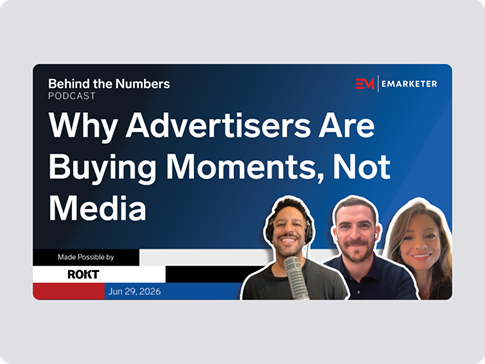
Marcus Johnson: Hey, gang. It's Monday, June 29th. Cal, Sky, and listeners, welcome to Behind the Numbers, an eMarketer podcast made possible by Rokt. I'm Marcus, and joining me for today's conversation we have two folks. Principal Retail Analyst — she lives in Austin, we call her Sky Canaves. Welcome to the show.
Sky Canaves: Hey, Marcus.
Marcus Johnson: Hello there. Also joined by special guest, SVP Strategic Key Accounts at Rokt, living in New York — it's Cal Donnelly.
Callum Donnelly: Great to be here. Thanks for having me.
Marcus Johnson: Absolute pleasure. Anytime we have a special guest on, we start, of course, with a speed intro. Cal, what do you do in a sentence?
Callum Donnelly: I lead our strategic key account experiences vertical, which includes all of our major ticketing, travel, and entertainment clients at Rokt.
Marcus Johnson: Very nice. Second question — what's your Mount Rushmore of movies?
Callum Donnelly: It's gotta be Ocean's 11, Snatch, Pulp Fiction, and The Dark Knight.
Marcus Johnson: Cal, pick one. What's the top one?
Callum Donnelly: I started watching Snatch with my dad when I was like 15, 16, and we've watched that a million times together.
Marcus Johnson: Such a good rewatch. All right, Sky, best of luck.
Sky Canaves: My pick is going to be a little more quirky. I'm going to go with Amadeus, then I've got my Chinese films — Raise the Red Lantern and In the Mood for Love. And I'm going to wrap it up with WALL-E. That one would probably get my top pick because I've watched it so many times with my daughter.
Marcus Johnson: I can't watch it more than once. That should be a horror film. It's terrifying.
Sky Canaves: The message is terrifying. But very true also.
Marcus Johnson: Painfully true. Anyway, today's real topic — why the advertisers winning on performance are buying moments, not media.
Marcus Johnson: Cal, one of the words that kept coming up when we were talking before the episode was intent. What does intent mean to you?
Callum Donnelly: From a Rokt perspective, we're all about driving intent. That's essentially how our commercial model and our business works. As customers are checking out at our high-intent, peak moment where they're focused on what they're purchasing, we're all about trying to show the most relevant next best action for those customers. What we're here to do is drive intent for our advertisers, intent for our partners, but most importantly, make sure that the intent for the consumer is there. How do we show up in the right way? How do we show up in a way that's not going to add additional psychological decisions for the consumer?
Marcus Johnson: How has consumer intent changed across the year, seasonally?
Callum Donnelly: We're a three-sided network. We have ecommerce publishers and partners that we optimize and monetize their traffic, advertisers and brands which bid to show up on those ecommerce sites, and then we have the customer. Everything that we start and stop and think about is the customer and their intent, because their engagement and conversion is what drives our entire flywheel. Over the last nine or ten years, we've added more and more supply across a wide variety of verticals — it started in travel and ticketing, then retail, and now we're in essentially every major industry. Seasonality-wise, each industry has different peaks and troughs, but our network doesn't see huge seasonal swings because we're live in all those industries with such penetration.
Sky Canaves: Retail intent has shifted a lot over the past few years, particularly since the pandemic. Promotional calendars and sales events are shifting and continue to shift. We just had a June Prime Day, really early, that's now twice as long as it was a couple of years ago. And where we see it most is in the holiday season — November, December. This year we're forecasting that for the second year in a row, holiday season sales growth will be lower than the average for the full year. There's a broad deceleration, which points to shifts in consumer intent to other parts of the year.
Callum Donnelly: If you think about the start of the year, Fanatics is a perfect example of a retailer with seasonal trends as the NBA finals and Super Bowl happen. But if you'd said at the start of the year that Fanatics would have their largest ever day with 8,000 orders per minute after the Knicks won — that came out of a cultural moment, not a seasonal trend. If you're a brand that's capable and flexible and willing to take some risks, you can really show up in a way that matters.
Sky Canaves: Flexibility is key because there are cultural moments you can plan for, but certain things can take off within them. We know the NBA championship is coming, it's got its dates, but the Knicks win — the big team from the big city, more than 50 years since they won — it becomes a huge cultural event that resonates across the country.
Marcus Johnson: You said, Cal, that "summer, not Q4, is the peak intent window for a significant share of the consumer economy." What makes you say that?
Callum Donnelly: Historically there are some verticals obviously large in the summer space — live events, exhibitors and blockbusters. Since the pandemic, live events have had record after record year because of all the pent-up demand. Massive on-sales, whether it was Taylor Swift a few years ago or Bruno Mars just recently. Those moments typically happen in the summer and drive significant demand — not just from a ticket perspective, but from a brand perspective. You have consumers who are young, who have disposable income, showing up to multi-day events and spending a ton of money. And this year, for the first time since COVID, the movie industry will have the largest ticket sales since 2019. That space is becoming more experiential — consumers are creating an entire event around going to the movies, buying merchandise, making it a day out. That means a lot more consumer spending to capture.
Sky Canaves: When it comes to experiences, there are emotional commitments that exist both before and after the event. Things like going to the movies or a concert — prices have gone up, so they're more of an investment emotionally and financially. And then because of social media, people want to share and commemorate it. That's an opportunity for retail in the post-experience window too.
Callum Donnelly: You've got a different type of mindset when you have a cultural event that's once in a lifetime — waiting for the Knicks to win, a Taylor Swift concert. These people have spent their lifetime waiting for this type of event and are willing to spend considerable amounts of money to make sure they're there. They're willing to hear from brands, listen to brands, in a way that's completely different from a regular, utilitarian consumer getting an Uber or ordering groceries.
Marcus Johnson: You say Rokt believes one of the most valuable moments is the immediate seconds post-purchase. Why?
Callum Donnelly: Three critical reasons. Number one, it's incredibly rich in first-party data. When you're buying a ticket on Ticketmaster or a T-shirt on The Gap, you're not putting in a fake email address because you need that ticket delivered to your email and that shirt delivered to your home. So you're putting in all of your real first-party information. The ability for smart businesses that leverage ML and AI to build lookalike audiences and power the right next best action is incredibly powerful because of that data. Second, the consumer has just been through an incredibly long buying journey. Even something as simple as getting an Uber still requires you to focus — is my address right, is my pickup right? You're not multi-scrolling. You're really focused, so engagement is incredibly high post-checkout. Third, there's the buying mindset. Consumers are excited to buy things. It's one of the only places online where there's actual dopamine and a positive psychological experience. When you combine first-party data with the buying mindset and high engagement, you have a real opportunity to show up and offer something that feels like a gift post-checkout, not an interruption.
Callum Donnelly: The last thing you want to do is overburden the consumer with more decisions — what we call the paradox of choice. Showing up in the right way, in a native and frictionless environment, in a way that's actually going to be rewarding — that's the pivotal experience.
Sky Canaves: That's such a fascinating psychological angle. There's post-purchase momentum — it's not item bought, case closed. There's still an opening for offers and targeting that is highly relevant and personal. It has to feel easy, low friction, and very relevant to whatever mindset the shopper is already in. And it's different from retargeting that takes place later — it's that immediate moment you're trying to capture.
Callum Donnelly: Some of the new products we've built are things like Shopper Rewards — all about incentivizing that customer to come back to the ecommerce retailer site after they've purchased. We offer things like gift cards and loyalty points to not just get a consumer to engage with a brand's offer, but give them a reason to come back and purchase again on the publisher's side. We want consumers to have an action that's exciting and rewarding in that moment, but also incentivizes them to come back into the network.
Marcus Johnson: Before you explained it, I'm like, "This is madness." And then right after I'm like, "This is genius. How did I not see it?" What would you say to CMOs listening who want to apply this kind of thinking?
Callum Donnelly: From the publisher side, retail media has now shifted to commerce media. This opportunity to not just monetize your customer's experience, but optimize it — to make sure that the customer you've spent all this time and energy getting through the funnel is being treated with the utmost respect. The businesses optimizing that entire full funnel understand the consumer from the moment they enter the homepage all the way through to the end of that experience. Understanding who the customer is will be critical to keeping them in your network and getting them to come back to your site first rather than going to Google or an AI assistant.
Callum Donnelly: On the brand side, it's really hard to time cultural moments. We know the NBA finals is happening, but we didn't know it was going to be the Knicks winning in such dramatic fashion. You need to be flexible, willing to take some risk, and condense your planning cycles to be able to show up in those moments in a way that's actually going to be meaningful to the fan base. If you can continue to be flexible and risk-on in some of those moments, it can be a huge windfall for your organization.
Sky Canaves: I'm looking forward to the rest of the summer. There are a lot of big additional cultural moments — the World Cup, Taylor Swift's wedding, and Olivia Rodrigo just announced a festival later in the summer, which will draw so much attention from younger consumers who are still spending and looking for experiences and everything that goes along with them.
Marcus Johnson: An excellent note to end on. Thank you so much to Sky and Cal. Thank you to the production crew — Lawrence and Danny helping us out with this one. And thanks to everyone for listening to Behind the Numbers, the eMarketer podcast made possible by Rokt.



.png)