

.png)
Ad placements that appear during the checkout process serve two audiences with distinct payoffs. For ecommerce businesses, the benefits are incremental revenue from existing traffic, sharper relevance for customers, and a checkout experience that drives repeat purchase. For advertisers, the benefits are access to high-intent shoppers, more efficient customer acquisition, faster creative testing, and a channel that's less crowded than search or social. Both sides gain first-party measurement that ties ads to commerce outcomes.
Customers reach checkout with focused attention and fresh purchase signals. Gartner has formally recognized checkout and post-purchase monetization as a category that lets retailers "generate incremental revenue from high-intent moments without disrupting the shopping experience."
How advertising during checkout works
Advertising during checkout is a commerce media strategy: brands place relevant offers on the selection, cart, payment, or confirmation page using first-party transaction signals to match offer to moment. Order status pages and other post-transaction surfaces also qualify.
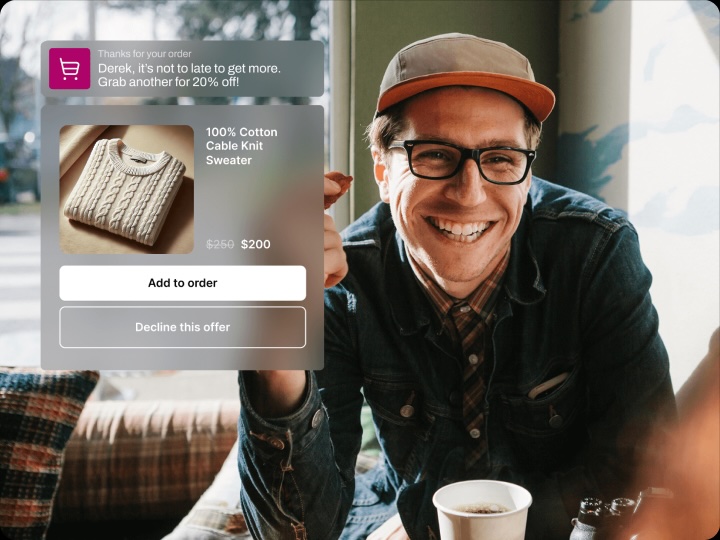
The mechanic is straightforward. The customer reaches a checkout-adjacent page. The advertising platform reads first-party transaction signals, such as basket value, category, timing, and loyalty status. It selects an offer that matches the moment. The customer accepts or declines. Outcomes are measured back to revenue, retention, or both.
This is different from generic display advertising. The customer has already shown intent through action. The business has fresh first-party signals. Measurement can run closer to the actual purchase. The ad can be tested, iterated, and optimized in days rather than quarters.
Why advertising during checkout matters now
Commerce media is the fastest-growing channel in digital advertising. IAB's 2025 Internet Advertising Revenue Report put commerce media at $63.4 billion in 2025, up 18% year over year and now a core performance channel powered by first-party data.
Gartner projects the broader retail and commerce media network market will reach $69 billion in 2026, a 17% increase over 2025, with networks expanding well beyond retail into financial services, travel and hospitality, and delivery platforms.
Boston Consulting Group expects commerce media to surpass $100 billion within five years and account for more than 25% of total digital media spending by 2026.
McKinsey frames the shift this way: commerce media has reached an inflection point where networks must compete on full-funnel measurement, omnichannel integration, and AI tooling, not just inventory.
Advertising during checkout sits inside that broader shift but solves a more specific problem: how to create value for both ecommerce businesses and advertisers at the moment customers are most engaged.
Benefit 1: Reach customers when intent is highest
For both audiences. Advertisers reach customers at peak decision-making; ecommerce businesses gain a more valuable inventory surface because customer attention is highest there.
Customers in the checkout window have already browsed, selected, paid, or confirmed. They’re deciding what to do next.
Independent consumer research confirms how different that audience is. A 2025 Harris Poll commissioned by Rokt found 79% of shoppers feel excited when a promotion is relevant to their interests, and 63% spend more with businesses that understand their preferences.
For advertisers, the implication is straightforward. The checkout window is one of the few moments where a customer is paying full attention, ready to act, and signalling exactly what they want.
Benefit 2: Create incremental revenue from existing traffic
For ecommerce businesses. Existing traffic becomes a new revenue stream without adding acquisition spend.
A payment, confirmation, or thank you page often has high attention but limited commercial use. When the space is managed well, it supports relevant third-party offers, loyalty actions, subscriptions, upgrades, or internal initiatives.
Incremental revenue at checkout improves unit economics without adding spend. Every transaction the business already has is an untapped revenue moment before the customer closes the tab.
Benefit 3: Improve customer experience through relevance
For ecommerce businesses. Relevance is the lever that protects customer experience while the page is being monetized.
Modern checkout ads act as a discovery tool, reducing choice paralysis by presenting a single, highly relevant offer based on real-time transaction data. A relevant offer helps a customer discover a useful service, save money, join a program, or add something connected to the moment. A weak offer adds friction.
Behavioral research backs this up. Sheena Iyengar and Mark Lepper's well-known choice-overload study found shoppers were ten times more likely to buy when shown 6 jam options than 24.
The same principle now drives marketing strategy. As Marc Allsop, head of EMEA at Rokt, told The Drum, modern shoppers operate in a "paradox of choice" where relevance is the only way to cut through.
A strong program shows the best offer, not every offer. In some moments, the best customer experience is no offer at all.
Benefit 4: Acquire customers with clearer economics
For advertisers. A performance channel where every paid engagement comes from a shopper who has already shown commercial intent.
Acquisition at checkout runs against demonstrated intent. The customer has already taken commercial action by the time the ad appears, so the channel works well for subscription, membership, financial services, travel, entertainment, retail, and app-based businesses.
The strongest acquisition programs measure beyond the click. They track conversion rate, CPA, retention, lifetime value, and incrementality. Cheap clicks from poor-fit customers are just delayed churn.
Benefit 5: Use first-party signals with stronger control
For both audiences. Ecommerce businesses keep control over how their data is used; advertisers reach customers through first-party transaction signals instead of broad audience assumptions.
The third-party-cookie phase-out left a gap in addressable audience targeting. Checkout placements close it from the other direction, by reading transaction context as it happens. McKinsey notes that commerce media networks are valued precisely because they link ad interactions to verified purchases.
Trust is the foundation. Advertising during checkout should give ecommerce businesses control over what appears, where it appears, and which data is used. Relevance and privacy work together, not against each other.
Benefit 6: Test offers and creative faster
For advertisers. A short feedback loop where creative and offer changes show up in days, not quarters.
Most A/B tests in marketing are slow because the conversion event sits far from the impression. At checkout, the impression and the conversion happen seconds apart, which collapses the feedback loop.
Teams test offer framing, creative copy, call-to-action language, audience segments, page placement, post-click landing experiences, bid strategy, and frequency rules. Small changes move large numbers. A clearer offer, a shorter landing path, or a more relevant audience rule can lift conversion without increasing spend.
Lucy Whitear, Performance Marketing Manager at Tails.com, summarized the discipline well: "Fail fast, learn faster. Our first multi-box offer didn't work, but we didn't give up. After refining our messaging, it became our best performer, boosting conversions by 153%."
Benefit 7: Connect ads to measurable outcomes
For both audiences. Ecommerce businesses measure revenue and customer-experience impact; advertisers measure acquisition economics.
Checkout ads allow for closed-loop attribution that ties every impression directly to a verified purchase or subscription. Gartner has been explicit on this point: as commerce media costs climb, advertisers expect networks to demonstrate customer growth, basket-size expansion, and impact on digital commerce metrics, not just media-side reporting.
Benefit 8: Extend commerce media beyond retail
For both audiences. The transaction mechanic works anywhere there's high-frequency commerce, including travel, financial services, ticketing, and delivery.
The mechanic doesn't depend on having a retail catalog. It depends on having a high-frequency transaction with customer attention attached to it. Gartner's 2026 Market Guide lists representative commerce media networks across finance (Afterpay, American Express, Chase, Klarna, Mastercard, PayPal, Visa) and travel, mobility, and delivery (DoorDash, Expedia, Grubhub, Instacart, Lyft, Marriott, Uber). The core mechanic is the transaction, not the retail shelf.
The five tests for advertising during checkout
The benefits only show up when the program is well designed. The following five tests describe the conditions a strong program needs to meet to deliver on each benefit. Use them as a buyer-side or builder-side rubric.
1. The relevance test: Does the offer match what the customer just did, or what they would plausibly value next? A relevant offer is timely, native, and informed by something real about the customer or the moment. Relevance doesn't require category match. An ad for a different category can be highly relevant when it's informed by a strong signal about the customer. That signal can come from the purchase category, the cart value, the timing, the customer's location, or a broader profile of who the customer is. The failure mode is a generic banner served without any matching signal. The signal to track is acceptance rate against decline rate at the placement level.
2. The restraint test: Is the ad load light enough that order details and confirmation come first? Strong programs show one clear next-best action, not a wall of offers. The failure mode is a confirmation page that buries shipping or order details under monetization, creating "transactional friction." The signal to track is page-level customer feedback and complaint rates alongside checkout completion and conversion rates. Monitoring for any "funnel leakage" ensures that monetization never comes at the expense of the primary transaction.
3. The measurement test: Can outcomes be tied to revenue, retention, and incrementality, not only clicks? The standard is closed-loop attribution and holdout-based incrementality, not click reporting alone. The failure mode is a program that reports CTR but cannot say whether acquired customers stayed or paid back. The signal to track is LTV-to-CAC and incremental revenue versus a holdout.
4. The control test: Does the ecommerce business control advertiser categories, creative standards, frequency rules, and placement design? A good program never trades long-term customer trust for short-term margin. The failure mode is loose category controls that allow off-brand or low-quality advertisers into a premium environment. The signal to track is the share of revenue from advertisers cleared through documented quality criteria.
5. The iteration test: Does the program get smarter with each transaction through testing and live optimization? Static placements decay. Strong programs run continuous experiments on offer, creative, audience, and post-click flow. The failure mode is the same offer running for months without testing. The signal to track is experiment velocity and the share of incremental conversion attributable to live optimization.
A program that passes all five tests can run at scale without eroding the customer experience. A program that fails any one of them tends to leak value somewhere.
Advertising during checkout vs. related terms
The terms overlap, but they are not interchangeable. Advertising during checkout describes the moment and placement. Commerce media describes the broader category. Retail media is one subset of commerce media.
What to avoid in advertising during checkout
The checkout window has high value because the customer is already engaged. That value disappears if the experience feels crowded, irrelevant, or disconnected from the transaction.
Programs fail when they treat checkout like a generic banner slot, show too many offers at once, prioritize margin before customer relevance, slow page speed, send customers to long or confusing landing pages, measure clicks without measuring downstream quality, or run without audience, offer, and placement controls.
A strong program is selective. It respects the transaction, matches the moment, and gives the customer a clear choice.
Proof points from Rokt Ads campaigns
Advertising during checkout performs best when relevance, offer quality, and measurement work together. Three Rokt Ads case studies show what that looks like across categories.
ClassPass used Rokt Ads to reach high-intent audiences at the Transaction Moment, then ran structured tests on landing page simplicity and checkout speed. The campaign drove a 12% lift in conversion rate while staying within CPA targets.
Simplifying our post-click experience delivered immediate gains. We saw higher conversion without increasing acquisition costs.
Stefano Ziller, Senior Director of Growth Marketing, ClassPass.
Tails.com used Rokt Ads to find qualified audiences at checkout and refine offer strategy through iterative testing. The program delivered a 153% uplift in customer conversion, a 3 percentage-point increase in retention from first to second box, and higher LTV-to-CAC ratios than other partners.
The way we decide where we invest is underpinned by metrics, insight, and making sure we're making data-led decisions on the most profitable channels over the long term. That's why Rokt is a great partner for us.
Elaine Wan, Head of Performance Marketing, Tails.com.
BJ's Wholesale Club used Rokt Ads to acquire digitally savvy younger members as it expanded into new markets. Member acquisition grew 300% year over year at a steady CPA, and acquired members averaged 10 years younger than the existing customer base, with a 90% renewal rate.
When someone has just completed a purchase, they're open and excited. It's a little dopamine rush. That energy translates into higher intent.
Dani Kelley, Director of Member Acquisition, BJ's Wholesale Club.
Across the broader Rokt Ads platform: 1.1B unique customers reached globally, an average click-through rate of 4.03%, and an average conversion rate of 6.32%.
The common thread across all three campaigns is that advertising during checkout delivers when it is treated as a relevance engine, not a media add-on.
FAQ
What are the benefits of advertising during checkout?
Advertising during checkout helps businesses reach high-intent customers, grow incremental revenue, improve customer relevance, use first-party transaction signals, measure outcomes more clearly, and test offers faster.
How does advertising during checkout work?
A customer reaches checkout or a post-transaction page. The advertising platform reads permissioned commerce signals to determine whether an offer is relevant. The customer sees a native offer, accepts or declines, and the advertiser measures downstream outcomes such as conversion, CPA, retention, or ROAS.
Is advertising during checkout the same as post-purchase advertising?
Not exactly. Post-purchase advertising usually refers to offers shown after payment, such as confirmation page ads or order tracking offers. Advertising during checkout is broader and can include cart, payment, thank you, confirmation, and other checkout-adjacent pages.
Who benefits from advertising during checkout?
Three audiences benefit. Ecommerce businesses turn existing checkout traffic into a new revenue stream while improving the customer experience. Advertisers reach high-intent customers with measurable acquisition economics. Customers discover useful offers that match the moment of their transaction.
Does advertising during checkout improve customer experience?
It can, when the offer is relevant, native, and easy to act on. The goal is to improve the transaction with a useful next step, not add clutter to the page.