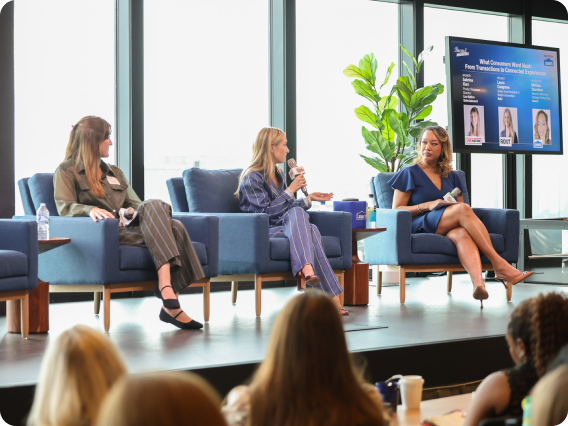


Ashley Firmstone, SVP of Rokt Ads, joined Marcus Johnson and Principal Analyst Nate Elliott on eMarketer's Behind the Numbers podcast to talk about ad fatigue, the psychology of purchase moments, and what marketers should actually be doing as agentic commerce enters the picture.
A few things from the conversation worth unpacking.
Irrelevance is the real problem, not volume
Marketers have been talking about ad fatigue for years, but the diagnosis often stops at "too many ads." Nate Elliott put it well on the show: you never hear consumers complain about ads that show them something they actually want. The frustration kicks in when the ad has nothing to do with them, or shows up at the wrong moment.
Ashley's framing cuts to the core of it. When content doesn't feel additive to what someone is doing, it registers as an interruption. Getting relevance right isn't a nice-to-have. For brands spending against performance goals, it's the difference between an ad that builds loyalty and one that erodes it.
The Transaction Moment is a different kind of attention
Rokt's thesis centers on the Transaction Moment, the point in a customer journey when someone moves from browsing to buying. Ashley describes a genuine psychological shift that happens in that window. Customers become focused, engaged, and receptive to offers that feel connected to what they're purchasing.
Nate put a personal example on it: he recently booked a trip to Berlin and has spent every spare moment since looking at luggage. The purchase created a need, and that need made him unusually receptive to relevant ads regardless of format. Rokt reaches 1.1 billion customers globally at exactly that moment, and the brands seeing results are the ones treating it as a distinct context, not just another placement.
AI has always been part of getting this right
Stitching together what a customer is purchasing, what they've purchased before, and which offer is most relevant to them in real time is not something humans can do at scale. Ashley noted that AI has been central to how Rokt operates for 13 years, long before it became an industry talking point. The speed and predictability of AI has improved, which means the quality of those real-time decisions keeps getting better.
Agentic commerce is coming, but brands still own the last mile
The conversation got interesting when it turned to AI agents and whether brands risk losing direct customer relationships as LLMs get more capable. Ashley and Nate landed in roughly the same place: for utility purchases, consumers will happily outsource the decision. For high-value or emotionally meaningful purchases, most people still want to be in the room.
Ashley pointed to Walmart's move with OpenAI and their agent Sparky as an example of a brand proactively building a strategy to maintain ownership of the customer journey. The marketers who should be paying attention are the ones who remember what happened when organic Facebook reach disappeared and brands realized they'd spent millions building an audience they didn't own.
The takeaway for performance marketers: invest in moments where you have real customer data, understand the LTV and incrementality of what you're acquiring, and don't trade direct customer relationships for short-term reach on AI platforms.
The full episode is worth your time. Listen to it here or watch below.
AI-Powered Relevance as the Antidote to Ad Fatigue
April 3, 2025 · Marcus Johnson, Nate Elliott, Ashley Firmstone
In today's economy, every single ad dollar counts. That's why performance marketers are turning to Rokt ads to reach 1.1 billion unique customers globally in the transaction moment when they're completing a purchase online. You only pay when customers engage. Learn more at rokt.com/emarketer. That's rokt.com/emarketer. Hey gang, it's Friday, April 3. Nate, Ashley, and listeners, welcome to Behind the Numbers, an EMARKETER podcast made possible by Rokt. I'm Marcus. Joining me for today's conversation. We have two people. One of them is our principal AI analyst living ... Who knows? But currently, he's in North Carolina near Asheville. It's Nate Elliot.
Hey, Marcus.
Hello, fella. I'm also joined by a special guest, the SVP of Rokt ads who lives in New York. It's Ashley Firmstone. Welcome to the show.
Hi, Marcus. Thanks for having me.
Hello. Of course, of course. Happy to have you. Anytime we have a special guest from outside the company, we start, of course, with the speed intro. So two questions for Ashley, one for Nate. We'll start with Ashley's. Ashley, what do you do in a sentence?
In a sentence. So SVP of Rokt ads. We help brands reach consumers as they're transacting online.
Very good. And favorite podcast to listen to at the moment, and why?
Yeah, my favorite podcast is Pivot. I'm a big Scott Galloway fan, so love to follow along. Obviously being in tech, they have all the latest trends, so it's a good one on my way to work in the morning.
Very nice. One of my favorites at the moment is ... I'm a bit shocked you didn't say Behind the Numbers, but that's fine. But one of my favorites is A Bit of Optimism by Simon Sinek. And he had Scott Galloway on his podcast, I know recently. I listened to the episode and I brought a piece of paper to take notes because there were so many good points. So I completely agree with this. I haven't listened to Pivot yet, but I will soon. Nate, how about you?
Behind the Numbers with Marcus Johnson.
Yes. Finally. Nate wins.
You were prepped for that.
What is it really, though? Because I know it's not.
Honestly, my favorite podcast isn't even a podcast. I listen to the podcast form of Pardon the Interruption, the ESPN show, where they talk about sports for half an hour. That's what I love to do on my commute most mornings.
Ashley, two nothing to Nate at the moment. There's still time to quote back. I do the same thing with First Things First. It's a TV show, but they have a podcast and so I listen to that as well. Anyway, today's real topic with these wonderful folks is AI-powered relevance as the antidote to ad fatigue. Okay, so, Ashley, as we were discussing what to discuss for this episode, we were talking a bit about consumers and them getting fed up seeing the same ads at the worst times. And we still haven't quite figured out how and when to deliver, it seems like, a non-disruptive experience. So we'll touch on that word I just mentioned, ad fatigue. What do you think is most responsible for consumers? I'll say current ad fatigue because this is not new.
Yeah, it's definitely not a new problem and it's funny that we are still working on solving it, but I think the big challenge is that consumers are over inundated with irrelevant content. And so when it doesn't feel additive to what someone is doing or it doesn't feel true to who that person is, it can be disruptive. And I think even think about your own experience as a customer. It's annoying when something doesn't actually match what you're expecting or what you want in those moments. And so advertisers take advantage of that, I think, and that causes a lot of the fatigue and disruption.
Yeah. Nate, relevance. Is that one of the main problems for you as well with this question?
I mean, it's one of the two big problems. So one is just the sheer volume of ads that people see. They're seeing more ads because they're spending more time with media and because each of those minutes with media now includes more ads than it ever has before. So I mean, more time with media, more ads per minute equals just a lot more advertising. But yeah, Ashley's spot on as well, that relevance is incredibly important. You don't hear people complain about ads that show them something they want to see or give them an offer on a product they're thinking of buying. You hear them complain when it has nothing to do with them when it's the wrong ad at the wrong point in time.
Correct.
Yeah. Speaking about the wrong point in time, advertisers trying to figure out when the right point in time is. And Ashley, you guys at Rokt think that one of the right times could be this, as you coined, transaction moment. Tell us about what that is, what that means to you, and why you think that might be the right time.
Yeah. We remain hyper-focused on that transaction moment, which is really when a customer goes from browsing online to what am I going to buy? What am I interested in buying? And they've actually added the item to their cart and they switch almost psychologically into a mode where they're highly engaged, they're focused on what they're purchasing, and they want things in those moments that feel additive to that purchase. And so Rokt focuses on that stream of events because it's a great time to be additive to the consumer, attach things to the cart that might feel relevant, sign them up for loyalty programs, select their best payment option that is right for them in that point in time. And it all feels, once you get it right, it feels intuitive to the customer. It doesn't feel like a disruptive ad trying to get you to buy more. It feels like it's a seamless consumer experience in that moment.
It's interesting because you would've thought that ... I mean, for me, conventional wisdom suggests if I've just bought something, I'm done. But to your point, you are hyper aware. You're hyper focused on buying stuff in that moment, so you do have this window where you can still capture people's attention. How did you come to this conclusion? How did the transaction moment materialize?
Yeah, it's an interesting backstory. I mean, the transaction moment has always been an important crux for e-commerce businesses. Our CEO, Bruce Buchanan, was the CEO of Jetstar Airlines. And when you think about the airline experience, how much you go through in that moment that you need baggage, upsells, you need the loyalty upgrade, you need the co-branded credit card of the airline, anything else that they want to sell you in that moment. But there wasn't really a strong technology to say, "Okay, well, what are the best things to serve to a consumer?" And how do we make sure that if they came through last time and they didn't opt into a seat upgrade, we're not serving that again, but we're doing something that feels more true to Marcus or true to Nate in that moment? And so when he found the technology for Rokt, that ended up not just being a challenge in the airline space, but it's a challenge that a lot of business's space, but the transaction moment is crucial because that's where you make a lot of the profit on the actual sales.
So airline tickets, very low profitability, same thing with entertainment tickets. So having those additive ancillary revenue sales is going to be what creates the margin on those businesses. And so adding to that or getting that right is really critical for an e-commerce business. Now we've seen as the industry's evolved and more retailers have moved to e-commerce that's become a bigger challenge for retailers. They need to make additive moments and additive dollars through that transaction flow. And so how do they do that without overwhelming the customer or getting that moment wrong?
What are some of the ad formats that feel additive to this part of the consumer journey?
I think it just needs to feel native. I think it looks different in every transaction flow. I mean, it's going to be very different when you're buying a sweater on Macy's versus taking an Uber and all of those moments need to feel true to whatever that customer is doing in that moment and what they are expecting. You're going to want something very different when you're doing each of those activities. And I think that that's something we look at, is what is the consumer behavior in that moment? What have we learned about this moment and the interactivity of a customer as they're going through that flow?
Marcus, I'm going to jump in and say I don't even know that I think the ad format is the most important thing at that point. I mean, it really is about relevance. And you said a minute ago, Marcus, I've just bought something. Why would I buy something else? But I think you're forgetting that lovely endorphin rush that comes when you book a flight to Europe or get tickets to a show or whatever it is. And Ashley, the flight example you mentioned, I mean, my wife and I just planned our summer trip and I've spent ...
Where are you going?
Well, we're going to Berlin, which is exciting.
Very nice.
There in a couple of years. And I've spent almost every moment since then looking for a new luggage because, hey, we're going to Berlin. I want some new luggage for that trip. Whatever the ad format is, this is an incredible moment for companies to put something in front of me that might meet my needs. And whether that's an email after the fact, whether it's something on a conversion page, whether it's a retargeted ad, I mean, there are a lot of ways you can do this. And as long as the product is relevant and meets the need that I've created with the purchase I just made, then it's going to make sense for me.
Yeah, it's such a great point, Nate. I mean, we think about that a lot and it's such a unique moment in the internet. I mean, when you think about shopping on Facebook or browsing or scrolling or there's a lot more going on that could cause stressors or things that seep into your mind or you're very passive. But in that transaction flow, you're locked in and then you have that endorphin rush of like, "I just purchased something or I'm about to purchase something that I've been waiting for." And so it becomes this different moment for a customer, where they're very receptive to receiving offers that feel additive.
Actually, how does AI fit in here? How has that helped or hindered things?
Yeah. AI has been a part of what we do for many year, for 13 years. So it's only been additive for us the speed at which AI has now been evolving in the recent years. So I would say everything that we do latches on to AI. How are we learning about the customer in that moment? How are we making decisions in real time? Humans just can't do what AI can do using the contextual relevancy of that customer and what they're purchasing, the data that we know about that consumer's past purchases. What is a brand looking to target in that moment? So who is a relevant new customer for Disney+? That's something that it's very difficult to stitch all that together in a real-time fashion and do that at scale. AI helps unlock that, so that's always been true for Rokt and I think what's interesting about where it's all evolving to is AI is just getting faster, smarter, more predictable.
And so that helps unlock a world of possibilities of where we can take this and how relevant it can be or curated it can be for each customer.
We're talking about the transaction moment, things happen before and after. Nate, how do you see AI agentic commerce influencing that kind of browsing experience up until the transaction moment and then any ways that can influence it after the fact that you ...
Yeah, I mean, it's a really interesting question because AI plays on both the positive and the negative side of this question from my perspective. Consumer's use of AI is going to only increase their ad fatigue right now. And everyone's talking about agentic commerce and these tools being able to buy things for you and you don't have to make the decision, you don't have to review the purchase. It can just buy things for you. Our forecast says that's going to be a pretty small percentage of what's happening. I mean, even before OpenAI decided to step back from their instant checkout, we said that maybe 5% of the AI-driven commerce sales in the US this year would happen on AI platforms or through AI platforms. The other 95% would happen when people left AI platforms to go to retailer sites and apps to make the conversion. I mean, there's a decent chance that goes down further now with OpenAI stepping back from instant checkout.
And that's just of the percentage of sales that AI influences, which itself is still a relatively small percentage of all commerce sales. So I don't know that agentic commerce is right around the corner as some folks think. We think the more likely use case for AI within shopping is people use it as part of their research journey. And right now it doesn't look like it's replacing other parts of that journey. It looks additive. So as we've seen consumers' use of AI absolutely go through the roof over the past couple of years, their use of other tools hasn't necessarily gone down. As many people go to Google every day right now as did a year ago, years ago, they're spending as much time, they're doing about as many searches. And so you've got all these new AI users spending all this time. A lot of them are looking for products and doing shopping and yet they're not stopping their search behavior.
They're not going to retailer sites and apps any less. It looks like AI actually creates more steps through the journey. And with OpenAI, just they're ready to go gangbusters on selling ads right now. As people add more steps and more time to their research, they're going to get hit with more and more ads. And that basic question that Ashley talked about earlier in the podcast about people just getting overwhelmed by advertising, I think it's actually going to get a little bit worse before our use of AI to make the ads more relevant makes it better, which goes back to the stuff that Ashley was just mentioning.
Yeah. So very interesting points, Nate, so thanks for sharing. I would agree. I think initially people were worried how quick the transaction was going to go into the LLMs and we're talking to a lot of our customers that are concerned. Are they going to lose the loyalty with the customer? I think that that's the biggest concern on marketers' minds and we stand by that we think that they'll still own that last mile. I think it's going to be a long time before consumers truly trust LLMs to make those purchases on their behalf. And I think that there's something around the customer, actually, we talked about that endorphin moment. You like going to the brand, you like seeing what else is available from a loyalty perspective with the brand. You like attaching yourself to that brand because you've decided to purchase with them.
So there's a little bit of that psychological piece that I think will also maintain in consumer behavior. And I think the transaction moment is only going to become more important for e-commerce sites and brands because the browsing behavior, yes, I believe that that's shifting and changing. And consumers are, while they're doing it in more places, yeah, it's going to be over and undated with options as far as how do you browse and decide what you want to buy. But I think that last step is going to still be in the control of the brands. I mean, even looking to see what Walmart just recently did with OpenAI and how they're now plugging in their AI agent Sparky into the OpenAI experience is interesting. And it's Walmart's play to still own that customer journey and that experience. And so I think we'll still see a lot of that come through and how that's going to evolve. I think is still unknown, but I think the transaction flow is still going to be part of that customer journey with the brands for a long time.
Yeah, it's interesting because curious as to what's going on here because if you'd said to people, "Hey, there's this AI thing that can help you shop and buy things. Do you want to use it?" You'd imagine that most people would say, "Yeah, that sounds perfect." But what they're doing is they're using it to look around and then they're going back to brand sites directly. What's going on there? Why are they? Is it just inertia? Is it that AI hasn't figured out shopping quite yet? Nate, what do you think is happening? Is it more a story of AI or is it more a story of brand websites?
I think it's a story of brand websites and consumer behavior. And you use the word inertia. I think it's more powerful than inertia. I think it's habit. This is a habit that people have developed over decades of going to certain websites and certain apps and doing their shopping. And even more than that, there's the meme. Marcus, you're going to ban me from talking about this at some point after I've mentioned it on 30 of your podcasts. I think I'm only on 20 right now, but the meme about I don't want AI to do my art and writing so I can spend more time doing laundry and dishes.
I want it to do my laundry and my dishes so I can spend more time doing art and writing. And there are parts of the shopping that we do as human beings that are more laundry and dishes. I don't want to know when the milk is running out or when the paper towels are running out. I would love a tool to figure that out and just order it for me, but so much of what we buy, including a lot of the higher value things that we buy, that's closer to the art and the writing. That's closer to the thing that people really enjoy. And I don't think they want AI to take over a lot of those purchase decisions and purchase journeys.
Yeah, I completely agree. I think we've seen a little bit of it happen already. People outsource some of the utility stuff, right? You can reorder your same grocery order online because, yeah, I buy the same things. I'm happy to outsource that. But Nate, you talked about the trip you booked with your wife, that's an experience in and of itself. We're going through, we're booking it together. Hopefully there's not bickering involved and you guys are aligned with where you're staying and everything, but it is a fun experience that you have. And so I think people will be remiss to let that go because it's actually somewhat enjoyable. I think the same thing when you purchase a concert ticket. If that's an artist you've been waiting to see, you better bet that I'm going to be online making sure that that ticket purchase goes through and that I got the seat that I want and I've got enough seats for my friends to go. So I think that there's some things that we just will not be willing to let go of for quite some time.
Yeah, these are great points. So folks listening to this at the moment, what would you tell them, Ashley? What can marketing folks do today?
Yeah, I think there definitely needs to be a strategy to think about agentic commerce and I think you have to have some ideas of how you as a brand are going to play into that, but also have a plan for how you're going to maintain loyalty, continue to drive value for your customers because that is what is going to keep them coming back. And I think if you're thinking about marketing, where am I going to serve my brand? I think you want to think about high intent moments where you have true customer data. You understand the longevity, the LTV, the incrementality of those customers. That's where you want to be investing your marketing dollars to still be acquiring customers on. Acquiring customers is going to be crucial because of that loyalty factor. So the more you bring in now, that's not something that goes away. It's going to become even more of a focus as browsing and discovery get infiltrated.
Nate, anything to add? Yeah.
Yeah, I'd say absolutely look for ways that you can use AI both as a platform, a channel to reach the customers who are looking for you and the things in your category that you might want to compete with, and also to find ways that AI can make the things you do as a marketer more efficient. I mean, the more you can find tools and partners who are leveraging AI to make decisions about what creative shows up in front of which person at what point in time, the more likely you are to be successful. But I'd also say as you do this, especially the first part of it, using AI platforms as a marketing channel, make sure that you're not giving up control of that customer relationship. And Ashley talked about this a little bit just now and a little bit earlier, but the loyalty, the relationship, the established relationship that these companies have with their customers is incredibly important.
And we've seen them go through versions of digital platforms that have asked marketers to seed control and in too many cases marketers have seeded control. And if you remember as a marketer, as a company, spending hundreds of thousands or millions of dollars building a Facebook fan list and then realizing later that you didn't own those fans, that you didn't own that relationship, that organic reach was dead and you had to pay money just to send marketing messages to the people you'd spent millions of dollars building a list of. I want to make sure that marketers don't get caught in a similar situation as they increasingly use LLMs and AI platforms as a channel to reach their audiences.
A good point to end on as any. Thank you guys so, so much for hanging out with me today. Thank you first to Nate.
Thanks so much.
Yes, indeed. And thank you, of course, to our special guest, Ashley.
Yes, thank you.
Thank you for being here. Thank you to the whole production crew. We've got Danny and Lance in the background helping us out with this one. Thanks to everyone for listening into Behind the Numbers podcast made possible by Rokt. We're back on Monday discussing the ruling that could unravel social media. Until then, happiest of weekends.
.jpg)
.png)