


%20(1).png)
What is the modern commerce stack?
The modern commerce stack refers to the full set of technologies that power how a business sells online, from attracting customers to helping them discover products, complete transactions, receive orders, and return to buy again. In its broadest sense, it includes every layer of a commerce operation: traffic acquisition, product discovery, cart and checkout infrastructure, payments, fulfillment, analytics, and post-purchase retention.
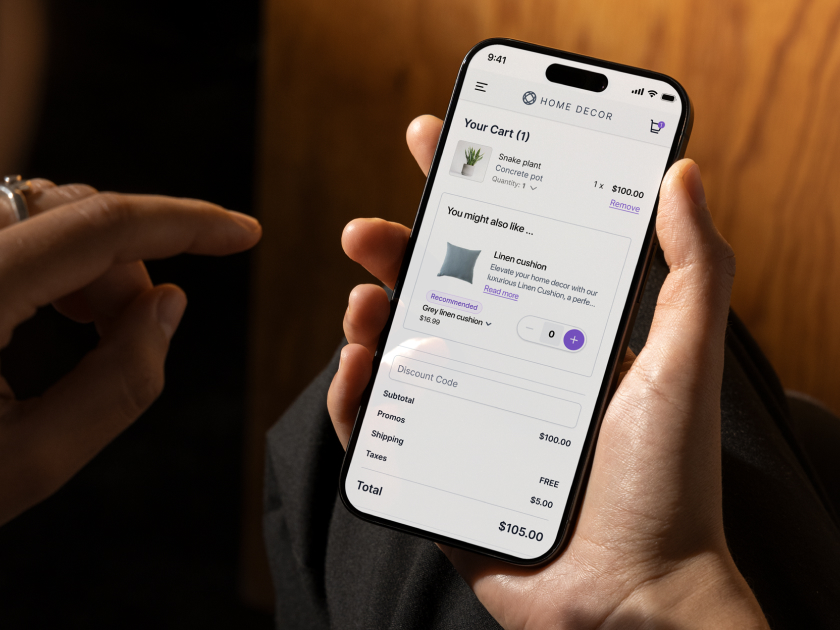
As commerce organizations mature, many foundational layers of the stack — catalog, checkout, payments, fulfillment, analytics, and lifecycle marketing — become less differentiated on their own. The next area of opportunity is increasingly inside the transaction itself: the window from product selection through confirmation, where purchase intent is high, behavioral signals are live, and the business still has an opportunity to influence order value, relevance, loyalty, and customer experience.
This is where an emerging layer of the modern commerce stack is taking shape. Rather than treating the transaction as a handoff between acquisition and retention, leading commerce businesses are building capabilities to act within the purchase flow itself. These capabilities combine real-time data capture, AI-powered decisioning, and in-purchase experience infrastructure to determine what, if anything, should be shown to each customer during the transaction.
The goal is not to add friction to checkout. It is to make relevant, low-latency decisions within the natural flow of the transaction, so each interaction feels native, useful, and measurable.
The result is a broader view of commerce infrastructure. Traditional commerce systems were built to bring customers to checkout and process orders efficiently. The modern commerce stack is increasingly built to optimize the purchase moment itself: the point where a customer has demonstrated high purchase intent and is actively completing a transaction. That point is what we call the Transaction Moment™: a high-intent stage in the customer journey where attention, intent, and live behavioral signals converge.
Why the Transaction Moment matters
Many mature commerce organizations have already invested heavily in acquisition, discovery, checkout, fulfillment, and retention. Yet one of the most under-optimized opportunities is the lack of real-time coordination between these systems. That gap is most visible during the Transaction Moment: the window across cart, payment, and confirmation, when purchase intent is high, attention is active, and live context can be used to shape a more relevant customer experience.
This window matters because the signals are different from those used elsewhere in the customer journey. Pre-purchase marketing often relies on historical profiles, predicted intent, or audience segments. Post-purchase marketing reacts after the transaction is complete. The Transaction Moment sits between these stages, when a customer is actively completing a purchase and the business can still use real-time context — such as cart contents, basket value, product category, session behavior, payment context, and customer status, where permitted — to determine what, if anything, should happen next.
The modern commerce stack creates value by coordinating data, decisioning, and experience within that moment. A real-time data layer captures what is happening now. A decisioning layer determines the next best action based on current context. An experience layer delivers the interaction inside the purchase flow without disrupting checkout. The goal is not simply to add more messages or monetize a single surface. It is to make the transaction flow more adaptive, from cart and review through payment and confirmation.
Relevance is the primary performance variable. For some customers, the right action may be an upsell, loyalty prompt, payment option, subscription offer, retail media placement, or post-purchase experience. For others, the right action may be no action at all. A modern stack must be able to make that decision in real time, with enough intelligence to protect the customer experience while increasing value per transaction.
This is why the Transaction Moment has become an important frontier for commerce leaders. Systems that can act across the purchase flow are better positioned than systems that rely only on static checkout rules, batch-processed data, or disconnected post-purchase campaigns. When data, decisioning, experience, and measurement operate as one system, each transaction becomes both a revenue opportunity and a measurable signal that can improve future relevance.
How the modern commerce stack works
High-performing commerce stacks combine three core capabilities:
- Real-time data — capturing and activating first-party signals as they happen
- Decisioning systems — determining the next best action using live session inputs
- In-purchase experiences — delivering relevant interactions within the transaction flow
The defining characteristic is low latency between data, decisioning, and experience. These capabilities increase value per transaction; they don't replace the transaction itself.
Why traditional commerce stacks fall short
In most mature commerce organizations the limitation is coordination between existing systems. Common constraints include:
- Data is processed after the transaction, limiting its impact on live decisions
- Decisioning relies on historical profiles rather than current session behavior
- Experiences are defined in advance through campaigns, not adapted in real time
- Revenue is concentrated in the initial purchase, with limited value captured post-selection
The result: relevant interactions arrive too late to influence the transaction.
The four layers of the modern commerce stack
1. Data layer (real-time signals): Captures transactional and behavioral data in real time and makes it immediately available for decisioning.
Common tools at this layer: Segment, Rokt mParticle, RudderStack, Snowflake, plus event-streaming and warehouse activation infrastructure.
2. Decisioning layer (real-time intelligence): Determines the next best action based on current session data and contextual signals.
Common tools at this layer: AWS SageMaker, Rokt, in-house ranking models, feature stores, Optimizely, Bloomreach, Algolia, Dynamic Yield, Adobe Target.
3. Experience layer (in-purchase interactions): Delivers relevant interactions directly within the purchase flow without disrupting the user experience.
Common tools at this layer: Rokt, Rebuy, Bold Commerce, Stripe Checkout
4. Value layer (measurement and outcomes): Measures the impact of each interaction on incremental revenue, average order value, and conversion.
Common tools at this layer: Amplitude, Looker, Northbeam, Triple Whale
For a commerce stack to perform effectively, these layers must operate as a coordinated system with minimal latency between them.
The architectural requirement: real-time coordination
To operate inside the Transaction Moment, a commerce stack needs needs low-latency coordination between data, decisioning, and experience. Session signals must be captured, evaluated, and translated into an appropriate customer experience within the natural pace of checkout. When that process is slow, the interaction feels like friction. When it is fast and relevant, it feels native to the transaction.
This is why modern commerce stacks increasingly rely on event-driven flows. Signals such as cart updates, payment context, customer status, and product selection can trigger decisions in real time, rather than being stored only for later analysis. For the most latency-sensitive surfaces, decisions may need to happen in milliseconds, with sub-100ms response times as a useful target.
The goal is not to add more infrastructure for its own sake. It is to make the purchase flow adaptive without making it feel heavier, slower, or less trustworthy.
How leading companies are evolving their commerce stacks
Leading commerce companies are moving from systems that optimize isolated stages of the customer journey to stacks that coordinate data, decisioning, experience, and measurement in real time.
This pattern appears across marketplaces, retail platforms, retail media networks, and mobility or delivery platforms. Each uses live behavioral and transaction signals to make commerce experiences more relevant in the moment, whether through recommendations, offers, checkout extensions, sponsored placements, pricing, routing, or fulfillment choices.
The common thread is the ability to turn live customer context into a relevant action within the flow of commerce. That is what separates a stack that simply processes transactions from one that learns from and creates more value within each transaction.
How to evaluate a modern commerce stack
To assess whether a commerce stack is optimized for the Transaction Moment:
- Can customer data be activated in real time during a transaction?
- Does decisioning use current session signals or historical profiles?
- Are experiences dynamically generated within the purchase flow?
- Can the stack orchestrate experiences across the entire Transaction Moment, from selection and cart/review to payment and confirmation, rather than optimizing only a single post-purchase placement?
- Is value measured per transaction or only at the point of conversion?
- Do data, decisioning, and experience systems operate as a unified system?
Gaps in real-time coordination and measurement are common. Most organizations have the components; few have the latency and integration required to use them together at the Transaction Moment.
FAQ: Modern commerce stack
What is the modern commerce stack?
The modern commerce stack is the full set of technologies that power how a business sells online, including acquisition, discovery, checkout, payments, fulfillment, analytics, and retention. Increasingly, modern stacks also include real-time data, decisioning, and in-purchase experience capabilities that help businesses create more value during the transaction itself.
What is the Transaction Moment in commerce?
The point in the customer journey between product selection and purchase confirmation when intent, attention, and live behavioral context are all present simultaneously.
How does the modern commerce stack differ from traditional ecommerce systems?
Traditional ecommerce systems optimize individual stages of the customer journey, often before or after the purchase. The modern commerce stack coordinates real-time data, decisioning, and embedded experiences across the full Transaction Moment, from selection and cart/review to payment and confirmation, to create more relevant interactions and more value per transaction.
What is real-time decisioning in commerce?
The process of determining the next best action using live data from the current customer session, rather than batch-processed historical profiles.
Why is real-time data important in ecommerce?
Real-time data enables systems to respond to current behavior. At the Transaction Moment, that responsiveness is the difference between a relevant interaction and a missed one.
How much incremental revenue can in-purchase optimization generate?
Impact varies by category, traffic volume, placement, relevance, latency, and measurement methodology. Mature teams should evaluate in-purchase optimization through holdouts, incrementality testing, and revenue-per-transaction reporting rather than relying on a universal benchmark.


%20(1).webp)
.png)