

The martech landscape is evolving, with a growing focus on agentic AI. While the vision of a future where artificial intelligence executes actions autonomously is compelling, the daily reality for many enterprise marketers still involves managing manual workarounds and technical friction. As the industry explores what AI might achieve in the future, there is a clear opportunity to address the immediate, concrete workflow challenges that often prevent data from driving measurable revenue today.
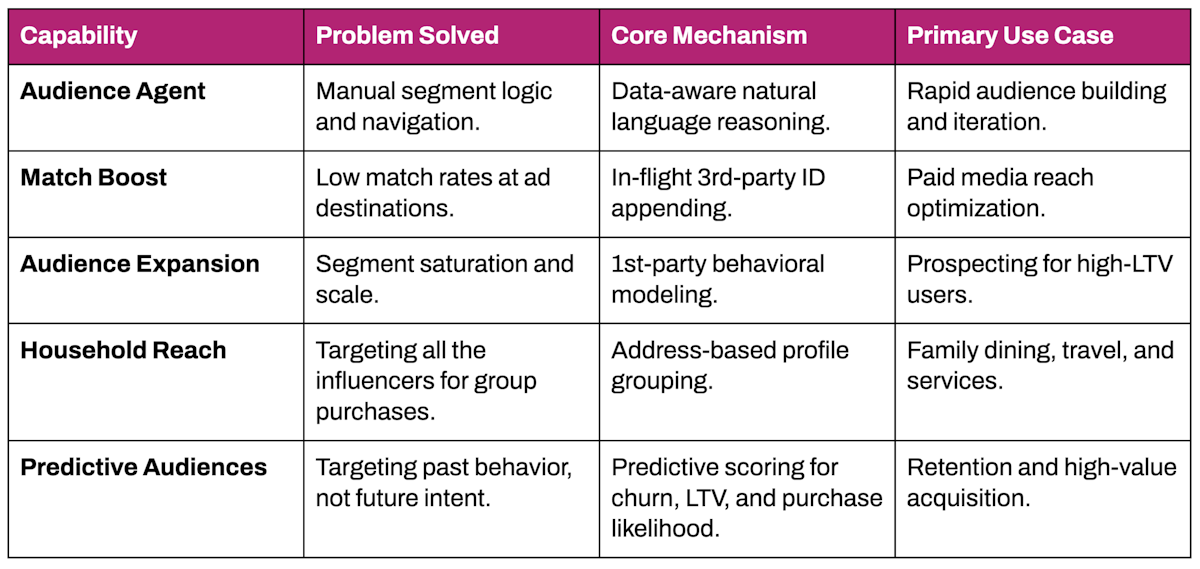
At Rokt mParticle, our focus for agentic features is to move beyond high-level abstraction and solve the specific identity, scale, and navigation hurdles that sit between a great strategy and an impactful campaign. With the launch of Audience Expansion, Household Reach, and our new Audience Agent—joined by our existing drivers like Match Boost and Predictive Audiences—we are providing a comprehensive suite of performance accelerators. These updates represent a shift in the marketer's experience: moving from a world of navigating complex data dictionaries and identifiers to one where the platform collaborates with you to drive measurable lift.
The invisible friction in enterprise marketing
Before exploring the new capabilities, we must be honest about the status quo. For years, enterprise marketers using even the most sophisticated Customer Data Platforms (CDPs), have faced a persistent set of "last-mile" failures. You build a perfect segment in your CDP, yet when it hits Meta or Google, the reach is a fraction of what you expected because identifiers didn't match. You find a high-performing pocket of users, but within weeks the pool saturates, leaving you with nowhere to grow. You target an individual for a household purchase, missing the other decision-makers entirely. Worst of all, you spend half your day navigating complex UIs just to translate a simple business goal into technical logic.
These are not creative failures; they are infrastructure failures. They all share a root cause: the intelligence that could fix them sits too far from the moment of execution.
The Performance Engine
The Performance Engine closes that distance: an Audience Agent that turns plain-language goals into live audiences, and a suite of Performance Accelerators that sharpen the mechanics of activation, right where campaigns lose performance.
Conversational intelligence: The Audience Agent
Perhaps the most significant leap forward is the Audience Agent. Unlike generic "prompt-to-code" tools, our agent understands which events actually exist in your data and which attributes are populated. When you say, "I want to target users who added to cart three times but haven't purchased in 30 days," the agent doesn't just guess at the logic; it validates the definition against your actual data structure. It asks clarifying questions if a goal is ambiguous, ensuring that the final output is not just logically coherent, but executable. It puts a virtual data analyst in the room with every marketer.
Solving the identity gap: Match Boost
Consider the common scenario where an audience looks robust in mParticle but under-delivers on Google Ads. This usually happens because the profile is incomplete—you might have a mobile ID but no email or phone number, so to the ad platform the record is effectively invisible. Match Boost solves this by appending trusted third-party identifiers in real-time as the audience is activated. Crucially, this data never persists in your mParticle instance, maintaining your privacy standards while immediately increasing reach. The results speak for themselves: CKE Restaurants (Hardee's and Carl's Jr.) saw a 42% improvement in Meta match rates and a 117% boost on Google Ads.
Precision scaling: Audience Expansion
When a high-performing segment like "Trial Converters" reaches its natural limit, marketers often turn to third-party lookalikes in downstream ad platforms. But platform-level lookalikes rely on the social network's signals, not your customer data, so the audience you reach drifts away from the customers you actually want. Audience Expansion works within your own first-party dataset, identifying existing users who behave like your seed audience. You get more visibility and control over who gets added, so you can intentionally scale toward the people who look and act like your best customers.
The power of social graphing: Household Reach
In many campaigns, the purchase decision isn't made by a single person. For example, if you're selling a streaming subscription or home appliance, the buying decision is shared. Household Reach extends your audience to include other members of the same household as your qualifying audience, capturing shared decisions like family plans and subscriptions. This ensures you are reaching everyone influenced by the decision, rather than just the person who clicked a link six months ago. Household Reach extends your reach in a way that matches how purchase decisions actually get made.
From past behavior to future action: Predictive Audiences
The best audiences don't just reflect what customers have already done. They anticipate what customers will do next. Predictive Audiences puts ready-to-use predictions at your fingertips, scoring users on signals like purchase likelihood, churn risk, and lifetime value so you can act on intent before it shows up in the numbers.
The Audience Agent makes those predictions easy to put to work. Ask for something like "high-value customers likely to purchase in the next 30 days," and it applies the relevant predictive attribute and assembles the audience for you.
What sets this apart is how much say you have in the outcome. Instead of working from raw probability scores, an intuitive Predictions UI gives you an interactive likelihood curve to tune the audience in real time, balancing reach and precision so every audience you build is a deliberate one, not a black box.
Putting it all together: The marketer's workflow
The true power of these features is realized when they are layered together. Imagine a marketing manager for a travel brand planning a summer promotion. Instead of spending hours in segment builders, they start with the Audience Agent: "Find me families who booked a mountain trip last summer but haven't booked anything yet this year." The agent drafts the logic, the marketer approves, and the audience is live in seconds.
To maximize the campaign, the marketer enables Match Boost to ensure every possible email and phone number is matched on Meta. They then toggle on Household Reach, knowing that travel is a shared decision. Finally, realizing the audience is smaller than their budget allows, they apply Audience Expansion to find other users in their database whose behavioral patterns suggest they are also "mountain travelers." Within a single workflow, the marketer has moved from a vague intent to a high-reach, multi-layered campaign that is optimized at every stage of execution.
This launch marks a turning point for mParticle. We have always been the platform for complex data problems, but we are now the platform that helps you solve them faster. By closing the gap between data and campaign performance we are ensuring that infrastructure is no longer the bottleneck for your creativity and strategy. The accelerators drive the lift; the agent makes every marketer better at driving it. It's performance made easy, and it's available now.
BLOG
From data infrastructure to revenue engine