

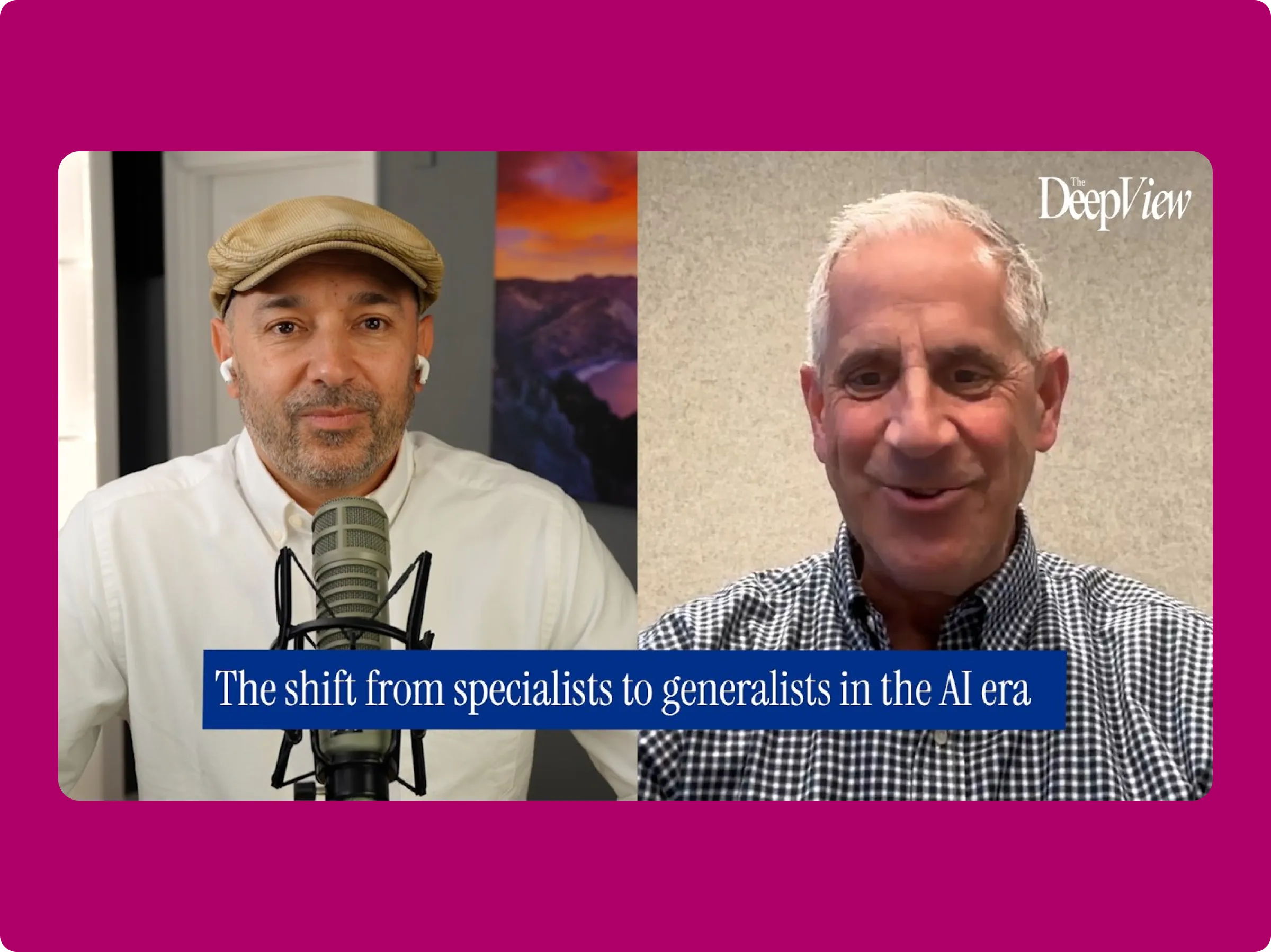
When AI can help almost anyone learn almost any skill, what makes someone great at their job? For Bill Barton, Rokt’s chief operating officer, the answer has little to do with technical skill.
Jason Hiner, editor-in-chief and host of The Deep View, invited Bill on after hearing that some of the world’s biggest technology companies have asked Rokt to show their teams how it uses AI. Their conversation covers why culture stays constant and the six traits Bill believes matter in any role.
Every role gets a seat in the AI era
Early in 2025, Rokt made a deliberate choice to bring the whole company into the AI era together. That meant online training, competitions, and hackathons open to everyone.
“It wasn’t just for software engineers. It was for every single role in the company,” Bill says.
You can see it in the day-to-day. Bill describes colleagues in roles most people would call nontechnical asking for help in a shared chat space. They’re connecting company tools to build their own apps, like one that helps employees order lunch. “It’s definitely now part of the way Rokt breathes and lives and does things,” he says.
The case for generalists
Bill has moved across disciplines himself. He started as a hands-on software engineer, went on to lead product and engineering teams (including helping lead the Alexa team at Amazon), and now leads Rokt’s people, finance, legal, and corporate security teams.
“AI is beginning to really blur the lines between different disciplines,” he says. An engineer can now get much closer to understanding the legal questions behind data privacy. People outside finance can work through finance issues. Deep expertise still matters. As Bill puts it, “If you’re going to practice law, you still need a law degree.”
You can see the change in how Rokt organizes its people. When Bill first joined in 2022, Rokt had around 15 job ladders. Today it has four.
Bill has long pushed teams to replace many specialized solutions with fewer, more general ones. AI now makes that possible in every discipline, which cuts complexity and coordination. “More and more of the creativity and the inquisitiveness of the workforce can be pointed at the product and our customers and our clients,” he says.
“That to me is part of why I’m optimistic about what this wave of AI will do for people.”
Culture is the constant
Jason suggested Rokt had transformed its culture to embrace AI. Bill pushed back.
“I don’t think Rokt has changed its culture,” he says. “I think having a durable culture is one of these timeless truths.”
When Bill joined, generative AI hadn’t yet reached most workplaces. The tools have changed radically since then. Rokt’s principles, priorities, and ways of working have not, and Bill sees that as what lets teams move fast. He points to Amazon, where he spent ten years, as an example of a company whose culture is so well understood that teams don’t have to stop and debate the basics. In his words, “Having priorities makes decision-making simple.”
That kind of culture takes work to keep. As companies grow and bring in new people, Bill says it’s easy for culture to fray, and for teams to start relitigating issues a smaller team would have settled long ago.
Six traits for thriving through change
To keep a culture from fraying, Bill comes back to six traits he believes matter in any role. After more than four decades in tech, he shares them often, even with new college grads.
- Relentless
- Resilient
- Rigorous
- Inquisitive
- Optimistic
- Humble
“I think those are timeless attributes,” he says. They help people “encounter change, overcome change, embrace new things, not be fearful, and thrive.”
“It’s not enough to survive,” Bill says. “At great companies, people should aspire to thrive.”
Listen to the full conversation
Bill and Jason also cover Bill’s “failed” retirement experiment, what Amazon taught him about culture, and his advice for leaders managing their time in the AI era. Listen to the full episode of The Deep View, or read the transcript below.
Read the full transcriptThe Deep View, Episode 72, “6 timeless attributes for succeeding in the AI era” (October 18, 2026)
Bill Barton: Every human worker who can leverage these tools and do that is now ten to a hundred times more valuable than others. And we saw the same thing play out in the industry when, for example, AWS and GCP and Azure and these large frameworks emerged, and all of a sudden, like, you couldn't hire software engineers and they were starting to get paid like investment bankers fresh out of school because they had been empowered with these super powerful frameworks and they were able to create so much more value.
Jason Hiner: In this episode, I talk to Bill Barton, COO of Rokt. This is a company that is moving so fast and driving so much innovation in the way it's implemented AI inside the company that some of the world's biggest tech giants are having Rokt come in and talk to their employees about how to do it. So I asked their COO to come on the podcast so that we can all learn from what they're doing. I can't wait for you to hear what Bill Barton has to say. He's a technology and product leader who previously helped lead the Alexa team at Amazon and is now running operations at one of the world's fastest growing e-commerce companies. Bill also has amazing advice about the six attributes anybody needs to develop in order to become successful in any role. Alright, you're going to really enjoy this one. So here it is, our conversation with Bill Barton of Rokt. So Bill, for those who aren't familiar, talk a little bit about Rokt and then your role at the company.
Bill Barton: Yeah, sure. So Rokt has been around for 13 years, probably going on 14 I think, and specializes in helping e-commerce companies derive more value from what we call the transaction moment, which is really the purchase journey once the user has begun, the consumer has begun engaging with that e-commerce site's product catalog and so on. And we've been growing like a weed year after year. We're going to do over 10 billion transactions this year. We have tens of thousands of clients on both sides of our two-sided network and super excited about the future. And for myself, I'm currently Chief Operating Officer, so I lead all the non-product, non-tech, non-go-to-market functions in the company, so people, finance, legal, corporate security. It's sort of a funny role because for the first few decades of my long career, I was a product guy. I was a hands-on software engineer and led technical teams and product development teams, including at Rokt for the first couple of years, but now I'm in this very different, more corporate role.
Jason Hiner: Very good. So, Bill, you, like you said, you were in this product role, product and kind of engineering and that before, but you left Rokt and then you recently came back. So tell us a little bit about that and kind of why and what the story is.
Bill Barton: Yeah, it's sort of funny. On my LinkedIn page, I say that I tried retiring and it was an experiment that failed. So about two years ago at this time, I decided I was nearing, just nearing an age and a stage of what I was doing where I felt like maybe it was time for me to step back from full-time work, pursue other things in my life that I'm really passionate about, notably road cycling, which notoriously takes a lot of hours a day if you're going to do it right.
Jason Hiner: Sure.
Bill Barton: I always planned when I retired to keep doing some consulting, so I kept my hand in it with Rokt a little bit and I was helping with talent development, interviewing candidates and that type of thing. But then, early this year, Bruce, our founder CEO, asked if I was interested in coming back and doing something very different, which, as I said, is leading these corporate functions. And I decided that, yeah, I had a huge appetite to come back and be part of the wonderful Rokt family. And sometimes people say, well, what is it that's really compelling about Rokt? In addition to just how fast Rokt moves, it is the fact that it has a sort of family fabric to the place. And I just, yeah, really like being here, really like being in the office and being around the other folks here. So here I am. It wasn't necessarily on my bingo card on New Year's Eve that I'd be back in a full-time role, but here I am.
Jason Hiner: When did you go back, just this year then?
Bill Barton: Yeah, I was consulting sort of part-time, half-timish as we entered the new year. And then it was mid-May. So getting close to six months ago, five or six months ago, that I came back and have been at least full-time since.
Jason Hiner: Where is, you said, here, it sounds like there is sort of an in-person culture there. Where's here? Where's the HQ? And where are you located?
Bill Barton: Oh, HQ is, we're in Lower Manhattan. And the company was started in Sydney, Australia back in 2012, but I think the headquarters have been here since 2019 or so. It was before I first joined in 2022. So we've been in this building here and sort of on the border between SoHo and what they call Hudson Square. And we are very much an in-the-office culture. So the place is always filled with people and buzzing, and we cater in lunch, and there's a ton of human energy here, which is great.
Jason Hiner: Nice. Now, you talked about leaving and sort of the decision to leave. What was it about the moment? And that was 2025? 2024 or 25?
Bill Barton: Yeah, yeah. Almost exactly two years ago. It was October 2024. And I sort of had this epiphany that maybe it was time for me to be done with my career. It was sort of an odd epiphany. And now part of it was just this awareness that there are other things, that personal passions, like I said, things I wanted to spend time on, spend time cycling, spend time with my family. But another thing was it was really when the new wave of what people, in too abbreviated fashion, call AI, but it's generative AI, large language models, and I think most people understand the distinction there, just beginning to unfold. And I could tell it was something where if I wanted to be at the top of my game as a product development leader, it was going to be one of these two-, three-year sort of hills to climb to get really properly on top of it and keep up with it. Not that I'm sure anyone can keep up with it right now. And I asked myself if I had an appetite to do that again, because I've done it many times in my career. And in that moment, the answer was, you know what, I think it's time to hand off to some of the younger people who were here at Rokt. Not necessarily because they were younger, but they were better. Maybe that's the right way to put it. Not to hand off to the younger people here at Rokt, but to hand off to the better people here at Rokt. Just more schooled to begin with in some of the technologies and the capabilities and the potential for AI. And they were really crushing it. And I began to feel like I was not helping as much anymore. And so all these different thought processes came together and I decided, okay, I'm going to retire. So I did that and I left the business. I was completely out of the business for six months or so. No email, no chat, no Rokt at all. But then I sort of got sucked back into the vortex as a consultant starting at the end of 2025. And once again, here I am, fully in the vortex.
Jason Hiner: So you like purposefully chose to step aside to let others sort of take the lead on some of the like technical product parts of Rokt. But you got pulled back in to do some of these other things. And then there's been quite an interesting journey. You and I talked a little bit before about it. So talk a little bit about the decision making to kind of come back in beyond just sort of being part of the team again and believing in the culture. You also had the sense that there were some opportunities. There were some things changing and that you could help there. So what did that look like?
Bill Barton: Yeah, well, I think, so part of it was being asked to come back and lead these very different functions than I had led in my career, but where I've partnered with them in my career.
Jason Hiner: Okay.
Bill Barton: I've always, I've a long time partnered with a people or HR organization, finance partners, legal partners, security partners. So while I wasn't sort of individually expert in any of those disciplines, certainly they were part and parcel of leading large development organizations, which I've done for a couple of decades now. So I felt competent that I knew enough about them that I could then bring the experience I had as a, as a generalist leader. So that was part of it. And a new problem area, and new problems areas are just interesting, I think, for any of us, right? It's like, hey, you get the new brain candy, not the old brain candy. And then I felt that the use of AI tools was allowing anyone to become, not necessarily expert. You know, if you're going to practice law, you still need a law degree.
Jason Hiner: Yeah.
Bill Barton: And, and so on. And these different disciplines, you definitely need the training, the expertise. But AI is beginning to really blur the lines between different disciplines, and people who are software engineers can, you know, maybe get to 80% of the way to understanding the legal issues behind something they might be doing, say, in the area of data privacy, data custodianship. People can understand finance issues. And so it was just really interesting to me how these boundaries were blurring and people could become more generalists. You know, I thought of myself as having become a generalist over time. First I was a hands-on software engineer way back in the dark ages and I was writing assembly code and that kind of thing.
Jason Hiner: Yeah.
Bill Barton: And, and even within software, people became more and more generalists and the distinction between a front-end engineer and a back-end engineer and so on began to erode as the tools got better. And now that's happening across all the disciplines in the company. And in fact, when I started at Rokt, we must have had 15 different, what we call job ladders. Like there was, you know, software engineer and data engineer and product manager and program manager. You know, there were literally over a dozen of these. And now we're down to just four.
Jason Hiner: Wow.
Bill Barton: And I think part of that is the power of these tools to let people, you know, go beyond those old boundaries and begin to do almost anything they need to do to deliver on the role. So it makes it, it makes it really fun to lead these, I said, these corporate functions when it's not like, oh, the fun technical stuff happens over there. That's, that's not for you. You're, you're in legal or you're in finance. And everyone is sort of playing, playing together. And it's really interesting.
Jason Hiner: So this is kind of what fascinated me, Bill, is like that Rokt chose somebody who had worked in the product and engineering, you know, part of the, the org to come and run these like central services, right? That most organizations have, you tend to hire somebody that's very operational, very into efficiency, you know, and that, but it really does say something about the culture and the mindset of the company that they brought somebody who was in, you know, those kind of core functions of the company. to come and run, you know, these parts. And one other thing that really fascinated me, of course, I've talked to Claire Southey, who's the chief AI officer of Rokt. Claire was just on a panel that I did at the AI Conference, and Claire talked, you know, really purposefully about how Rokt is using AI to really transform the journey, you know, of the, of the product, to build this product that walks that fine line between delighting users and annoying them, you know, and using data to find that place, right? And not many people have told me that. And that's why I asked Claire to sort of come and, and be part of that panel. But in talking to you, sort of you look at AI through the other direction of, like, it's also transforming the internal culture of Rokt. And so I'd love to hear you talk a little bit more about that, because that's also, you know, what a lot of organizations, no matter what they do, right, are thinking about, dealing with. Employees are thinking about it. Employers are thinking about it. Organizations more broadly, in terms of how they architect their, yeah, their organizations for the future. And so, you know, you, you are living and breathing that right now. So can you talk a little bit about that? What have you all been learning about the ways that AI can be used internally?
Bill Barton: Yeah, it's, um, so it's clear, I imagine Claire spoke about the extent to which we're using AI just within the product itself. You know, Rokt's mission is to put relevant content and offers in front of consumers as they're navigating an e-commerce checkout journey, and actually AI and machine learning techniques for a long time have been used in that sort of content recommendation engine. Yeah.
Jason Hiner: And I would, for those who don't know in the audience, too, like, you all have some of the largest clients in the world. I think that the stat was, like, every consumer is, you know, they don't realize it, but they're being touched by, you know, Rokt, you know, Rokt in the transaction phase, you know, every sort of two to three days. You know, in the last two to three days almost every consumer in the United States has been, you know, touched by it because, yeah, it's giant clients.
Bill Barton: It's pretty amazing, right? So, as I said, we'll do over 10 billion transactions this year, which is on the order of twice the number of transactions Amazon will do, for example.
Jason Hiner: Remind me some of the clients, too, right? Like Uber and some of the others.
Bill Barton: Yeah, Uber, Ticketmaster, Kohl's, you know, PayPal, everybody knows. Like, pick the name of a top e-commerce company in the world, and there's a really good chance that they're on our network on one or both sides. Some of these clients are both, both a supply-side partner, meaning we're helping them monetize their checkout transaction journey, but they're also on the demand side putting offers and content in front of consumers, either on their own site and sometimes other people's sites. So, huge amount of data. So we have a great set of data to leverage the very latest in deep learning techniques and AI to make our network perform better for all the stakeholders of the network. And, like I said, I imagine you spoke with, with Claire about that at some length. Yes. Moving upstream of that on the software development side, as far as I can tell, we are absolutely at the bleeding edge of using autonomous AI-powered software development agents to actually build our software. And software engineers now are, they're like conductors of the symphony orchestra of autonomous AI agents. And our internal AI fleet, as we call it, is learning about our optimization functions and learning all the rules about our code and understanding our code base, and, you know, we're doing things in a matter of hours now that would have taken a team of software engineers weeks or, or months to do. Now that's playing out across the industry. Now move upstream from software developers, you know, pretty good understanding of AI, are leveraging it to build software. Across the organization, whether it's legal, finance, security, marketing, you name it, every function of the company is now steeped in and using AI tools to do the work, including this internal sort of AI fleet that we developed primarily pointed at our software problems. Well, you can use it to go study the tax code in 237 different jurisdictions. You can, you can do market research on it. And the company was very intentional about this. So I recall it was really as I was just stepping out of the business in early 2025, and our CEO Bruce Buchanan and others really became aware of what, what was coming, and, and we were very intentional about sort of leading the entire company, hundreds of employees, into the AI era. So we had online training. We had run competitions and hackathons, and it wasn't just for software engineers. It was for every single role in the company, and people, people sharing ideas and sharing questions. And it was amazing when I saw people who were, were in roles that you would think were totally nontechnical.
Jason Hiner: Yeah.
Bill Barton: And they're in a chat space and they're asking for help wiring up n8n and the API keys to get some sort of orchestration going between three or four different company tools because they're trying to build a cool little app that would help employees order lunch, or, and that kind of thing. So it's really pervasive. And part of the reason I think we're at the bleeding edge of it is, is that's what we hear from some of these top brands that you mentioned we work with. I won't name names, but we have, we have clients, and they're some of the best technology companies in the world. And you would think that they would say they are at the bleeding edge of applying their own technology. But they're, they're bringing us in to give talks and trying to teach their executive and leadership teams how to replicate what we've been doing at Rokt in terms of just this pervasive use and understanding and embrace of, of AI tools. So it's not. I can't claim credit for that. It's not limited to these corporate functions that I lead.
Jason Hiner: Sure.
Bill Barton: But it's definitely now part of, just part of the way Rokt breathes and lives and does things.
Jason Hiner: You, you all have successfully transformed the culture to where, from the bottom up, the people on your team, you know, all the teammates are using AI to empower, you know, their, their work and to do it in ways that are really changing and transforming the organization. So with that I'd love for you to talk a little bit about this idea. You know, you've dug into a little bit on generalization versus specialization. You sort of mentioned it earlier with the roles kind of collapsing, right? It used to be much more specialized. Now it's, like, a fewer number of job ladders and titles and career paths because that is moving towards, you know, generalization a little bit. Tell us a little bit about that, because that obviously has some, some really interesting implications.
Bill Barton: Yeah, it's always something I've been interested in. I don't think I'm unique at all. It's sort of basic software architecture hygiene. But I did adopt it as kind of a mantra that I would use with teams that I lead, which is to constantly seek to replace a larger number of more specialized solutions with a smaller number of more generalized solutions. Even very good software engineers and architects sometimes fall into the trap of, I've got this specific problem to solve. I'm going to go write a specific solution that will solve it instead of generalizing a preexisting solution which maybe only needs a little bit of enhancement or expansion in its surface area to solve this new class of problem. So that's something I've been maybe a little bit preachy about for quite a while.
Jason Hiner: Okay.
Bill Barton: And now it applies, largely enabled by the power of these AI-based tools, to any discipline, not just, not just software. So the ability to reduce the number of different solutions and systems you have that can then in turn solve more and more problems, well, now you've eliminated a lot of complexity, a lot of coordination, a lot of ongoing support of, you know, hundreds of different tools. And now maybe you're just talking about, you know, dozens of different tools and different solutions. And more and more and more of the creativity and the inquisitiveness of the workforce can be pointed at the product and our customers and our clients and accelerating things. And it's just sort of this flywheel that feeds on itself. So I did, I put a post on LinkedIn several weeks ago about this. You know, and I think I said, I think these concepts of simplicity, generalization instead of over-specialization, they've been around for decades. They're not new concepts per se. But they're now becoming really applicable across, I would say, almost all fields of human endeavor. And that to me is part of the, is part of why I'm optimistic about what this wave of AI will, will do for people.
Jason Hiner: You know, one of the things you said that enabled you to be able to play a key role, you know, in the ways that, because this is changing, is that because there are some timeless truths, right, that still stay. One of the things that you've talked about here is, like, that, you know, these things sound, like, new and innovative and all that, but they also connect with some things that we've kind of always known. We're just having to sort of read the reality and, you know, reimagine them for, for the current, you know, reality. Talk a little bit about that, Bill, because I really, I really like that line of thinking. Love to hear more.
Bill Barton: Yeah, it's interesting. Maybe, maybe when I retire again I'll have time to, I thought about writing a book, and the title of it would be something like Ten Timeless Tenets for Transformative Tech Teams. I'm a big fan of alliteration.
Jason Hiner: That's some good alliteration right there.
Bill Barton: Yeah, well, having been born Bill Barton, I'm a big believer in the benefit of alliteration.
Jason Hiner: Fair enough.
Bill Barton: Yeah, so I think, yeah, the timeless elements, you know, I joke with people I'm sort of a dinosaur, right? I've been, I've been in the industry for over four decades now, but some of the lessons I've been taught and learned still apply despite AI. A few minutes ago you said that Rokt had been successful. I forgot the exact word you used, but you talked about changing our culture so that, to allow people to embrace AI or to get them to embrace AI. I think one of the really interesting things is I don't think Rokt has changed its culture.
Jason Hiner: Interesting.
Bill Barton: I joined in 2022. It was a couple years before generative AI and ChatGPT and so on first started, you know, really, really manifesting in the workplace, and things have really changed pretty radically just over two years, and I'm sure they'll keep changing. But I feel like the culture at Rokt actually has remained the same, and I think having a durable culture is one of these timeless truths. So I think, and, you know, I spent ten years at Amazon. Amazon has a very unique culture, and I think each of, you know, Google and Microsoft, I think every great company, and there are many of them out there, part of what makes them great is they develop a unique culture. And then the culture and the people they attract, you know, the traditions, they all, again, it's like a flywheel, they feed each on each other, and you end up with a, with a team and a company and a way of thinking about things that lets you get things done very quickly, because there are certain things you don't have to mitigate anymore. Like, you just, you know them, you understand them. So you asked, what are some timeless things? I think that's one of them.
Jason Hiner: Okay.
Bill Barton: Make sure you know what your, what your principles are, what your culture is, what your priorities are. You know, a saying of mine is that having priorities makes decision-making simple.
Jason Hiner: Sure.
Bill Barton: But it's very easy for an organization for that to begin to fray. You bring new people in, you know, maybe they don't understand the culture as much. You're beginning to re-litigate issues which a smaller team maybe two years ago wouldn't have to re-litigate. So staying true to your culture, I think, I think is important. I tell people I've landed on six attributes that I think are really important for anyone in the workplace.
Jason Hiner: Okay.
Bill Barton: And I've found myself giving this advice even to fresh college grads, not candidates at Rokt, but I had kids who recently graduated from school, and talking to their friends, and they all want to hear from the dinosaur about what I think they should know about the workplace. I sort of landed on these six, which is you have to be relentless. You have to be resilient. You have to be rigorous. You have to be inquisitive. You have to be optimistic and you have to be humble. I could go on and on about each of those six, but I think those are timeless attributes which, if people embrace them and try and live them, help make them successful. So these are some of the sort of principal cultural, you know, what are inherent attributes of approaching work and life that can allow someone to encounter change, overcome change, embrace new things, not be fearful, and thrive. And I think it's important to thrive. It's not enough to survive. It's enough to survive if you're in a really dire situation, then of course survival seems really great.
Jason Hiner: That's right.
Bill Barton: It's better than not surviving, but that's a very low bar, and I think at great companies people should aspire to thrive.
Jason Hiner: I love it. Last question about that, just double-clicking a little bit. You've also talked about the ways that AI now in Rokt has enabled your employees to, you know, what an inquisitive individual now can change the way they work, and it can become this, like, 10x to 100x kind of multiplier for the way that they work. Can you talk about that, and then what's that been the impact on the way you think about headcount, right? Because you're, you run people, the way you think about hiring and those kinds of things, because that's another one of the, you know, the big questions right now going forward.
Bill Barton: Right. Well, first on, first let's talk about the multiplier itself. You know, whether it's 10x, 100x, people throw these numbers around and it's impossible to really measure rigorously, to use another of our six attributes. But it's plain to see that it's a large multiple. Just yesterday one of our engineers was giving a talk about how, you know, he wanted to migrate seven or eight different entire sort of code bases or systems from one architecture to our newer architecture. And he first tried to codify the rules by which our AI fleet should do each of those migrations, and it just wasn't, wasn't working. So then he, what he did was he told our AI fleet, it's like, oh, let's work together and do the first one together, just step by step, you know, highly iterative. And once he and the AI fleet did the first one together, then the AI went off and did the other six, seven or eight, or whatever it was, super, super quickly. So right there that's on the order of a factor of 10 productivity improvement. You know, do it, do it once and the AI says, oh, okay, I see what you're doing. I'm going to go do the other nine. And that plays out all over the place, whether it's software. There's someone else in our finance team who's been, who's been building an AI solution. You know, people talk about closing the books every month. We're doing sort of a virtual close every day now.
Jason Hiner: Wow.
Bill Barton: So these things are playing out. Now, I think, in terms of how does that make us think about our investment in headcount, to me it makes every, every human worker who can leverage these tools and do that is now 10 to 100 times more valuable than, than others. And we saw the same thing play out in the industry when, for example, AWS and GCP and Azure and these large frameworks emerged, and all of a sudden, like, you couldn't hire software engineers, and they're starting to get paid like investment bankers fresh out of school because they had been empowered with these super powerful frameworks and they're able to create so much more value.
Jason Hiner: All right, Bill, I'm going to ask you the same questions I ask everybody as we wrap up this podcast, as this, this episode. So the first one is, you know, what's the AI tool that you're using personally that, that's really interesting to you and you think more people should know about?
Bill Barton: Unfortunately my answer is not that interesting, and probably everybody already knows about it. So we have all these tools we're using internally, some of them homegrown, and they're built on top of Anthropic and other systems, and a lot of the software engineering industry is embracing those. But just in my day-to-day life, be it in the office or outside, the fact that when I go to Google and I do a search, I get a pretty complete, well-researched answer just from Google. I'm not talking about using Gemini or paying a subscription, just what, web search is different now. You know, now I usually, I just ask a question, I get a pretty good answer. It gives me everything I need to know. Sometimes I can click through and do more research. But to me the really interesting thing about AI is where it's just becoming kind of pervasive, and maybe you barely even notice, oh, I'm using AI now. I think that is, that, that's, that's changing things, and I interact with it probably 100 times a day. I might be biased because that's part of what we were trying to do when we built Alexa at Amazon was to make intelligence frictionless and pervasive. But I think it's getting really, really good in the search, what we used to call a search engine, and now it's just, I don't know what to call it. It's your information assistant.
Jason Hiner: Yeah, our information assistant. That's good. I know we didn't get to get into, to Amazon too much. You know, your, your history there. But do you still follow with a close eye some of the things that they're doing?
Bill Barton: I wouldn't say I follow any of the things they're doing with a close eye, but I follow many of the things they're doing with, with at least glancing off to the side. And of course I have many wonderful colleagues who I spent many years with and we're connected on LinkedIn or just outright friends and get together once in a while. So it's definitely fun to keep up with them. Like I said, I think Amazon is a unique company. A great company. I loved my time there, and I think part of what they're great at is being bold and innovating.
Jason Hiner: Very good. We'll save that for next time. I'll ask you some more about your time.
Bill Barton: Yeah, Amazon Tales.
Jason Hiner: Yes, yes, yes. Very good. All right. So the last question is one that is really top of mind for a lot of leaders right now, which is this idea of, I hear leaders talk a lot about, how do I get maximum leverage for my time? And the promise of AI was that it was going to automate away a lot of the grunt work, the things we didn't want to do, the tasks that we always wanted to get through as quick as we could so that we could get to the more valuable things. But most of the leaders that I see now, and the promise with that is that eventually you could touch grass or go and enjoy more, take a bike ride, to your point, too. But what I see now is, in fact, more leaders are spending more time. They're working more. They see more opportunity to get things done, and so they're really into keeping their head down and doing more work. And so with that, all of the leaders that I know right now are really thoughtful about, and you elevated this idea early, about priorities. How do I prioritize my time? How do I set my priorities? How do I optimize and make sure I'm spending my time on the most important things? And so since you are a leader of leaders, a lot of the work you do, I'm sure, is coaching other leaders. I would love to hear what your best tip is for other leaders who are trying to optimize their time in the age of AI.
Bill Barton: Yeah, that question is another one where maybe because I'm a dinosaur and I've been through these waves before, yes, the pace of change with these AI tools is different in many ways. But I think people who are passionate about their work have for millennia probably wrestled with this trade-off between putting another 10 minutes, another hour, another day, another year, or whatever it is, and I don't think the wisdom about this has really changed much over those millennia. And for every individual you need to get a sustainable rhythm where you have, quote, work-life harmony. And there are periods where you might be working 24/7, and then there are other periods where you need to take a step back, and I think the answer is different for everyone. Look, early in my career when I was coding hands-on, I sometimes would get into what I call the coding frenzy and be cranking away until 3 in the morning and not get enough sleep. Here we are, 40, 45 years later, whatever it is, and it's all about AI and it can be really intoxicating, right? And you get into your work and next thing you know it's like, oh my God, it's 3 a.m. I should really get some sleep. I personally don't see how it's dramatically changed.
Jason Hiner: Okay, so priorities, you elevated that earlier, like setting your priorities, you mentioned setting priorities makes decision making a lot easier. So would you still say that it's as true as ever that being really good at setting priorities is the key to managing all of that?
Bill Barton: Yeah, I think so. I think whatever one's priorities are, being clear on them and recognizing when you're beginning to stray is the signal that maybe you need to change how you're investing your time. And I think for any of us, we get in these states in our lives where everything is kind of clicking. It's like, oh, work is going really well, and my life outside of work is going really well. And when my work is going well, I bring more positive energy to my life outside of work, and when that's going well, then I bring that positive energy back to work, right? I'm a believer in flywheels, and you have to get your personal flywheel turning in a positive direction. It's really easy, I think, for any of us to maybe let it start sliding backwards and that doesn't help either work or your life outside of work. But whatever one's priorities are, being clear on them and remembering to respect them, I think helps you get into this sort of positive flywheel zone. And it's usually ourselves. We're the ones who usually do it to ourselves and start kicking own goals when it comes to misprioritizing. It's not our boss or, oh, someone resigned this morning or, oh, a customer did this or that to me. We're usually in much more control than anybody else about how that's going.
Jason Hiner: Lots of timeless truths there, Bill. Thank you so much for your time. This has been a pleasure and, yeah, I appreciate it.
Bill Barton: Great. And hey, I look forward to doing one devoted to Amazon talk.
Jason Hiner: Perfect. Perfect. All right. Thanks so much.
Bill Barton: Thanks Jason.
Transcript courtesy of The Deep View. Sponsor messages have been removed.