


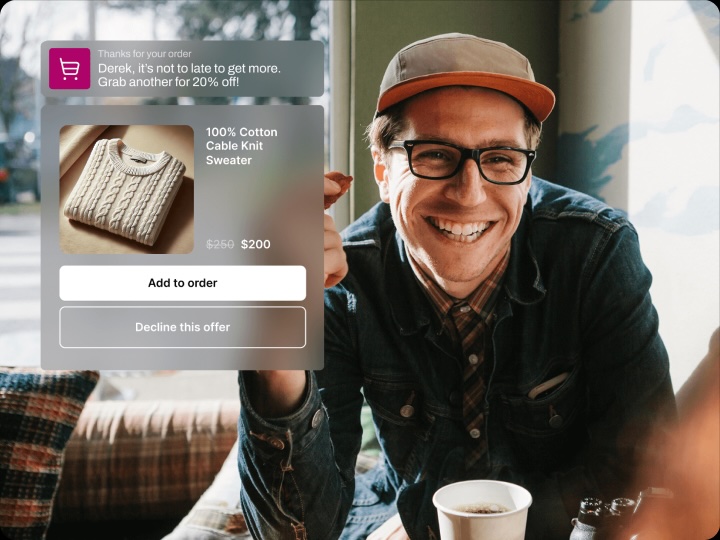
First-party data is information a retailer collects directly from its own customers: purchase history, browsing behavior, loyalty program activity, payment preferences, and post-purchase engagement signals. It is collected with the customer's knowledge, on the retailer's own properties, and owned entirely by the retailer.
Retailers are building their businesses around first-party data because the alternatives are disappearing. Third-party cookies are deprecated or restricted across major browsers. Apple's ATT framework gutted cross-app tracking. State-level privacy laws (California, Virginia, Colorado, Connecticut, and growing) are raising the compliance bar every quarter. The shift to first-party data is structural. It is not a reaction to one platform change; it is a response to the permanent erosion of third-party signal infrastructure.
Why are retailers prioritizing first-party data?
Three forces are converging.
Third-party signals are degrading faster than most retailers planned for: Google Chrome's cookie changes, Safari's ITP, and Apple's iOS 14+ updates have collectively dismantled the cross-site tracking infrastructure that powered digital advertising for two decades. Retailers who built acquisition strategies on third-party audiences are watching those audiences shrink in both size and accuracy.
Customer acquisition costs are rising as a direct consequence: A CommerceNext survey found that 86% of retail marketers increased their spending following Apple's iOS 14 update. When targeting degrades, retailers spend more to reach the same customers. First-party data is the only asset that improves targeting precision without increasing cost per reach.
Consumers expect relevance, and they know it requires their data: A MoEngage study found that 66% of consumers are willing to share personal data in exchange for better retail experiences. The transaction is clear: give me something relevant, and I'll give you the information to make it relevant. First-party data is the mechanism that makes that exchange work.
What types of first-party data do retailers collect?
Transaction history: what customers bought, how much they spent, when they purchased, what payment method they used, and whether they returned items.
Behavioral data: browsing patterns, products viewed, items added to cart and abandoned, search queries on-site, and time spent on specific pages.
Loyalty and membership data: program enrollment, reward redemption, tier progression, and engagement frequency.
Post-purchase engagement: email open and click rates, review submissions, repeat purchase timing, and responses to post-transaction offers.
Payment and checkout signals: payment method selection, checkout completion rates, coupon usage, and shipping preferences.
Each of these data types is richer and more reliable than anything available through third-party sources because it reflects actual customer behavior on the retailer's own properties, collected with consent.
How does first-party data improve performance at the point of transaction?
Most conversations about first-party data focus on upper-funnel personalization: better email segmentation, smarter product recommendations, improved ad targeting. That matters. But the highest-value activation point for first-party data is the transaction itself.
As Ed See wrote in Adweek, the distinction between personalization and relevance comes down to the question each one answers. Personalization solves for "who is this person?" Relevance solves for "what should we do right now?" At the point of transaction, retailers have both answers simultaneously. They know who the customer is (identity is confirmed), what the customer just did (purchase data is live), and what context surrounds the moment (payment method, cart contents, device, location). That convergence of identity, behavior, and context is what makes the transaction the richest activation point for first-party data.
A retailer with strong first-party data infrastructure can use that convergence in real time: surfacing relevant offers, suppressing irrelevant ones, and determining the next best action for each customer at the exact moment intent is highest.
Why is the transaction the highest-value activation point for first-party data?
Because it is the one moment in the customer journey where four conditions are true at once: the customer's identity is confirmed (they are logged in or have entered payment details), attention is earned (they initiated the interaction), purchase intent is proven (they just committed money), and the data is verified (it reflects an actual transaction, not a modeled estimate).
Collecting first-party data and activating it are two different capabilities. As Databricks recently argued, the gap between a retailer's data infrastructure and actual marketing outcomes is where most of the value gets lost. Retailers invest in collecting customer signals, then fail to act on them at the moment those signals are freshest and most predictive. The transaction closes that gap. It is where collection and activation happen in the same moment, on the same page, with the same customer.
Retailers who build first-party data activation around the transaction compound their advantage over time. Every interaction generates new signals. Every signal refines the next decision. The result is a relevance engine that gets better with every purchase, not a static audience segment that decays the moment it is built.
What should retailers look for in a first-party data strategy?
Data ownership and control: The retailer should own its customer data outright. It should never be pooled across clients, resold to third parties, or reused by the platform processing it.
Real-time decisioning capability: Batch processing worked when the best activation channel was a weekly email campaign. At the transaction, decisions happen in milliseconds. The infrastructure has to match.
Privacy compliance at enterprise scale: SOC 2 Type II, ISO 27001, GDPR, and CCPA compliance are table stakes. As Coresight Research recently noted in WWD, AI-powered marketing is pushing the boundary of what consumers consider acceptable, making privacy-forward data strategies a competitive requirement, not just a legal one.
Activation across the full transaction: First-party data should power decisions from payment selection through post-purchase confirmation, not just a single placement on a single page.
Measurement tied to outcomes: Impressions and clicks are proxies. The strategy should measure actual customer actions: purchases, sign-ups, incremental revenue, lifetime value.
Frequently asked questions
What is first-party data in retail?
First-party data in retail is information collected directly from customers through their interactions with a retailer's own properties. This includes purchase history, website browsing behavior, loyalty program activity, email engagement, and checkout signals. It is owned by the retailer, collected with the customer's knowledge, and is generally more accurate and reliable than third-party data because it reflects actual behavior rather than modeled estimates.
How does first-party data reduce customer acquisition costs?
When retailers target customers using their own first-party data, they reach people whose behavior and preferences are already known. This reduces wasted spend on broad, inaccurate third-party audiences. First-party data allows retailers to identify high-value customer segments, suppress low-intent audiences, and allocate spend toward the channels and moments most likely to convert, all of which lower the effective cost per acquisition.
What is the difference between first-party data and third-party data in retail?
First-party data is collected directly by the retailer from its own customers on its own properties. Third-party data is aggregated by external companies from sources the retailer does not control, often without a direct relationship to the customer. First-party data is more accurate, more privacy-compliant, and more durable because it does not depend on cookies, device identifiers, or cross-site tracking mechanisms that are being restricted by browsers and regulators.
How do retailers activate first-party data at checkout?
Retailers activate first-party data at checkout by using real-time decisioning systems that draw on transaction history, behavioral signals, and contextual data to determine the most relevant action for each customer at the point of purchase. This can include surfacing relevant offers, suppressing messages that do not match the customer's profile, or recommending products based on the contents of the current cart. The most effective activation happens across the full transaction, from payment selection through post-purchase confirmation.