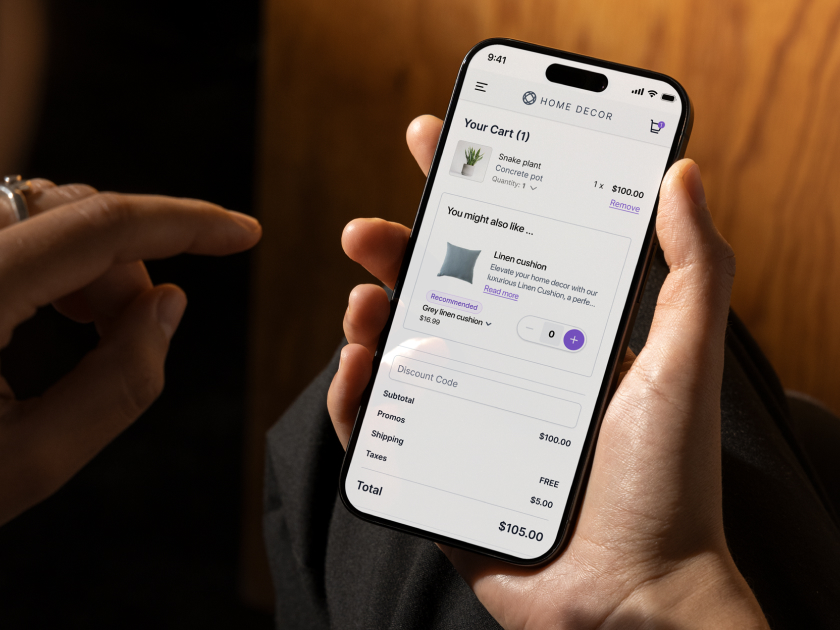



You can reduce cart abandonment without adding more pressure by making checkout simpler and more relevant. Remove unnecessary friction and choices, then use real-time signals to determine what will help each customer complete their purchase.
For one customer, that might be a relevant payment incentive or offer. For another, the best experience may be a clear path to purchase with nothing additional competing for attention. In practice, a simpler checkout removes unnecessary steps, choices, and distractions that can get in the way of completing a purchase. A more relevant checkout matches what each customer sees to what they actually need in that moment, whether that’s a useful offer, an incentive, or simply a clear path to purchase.
Reduce unnecessary choices at checkout
By the time customers reach their carts, they’ve already made a series of decisions about what they want to buy. Checkout adds more, including shipping, payment, promotions, loyalty programs, and potential add-ons. Each can have value, but too many choices can make the final purchase decision harder.
Research into the paradox of choice helps explain why. In a well-known study by Sheena Iyengar and Mark Lepper, shoppers shown six varieties of jam were substantially more likely to purchase than those shown 24. For ecommerce businesses, the takeaway is to be selective about which choices deserve a customer’s attention. Choice overload is one problem. The other is how those choices get presented.
What makes a checkout experience feel pushy
Certain tactics create short-term urgency at the expense of customer trust. Countdown timers that pressure customers to act before a deal expires. Exit-intent popups that block the page when someone tries to leave. Stock scarcity warnings ("Only 2 left!") on products that aren't actually scarce. Guilt-framing ("You're leaving items behind!") that treats the customer's hesitation as a mistake. Showing the same discount popup multiple times in a single session.
These approaches can produce a short-term conversion lift. They also train customers to associate checkout with pressure, which erodes return visit rates and long-term trust. The alternative is designing checkout around what's genuinely useful to each customer in that moment, showing something relevant when the data supports it and showing nothing additional when it doesn't. That sounds straightforward as a principle. Doing it for each individual customer at scale is the hard part.
AI can help businesses make those checkout decisions in real time. Rokt Brain uses first-party and contextual signals, including cart contents, order value, device, channel, location, and previous interactions, to determine the next best action for each customer in real time. Instead of applying the same checkout experience to everyone, businesses can determine whether an offer, incentive, or no additional action is most relevant to that customer.
Make payment part of the solution
This approach becomes especially important as customers move from cart to payment. Rokt Pay+ enables businesses to surface relevant payment-related and incentive-based experiences on the payment page, including payment method offers, loyalty or cashback incentives, and gift-with-purchase campaigns.
This gives businesses another way to address abandonment without defaulting to discounts. An incentive can appear when it adds value to a particular transaction, while customers who don’t need one can continue toward purchase without another decision getting in the way.
Look beyond the cart
A relevant offer can still become a distraction if it feels disconnected from checkout. Rokt placements are designed to appear natively within the ecommerce partner’s experience, while businesses maintain control over their customer experience and first-party data.
More importantly, reducing cart abandonment requires looking beyond the cart itself. Rokt defines the Transaction Moment as the period from cart through payment and confirmation, when customers are actively buying. Across that experience, the Rokt Brain determines the next best action for each customer in real time, while products including Rokt Upcart and Rokt Pay+ deliver relevant experiences at specific points in the transaction.
The checkout experiences that convert best are the ones customers don't feel pressured by. Relevance at the right moment replaces urgency as the mechanism, and the conversion data supports itThat may mean presenting a useful offer or incentive, or removing another decision altogether. The result is a checkout experience designed around helping customers complete their purchase, with relevance rather than pressure driving the next action.
Frequently asked questions about reducing cart abandonment
How can I reduce cart abandonment without offering discounts?
Start by reducing unnecessary friction, choices, and distractions during checkout. Then consider what will help an individual customer complete their purchase. A relevant incentive may be useful in some transactions, while in others the best experience is a clear path to purchase without an additional offer.
Can too many checkout options increase cart abandonment?
Too much choice can make purchase decisions more difficult. Research into the paradox of choice has shown that consumers can be more likely to purchase when presented with fewer options. In checkout, that means being selective about which promotions, payment options, upsells, and other experiences deserve a customer’s attention.
How can AI help reduce cart abandonment?
AI can use real-time customer, transaction, and contextual signals to determine which experience is most relevant to an individual customer during checkout. Rokt Brain uses signals such as cart contents, order value, device, channel, location, and previous interactions to determine the next best action in real time, including when no additional action is the most relevant experience.
How does Rokt help businesses reduce cart abandonment?
Rokt helps businesses create more relevant buying experiences across the Transaction Moment, from cart through payment and confirmation. Rokt Brain determines the next best action for each customer in real time, while Rokt Pay+ can surface relevant payment and incentive-based experiences at the payment stage. The aim is to help customers move through checkout with relevant experiences rather than adding unnecessary choices or distractions.