


Ecommerce businesses looking to increase checkout conversion have traditionally relied on two levers: lower the price, or increase the volume of offers. Both come at a cost. Discounting trades margin for short-term action and trains customers to wait for the next promotion. Flooding the checkout with generic offers adds noise that can erode the experience.
There's a third path that a growing number of ecommerce businesses are investing in: real-time personalization at checkout. Rather than lowering prices or adding more options, personalization uses behavioral data and transaction context to present each customer with a single, relevant next step. McKinsey research shows this approach delivers a 5-15% revenue lift and a 10-30% increase in marketing ROI.
For a broader look at how personalization technology is evolving across commerce, see How Is Personalization Technology Evolving in Digital Commerce?
What happens when checkout is personalized instead of static
A static checkout treats every customer the same. Same confirmation page, same offers, same experience regardless of who the customer is or what they just bought. That approach leaves measurable conversion value on the table.
Most generic checkout experiences fall into a predictable pattern: a grid of cross-sell recommendations that have nothing to do with what the customer just purchased, a discount popup that appears whether the customer needs incentivizing or not, or a loyalty enrollment prompt that interrupts the path to confirmation. These experiences aren't personalized. They're standardized, and the customer can tell the difference.
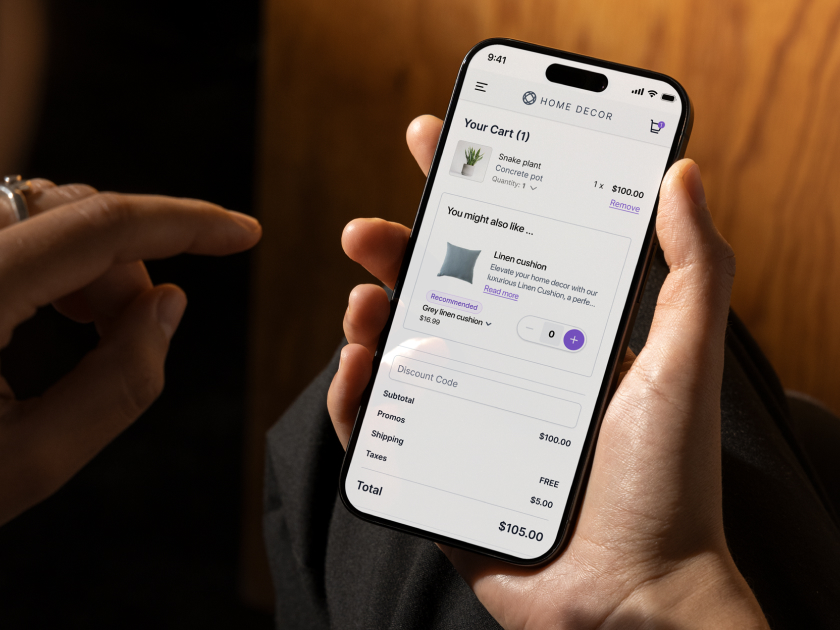
Personalized and real-time relevant checkout looks different. A customer completes a purchase and sees a single, contextually matched experience based on what they bought, how much they spent, and what's relevant to them in that moment. If nothing relevant is available, they see nothing additional at all. Backcountry consistently generates $0.25 to $0.35 in incremental revenue per transaction and ClassPass achieved a 12% lift in conversions without increasing cost per acquisition, with Rokt.
These results come from showing each customer something specifically relevant to them at the moment when intent is highest.
The role of behavioral data in checkout performance
Behavioral data at checkout carries a stronger signal than behavioral data elsewhere in the funnel. Pre-purchase behavioral targeting predicts what someone might do based on browsing patterns. At the point of confirmed purchase, the customer has already decided. The signals (what they bought, how much they spent, their purchase history, the context of the transaction) inform what comes next with a level of certainty that browsing data cannot match.
This distinction is becoming more commercially important as AI compresses the earlier stages of the customer journey. Research from The Trade Desk Intelligence and PA Consulting found that 95% of consumers double-check AI-generated search results, often verifying on the open internet, and that consumers are 1.6x more likely to finalize a purchase on the open internet than through AI tools. The checkout window is where that finalization happens. The behavioral data generated there is the highest-quality signal available.
The Rokt Brain uses this data to determine the most relevant experience for each customer during the Transaction Moment™, the window between selection and checkout, where customer attention, trust, and purchase intent are highest.It processes first-party data, contextual signals, and real-time transaction context to make decisions in milliseconds. As more partners and customers participate in the Rokt Network, the system gains more data points to refine its decisioning, meaning personalization accuracy compounds with scale.
Why personalization outperforms discounting as a conversion strategy
Discounting creates a short-term conversion spike at the expense of long-term margin and customer behavior. It teaches customers that the listed price is negotiable and that waiting yields a better deal. Over time, the business needs larger discounts to achieve the same conversion lift.
Personalization and relevance work differently. When a customer sees a relevant offer at checkout, the engagement is additive to the transaction. The business creates incremental value without reducing the value of the original purchase. BJ's Wholesale Club used personalized experiences at the Transaction Moment to drive 300% year-over-year growth in member acquisition while maintaining a consistent cost per acquisition. The growth came from relevance at the right moment.
Relevance at checkout also includes knowing when not to show anything. The Rokt ML suppresses experiences when no relevant option is available, ensuring the checkout experience stays relevant rather than generic. Partners retain full control over which categories, brands, and experience types are eligible to appear. ASPCA saw 413% greater conversion rates when using personalized audience targeting through Rokt compared to broad alternatives, demonstrating the value of precision over volume.
Frequently asked questions
How can I increase conversion without lowering prices?
Real-time relevance at checkout increases conversion by matching each customer with the most relevant next action based on their transaction context and behavioral data. Companies like Backcountry have achieved $0.25 to $0.35 in incremental revenue per transaction, using this approach through Rokt, without discounting.
What's the impact of personalization on checkout conversion rates?
McKinsey research shows personalization delivers a 5-15% revenue lift and 10-30% increase in marketing ROI. At checkout, where intent is confirmed, personalized experiences consistently outperform static approaches. Rokt Ads delivers a 4.03% click-through rate (10x Google Display benchmarks) and a 6.32% conversion rate.
How can I use behavioral data to improve checkout performance?
Behavioral data at checkout includes transaction history, purchase context, engagement patterns, and real-time session signals. The Rokt Brain analyzes 1.95 trillion data points annually to determine the most relevant experience for each customer in milliseconds. Because this data comes from the point of confirmed purchase rather than browsing behavior, the signal is stronger and the personalization more accurate.