

The checkout page is the most prime real estate,” said Lauren Copland, Ecosystem Partnerships Lead at Block. “It is the make-or-break for the end of the journey.
Lauren knows that real estate well. Block, the parent company of Square, Cash App, Afterpay and TIDAL, has spent several years building its partnership with Rokt within Afterpay’s checkout and post-checkout experience.
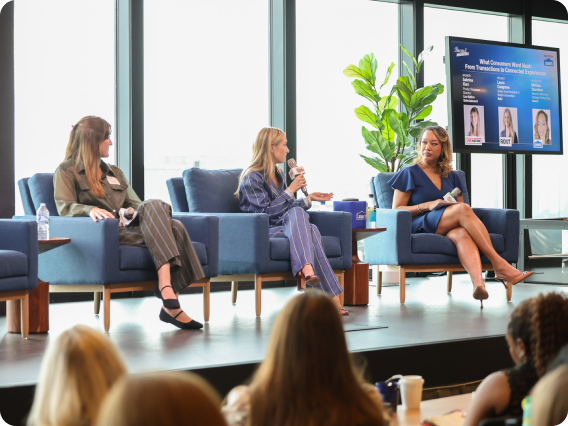
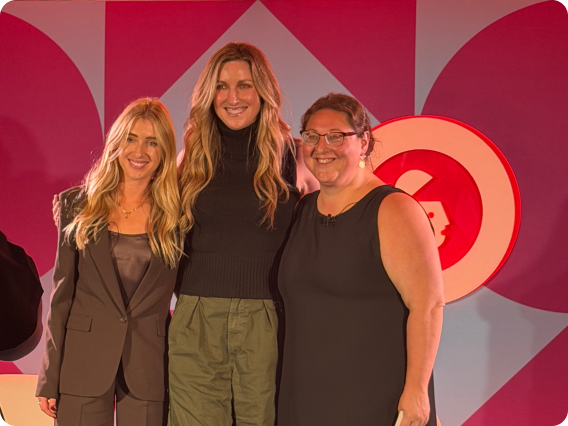
At Advertising Week New York, she joined Laura Cosgrove, Head of Strategic Partnerships at Rokt, for Beyond the Brand: Building Partnerships Across an Entire Ecosystem, moderated by Arielle Feger, Senior Analyst at EMARKETER. Their conversation centered on a question that comes with any successful partnership: how do you take a relationship that works for one brand and create value across a broader portfolio?
A partnership that starts with the customer
For Lauren, the partnership with Rokt worked because it fit with what Afterpay shoppers and merchants already valued: a checkout and post-checkout experience that feels seamless, trusted, and simple. Lauren said:
It was crucial that, as we were looking to bring partners into that environment, that it is a partner that is very much additive and someone that is not interfering with what the customer is there to do at the end of the day, which is checking out.
That focus is delivering results. Lauren shared that the partnership is driving about 32% year-over-year revenue growth, with a 4.6% response rate on offers compared with Rokt’s 3.8% network average. She also credited years of testing and refinement for getting there. “We’ve spent several, several years really working and testing and honing it and making it into what it is today,” she said.
Laura described Afterpay as a design partner for Rokt, providing feedback, customizing the integration around its needs and being among the first to market with new Rokt products. That willingness to keep testing and refining has helped the partnership evolve well beyond its starting point.
Relevance over personalization at checkout
As the conversation turned to expansion, Arielle asked how the teams distinguish between an opportunity that creates customer value and one that simply creates another revenue stream. Laura explained that Rokt’s North Star metric is conversion per impression. The goal isn’t simply to generate a view or click, but to determine whether an offer is relevant enough for a customer to take it up. Laura said:
If we deem that it’s gonna be a low-quality impression, we show nothing at all. And we would rather get out of the customer’s way and show nothing than show something that’s gonna introduce friction just for the sake of monetization.
She also distinguished between personalization and relevance. Personalization might change how an offer is presented. Relevance asks whether that customer should see the offer in the first place. “Should you be showing me the credit card at all, or could you be showing me another offer that’s more relevant to me and what you know about me?” Laura said. Lauren tied that back to Block’s own approach: “At the end of the day, something does need to be beneficial for the customer. It can’t just be a revenue generator.”
What carries across a portfolio
Block’s businesses share a broader mission, but each serves a different end user. A playbook built for Afterpay therefore cannot simply be applied to Cash App, Square or TIDAL. “What we did for Afterpay isn’t always going to be a perfect fit for those other brands,” Lauren said. What can carry over is the way the two organizations work together. As Lauren put it, the day-to-day operating mechanism that you’ve built with a partner can be replicated but not the playbook itself.
For Laura, expansion also has to be earned. “Unless you’re truly solving problems and bringing value to the customer and the business in one unit, you’re not gonna make it into other units,” she said. The Afterpay relationship now spans both customer acquisition across Rokt’s broader partner network and relevant offers within Afterpay’s own experience, giving the teams a view of the customer from the top of the funnel through conversion. As new opportunities emerge across Block, the teams can draw on those learnings while adapting the approach to each business and end user. How those insights are applied across the broader portfolio remains partner-led.
Clear ownership keeps partnerships moving
As partnerships grow, more teams inevitably become involved. Lauren’s answer is to maintain a single point of contact who can see across the relationship and understand where to prioritize. “Having that single point of contact truly allows for someone that’s gonna see across all the different initiatives that you have going on.” That person still brings in product, design, growth, and other teams, but remains the internal advocate for the partnership and keeps the broader picture in view.
Laura described a similar model at Rokt, where teams are structured around single-threaded owners with the cross-functional resources they need to move quickly. Clear ownership also matters when building the case for expansion. Lauren said alignment is often harder than proving the opportunity itself, particularly when several teams need to understand what a partner can bring. Laura sees helping with that process as part of the partner’s role. “As a partner, I think you have to help build the business case for them and take as much of the heavy lifting as you can off of their plate.” That means understanding who needs to be involved, what matters to them, and how they make decisions.
Laura added that the strongest partnerships also start with aligned principles and interests, including shared metrics and accountability. “I think people really need to share the pressure of what you’re trying to achieve,” she said. Looking ahead, Lauren hopes to maintain the transparency and trust the teams have built while continuing to explore opportunities for Rokt and Block to work together beyond Afterpay.
.png)